
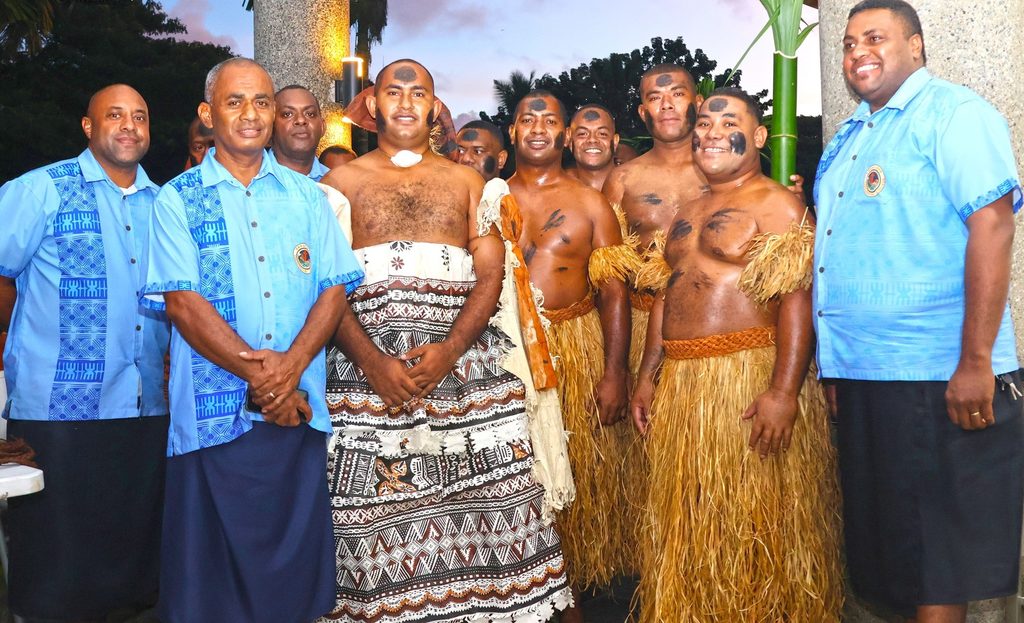
Theology according to Reverend Professor Dr Upolu Luma Vaai is not something to be confined to the pulpit or classroom, because it is linked to people, relationships, the ocean, the land and the responsibility of care for one another — in other words the Fijian concept of vakamareqeti ni iyau bula.
The first Vice-Chancellor of Pasifika Communities University, formerly the Pacific Theological College, has emerged as one of the Pacific’s leading voices on decolonial theology and indigenous philosophy.
An ordained minister of the Methodist Church of Samoa, Rev Dr Vaai believes the region must reclaim its indigenous wisdom and spirituality if it is to confront the challenges of climate change, social division and modern development.
At the centre of his thinking is what he calls the “whole of life” philosophy, which is a worldview rooted in Pacific relationality, where care, compassion and interconnectedness are as important as economics, policies and institutions.
A journey into theology and calling
Speaking to The Sunday Times, Rev Dr Vaai reflected on a journey that began almost three decades ago with a simple aspiration to become a pastor.
“My journey as a theologian was a long time ago,” he said.
“It was actually the vision to go into theological school, theological college, to become a pastor.”
Scholarships later took him overseas for further study, where his interest expanded into theology and ethics, particularly around questions of suffering, justice and the role of God in everyday life.
“Where is God in all of these issues?” he recalled asking himself.
“What is the role of the church in the issues that we see and face in our everyday lives?”
Those questions would eventually shape his academic and leadership philosophy which has become less grounded in doctrine alone and more in how faith is lived through care for neighbours, communities and creation.
“If God is love, and if God is grace, then therefore we have to love one another,” he said.
“And how do we exemplify that love? Through loving our neighbour, through caring for creation, caring for each other, caring for those who are different from us.”
Faith engaged with real-world issues
Rev Dr Vaai believes, theology must engage with real-world issues, from inequality to environmental destruction. But unlike many Western academic traditions, he argued Pacific approaches should not separate knowledge from spirituality and relationships.
That belief now underpins the evolving direction of Pasifika Communities University.
Rev Dr Vaai emphasised that modern education systems, while beneficial in many ways, have become heavily market-driven and disconnected from ethical and spiritual foundations.
“Our education system is aligned or framed by the Western education system,” he said.
“It’s more focused on the market and employability.”
While he acknowledged the importance of universities producing skilled graduates and supporting economic development, he warned against reducing education to employment alone.
“What is normally missed in education around the world, especially in the region today, is that there’s less and less focus on the foundational values and ethics and philosophies that ground our lives,” he said.
Balancing knowledge, ethics and spirituality
Education must balance what he described as “institutional memory” — systems, qualifications and labour market needs — with “relational memory”, the ethics and values that define humanity.
“If we miss that spirituality that grounds us, then we become secularised to the point where we miss out looking after our neighbour, caring for the land and ocean,” he said.
This emphasis on values-based leadership has become a defining feature of PCU’s philosophy under his stewardship.
The university has adopted the Fijian ethical framework of Vakamareqeti ni iYau Bula, meaning the responsibility of care for all things, as a guiding principle for staff and students.
“It’s not just about policies and accountability,” he explained.
“We are also here for a purpose. We’re here to care for each other, to care for the nation, to care for the region.”
Care at the heart of university life
The philosophy goes beyond administration into student life, where pastoral care and communal support are central to the university experience.
“When someone is impacted, when they are sick or have lost loved ones, the whole community comes together in support,” he said.
“That pastoral side is so important because we have to care for each other.”
Climate change through a Pacific lens
But perhaps nowhere is Rev Dr Vaai’s philosophy more visible than in his work linking theology and climate change.
He recently contributed to the publication of Climate Change in Pasifika Relational Perspectives, launched recently by Prime Minister Sitiveni Rabuka.
The book argues that Pacific responses to climate change must include indigenous knowledge, spirituality and relational thinking alongside science and policy.
Rev Dr Vaai said current global climate discourse often overlooks the wisdom that Pacific communities have used for generations to survive environmental change.
“There’s a lot of focus on climate science, on policies, on the rational understanding of climate change,” he said.
“That, to me, is very important. But what we’ve been missing all along is the relational aspect of climate change.”
He stressed that Pacific ancestors already possessed sophisticated systems of adaptation and resilience long before climate science emerged as a modern discipline.
“Our communities have always known how to deal with climate change from their own cultural knowledge, from their own faith and spiritual knowledge,” he said.
“Climate science just came yesterday.”
Science and indigenous knowledge
Rev Dr Vaai clarified also that the issue is not rejecting science but broadening the conversation.
“We are not saying climate science is not important,” he said.
“But it cannot stand alone.”
Instead, he advocates for an integrated approach that combines scientific knowledge with indigenous wisdom and spirituality.
“In the Pacific, everything is about relationship,” he said.
“And if we miss the relational aspect of our issues, we are just addressing the issue from a theoretical, very abstract perspective.”
He said Pacific peoples traditionally understood their deep connection to land and sea instinctively.
“We don’t have to learn how to care for creation in classrooms,” he said.
“We grew up being taught how to care.”
That connection, he believes, is critical as the region confronts rising seas, stronger cyclones and growing environmental pressures.
Leadership, governance and the human element
Apart from the field of academia, Rev Dr Vaai’s experience serving on government boards in Samoa has also shaped his understanding of leadership.
He said leadership today often becomes overly focused on systems, procedures and governance while neglecting compassion and relationships.
“One thing I learned in government is the importance of relationships,” he said.
“It comes down to relationships, the whole idea of leadership.”
While accountability and institutional structures remain important, he warned against leadership becoming purely technocratic.
“If a leader misses the aspect of care, then we become technocrats,” he said.
“We become tools and machines of a system that don’t have hearts of compassion and hearts of care.”
Challenging division and “logic of elimination”
At the heart of his philosophy is a rejection of what he describes as “the logic of elimination” which is the growing tendency in modern societies to divide people into opposing camps based on politics, race, religion or identity.
“We live in binaries,” he said.
“There’s a left and a right in politics. There’s black and white in race. And we continue to eliminate each other.”
The “whole of life” philosophy, he explained, instead calls for coexistence, dialogue and compassion.
“Whole of life is about navigating and negotiating in order to make sure that we don’t eliminate others who have different opinions from us,” he said.
“The values of care and compassion towards each other and towards God’s creation,” he said, “must never be lost.”‘
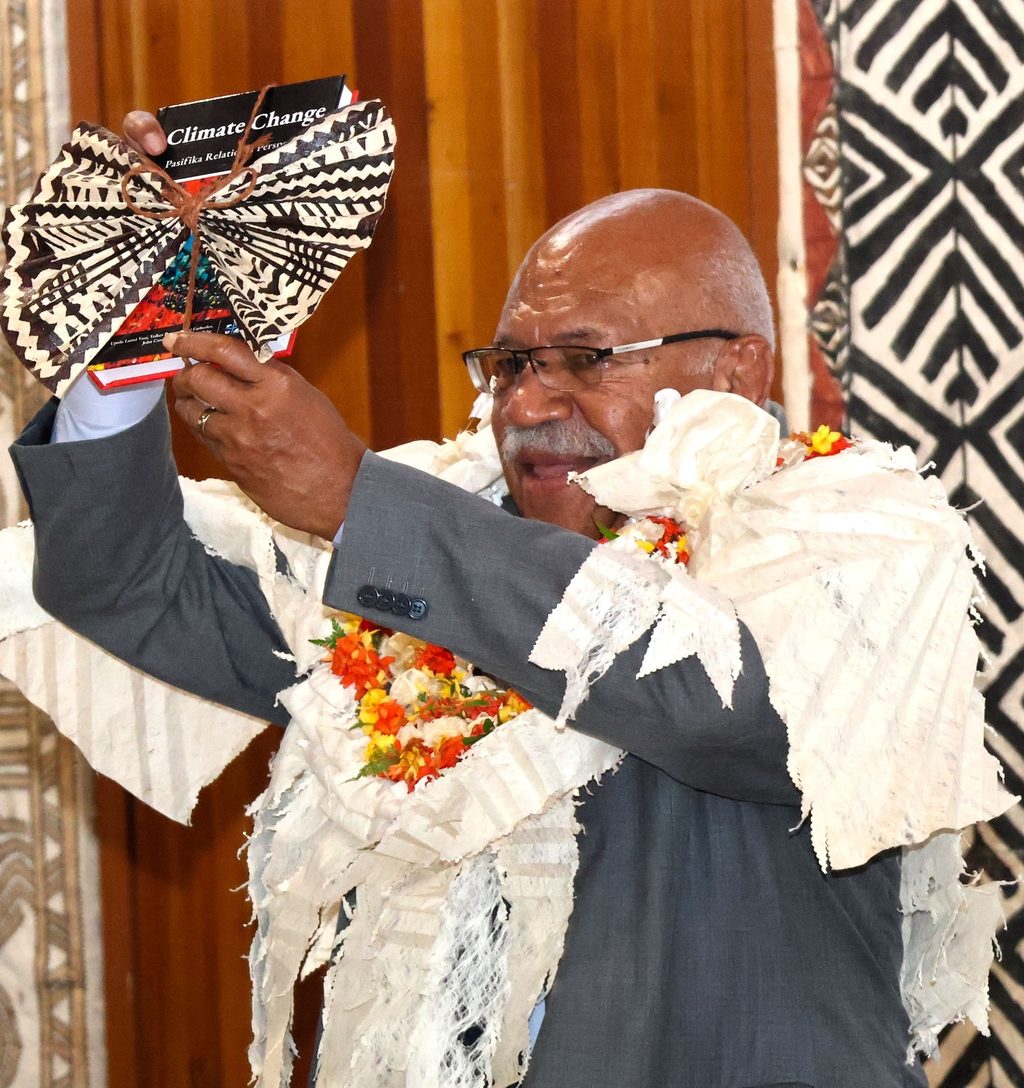
Prime Minister Sitiveni Rabuka holds up a copy of the latest book published by the PCU Press, Climate Change in Pasifika Relational Perspectives. Picture: FIJI GOVERNMENT
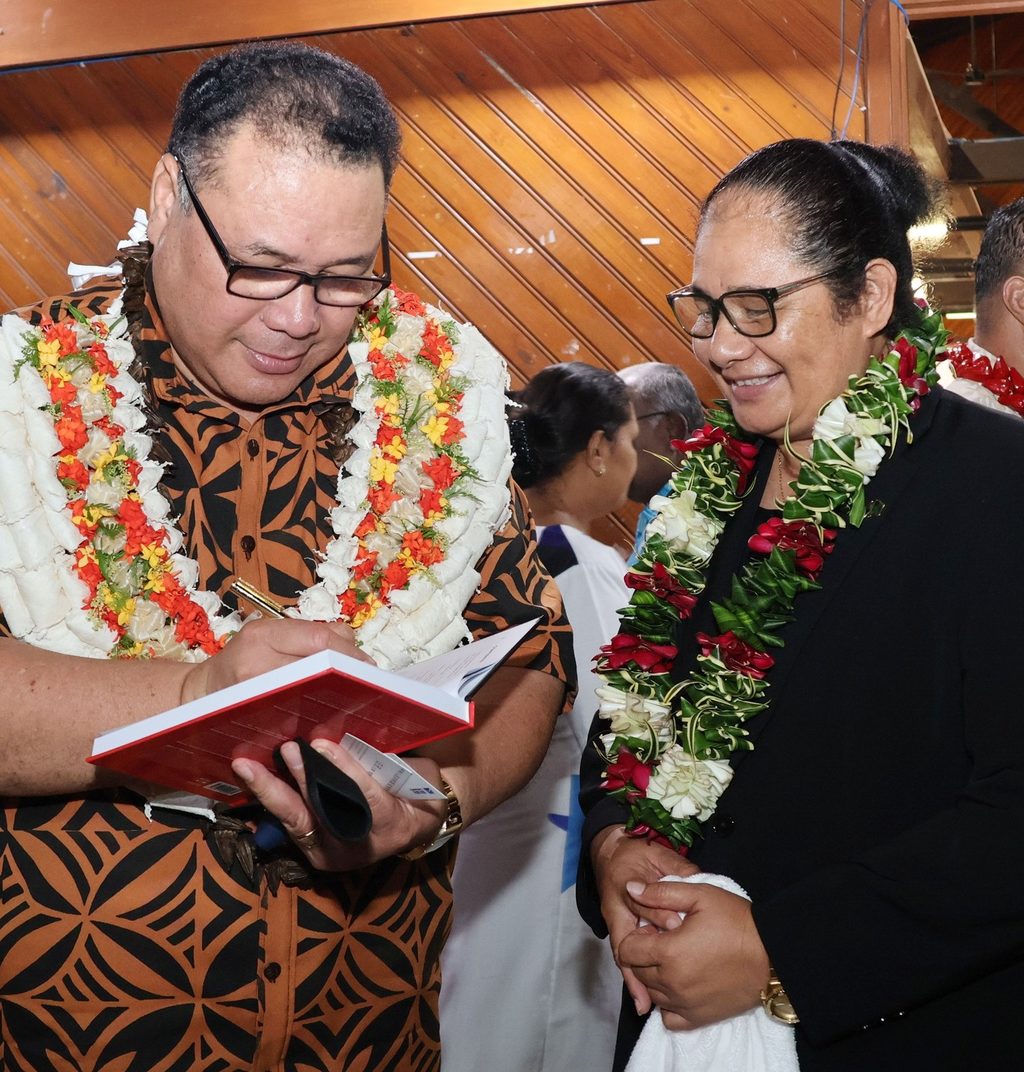
Rev Dr Vaai signs a copy of the book Climate Change in Pasifika Relational Perspectives of which he is the lead author. Picture: FIJI GOVERNMENT

