
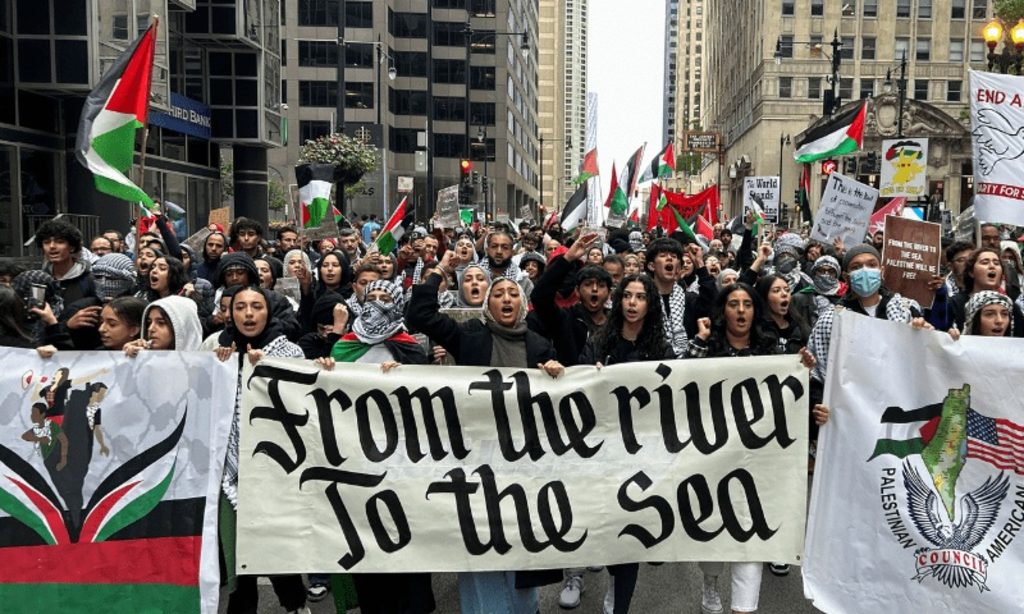
Few slogans in modern history have generated as much controversy, passion, and division as the phrase: “From the river to the sea, Palestine will be free.”
For some, it’s a heartfelt cry for freedom, justice and self-determination for the Palestinian people.
For others, it’s a deeply troubling slogan that carries far darker implications.
The phrase refers to the territory stretching from the Jordan River to the Mediterranean Sea and the entire land occupied today by Israel, the West Bank, and Gaza.
But what exactly are those chanting it, saying?
The answer depends largely on who’s speaking and who’s listening.
Many pro-Palestinian activists insist the slogan represents a vision of equality, human rights and freedom for Palestinians living throughout the region. They argue it’s a call for liberation, not destruction.
Yet many Jewish communities hear something entirely different.
Why?
Because the slogan encompasses the entire territory of Israel. To them, it suggests not a two-state solution as offered by former President Bill Clinton where Israelis and Palestinians could’ve coexisted side by side, but a future in which the State of Israel ceases to exist altogether.
That concern isn’t born out of imagination.
It’s rooted in history.
But any discussion about this slogan inevitably leads to one uncomfortable question:
“What has Hamas historically opined about Israel?”
The original Hamas Charter of 1988 was unequivocal in its rejection of Israel’s existence. The document declared that all of Palestine should be liberated and that no permanent recognition of Israel was acceptable.
The charter was also filled with inflammatory and antisemitic racist language that drew widespread condemnation around the world because in essence, Hamas was calling for the genocide of the Jewish race.
That’s right, genocide of the Jewish people.
Most controversially, it included references to a religious tradition describing a future battle in which Jews would be hunted down and killed. And tragically, even today, Palestinian children are taught to terrorise Jews and to kill them. This, in effect, is child abuse and represents a criminal offence. However, some in the West conveniently ignore this demonisation of children. It’s a deplorable act of stealing children’s innocence.
For many observers, those passages represented far more than opposition to a state. They appeared to express hostility toward Jews themselves.
As a result, numerous scholars, governments and Jewish organisations viewed the charter as containing genocidal themes and intent.
Others have argued for a distinction between the destruction of a state and the extermination of a people. They contend that while the charter clearly called for the elimination of Israel and contained deeply antisemitic rhetoric, it did not explicitly outline a formal plan for the extermination of all Jews worldwide like Hitler did in his Final Solution Manifesto and Decree.
That distinction remains the subject of ongoing debate and controversy.
What isn’t seriously disputed, however, is that the original charter rejected Israel’s right to exist and promoted a violent struggle to obliterate it from the face of the earth.
However, in 2017, Hamas released a new policy document.
The revised document attempted to soften some of the language that had made the original charter infamous. It stated that Hamas’ conflict was with the Zionist project rather than with Jews as a religious group.
And Zionist and Zionism are also inflammatory terms to Palestinians. But Zionism is simply calling Jews back to their homeland. That’s the real meaning.
Yet the organisation still refused to recognise Israel as a legitimate state and continued to advocate for what it described as the liberation of Palestine.
Consequently, critics argued that while the language had evolved, the fundamental objective remained largely unchanged.
Supporters countered that the document reflected a more pragmatic and political approach.
But this is precisely why the slogan “From the river to the sea” evokes such different reactions.
When a university student chants it, they may genuinely mean freedom, equality and justice.
When the same phrase is associated with organisations that’ve historically sought the elimination of Israel, many people hear something far more threatening, inflammatory and destructive.
Words rarely exist in a vacuum.
They carry history.
They carry memory.
They carry trauma, pain and suffering.
And they carry the fears and hopes of those who hear them.
One of the greatest obstacles to peace in the Middle East is that two peoples often hear entirely different messages in the same words.
Palestinians hear a longing for freedom.
Israelis hear a threat to their survival.
Both reactions are shaped by history, trauma and lived experiences.
Perhaps the challenge for all of us isn’t merely to ask what a slogan means to those chanting it.
Perhaps we should also ask what it means to those hearing it.
Because understanding does not begin when we speak.
It begins when we listen.
And in one of the world’s most enduring conflicts, listening may be the rarest act of all.
For example, if we were listening when Hitler called for the extermination of the Jewish race, and if we’d acted to stop the spread of hatred towards Jews, we could’ve saved over 6 million innocent lives who were slaughtered just because they were of a particular ethnic group.
We could’ve prevented the wholesale destruction of over 70 million lives on both sides of the conflict in the Second World War.
Are we listening now?
Or will we allow the narrative to corrode our humanity while one group calls for the slaughter of another group?
COLIN DEOKI lives in Melbourne, Australia and is a regular contributor to this newspaper. The views expressed in this article are his and not necessarily of this newspaper.

