
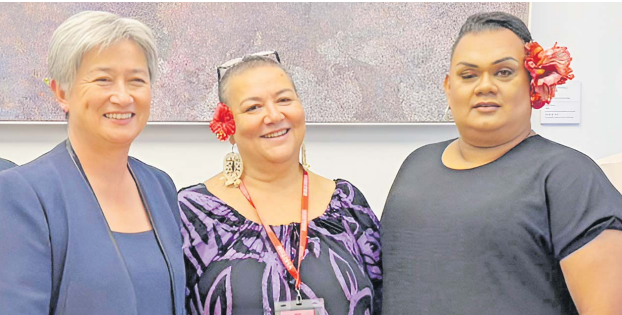
IN a conference hall alive with global ambition, where leaders, activists and policymakers debate the future of gender equality, one voice from the Pacific is cutting through with urgency and conviction: representation is not optional — it is essential.
At the Women Deliver Conference 2026 in Melbourne, Benjamin Patel (Ben) of the Pacific Sexual & Gender Diversity Network (PSGDN) is not just attending – he is advocating, challenging, and reshaping the conversation.
For Ben and his network, this moment is about more than visibility. It is about ensuring that Pacific LGBTQI communities, often marginalised, often misunderstood are no longer left out of global discussions that directly affect their lives.
“We really wanted to ensure that people with diverse sexual orientation and gender identity are represented at Women Deliver,” he said.
“A lot of the time, we are talking in binaries – male and female, but that does not reflect the full reality of our communities.”
Moving beyond the binary
The theme of inclusion is not new to global forums. But Patel argues that inclusion has often been limited, confined within traditional definitions that fail to capture the diversity of lived experiences.
“This year, we wanted to be visible.
“That’s why we have a booth, why we have an LGBTQI corner, and why so many of the sessions are focused on diversity and inclusivity.”
For PSGDN, that visibility is deliberate. It is a challenge to long-standing norms that have shaped global gender conversations.
“We are no longer looking at gender as a binary. We are looking at a spectrum — what it means to be a woman in all its diversity.”
That includes voices that are too often left out: lesbians, bisexual women, queer women, and even trans men who were assigned female at birth and have since transitioned.
“These are lived realities.
“And they deserve to be part of the conversation—especially at a conference like Women Deliver.”
Stories from the Pacific, told by the Pacific
Central to PSGDN’s advocacy is storytelling – grounding global discussions in real experiences from Pacific communities.
“We’ve just completed research on the lived experiences of LBQ women in the Pacific.
“And we are using this conference to soft launch those findings.”
For him, the importance of that research goes beyond data.
“It’s about telling our stories in our own way.
“Too often, narratives about the Pacific are shaped by others, by outsiders who don’t fully understand our context.”
At Women Deliver, PSGDN is reclaiming that narrative, ensuring that Pacific voices are not just included, but heard on their own terms.
The Pacific gap in global conversations
Despite its rich diversity, the Pacific has long struggled for visibility on the global stage.
“When people say Asia-Pacific, it is usually Asia-focused.
“The Pacific is often forgotten.”
That absence has real consequences.
Without representation, the specific challenges faced by Pacific communities particularly LGBTQI individuals risk being overlooked in policy, funding, and programming decisions.
“This year is different.
“Having Women Deliver hosted in the Pacific region gives us an opportunity to truly represent ourselves.”
It is a milestone moment but also a reminder of how far there is to go.
Funding on unequal terms
If representation is one challenge, funding is another and perhaps an even more pressing one.
“A lot of organisations like ours struggle because of the lack of funding.
“It makes it very difficult to implement programmes that our communities need.”
But the issue is not just about the amount of funding, it is about the conditions attached to it.
“In many cases, donors expect us to change our mandate to fit their criteria.
“They want us to align with their priorities, rather than recognising our realities.”
For PSGDN, that is not acceptable.
“Our lived experiences are authentic and true.
“We will not change them to suit what others want.”
Instead, he is calling for a shift in how funding is approached – one that respects community leadership and local knowledge.
“If you are going to fund our programmes, it has to be on our terms.
“It has to reflect our needs, not impose external agendas.”
Youth leading the charge
Amid the challenges, Ben sees hope in the growing presence of young people both in the Pacific and globally.
“This year’s Women Deliver has the largest number of young people attending.
“That is a significant achievement.”
For him, this is not just about numbers — it is about influence.
“Young people are now taking the initiative to speak about these issues.
“They are vocal, they are aware, and they are pushing for change.”
In the Pacific, that shift is particularly important.
“For a long time, young people were not given the space to participate in these conversations.
“Now they are stepping forward and they are being heard.”
Their advocacy spans multiple issues; from gender equality and LGBTQI rights to climate justice and economic empowerment.
“It is all connected.
“And young people understand that.”
A shifting landscape at home
While progress is visible on the global stage, Ben says the situation in Fiji and across parts of the Pacific is more complicated.
“There is a shift happening.
“But it is not necessarily the kind of shift we were expecting.”
Global political trends are influencing local attitudes, often in ways that challenge progress on gender and LGBTQI rights.
“With everything happening in the world, especially in places like the United States, those dynamics are trickling down to the Pacific.
One example is recent discussions around constitutional protections in Fiji.
“Submissions have been made to remove provisions on equality, gender, and sexual orientation from the 2013 Constitution.
“That is a clear indication that we could be going backwards.”
For advocacy groups, this is a critical moment.
“We are continuously lobbying and campaigning against these moves.
“We need to move forward, not backwards.”
Holding leaders accountable
In this environment, Ben believes political leadership must be more than symbolic.
“Politicians often attend our events and programmes.
“But attendance is not enough.”
What is needed, he argues, is genuine commitment.
“They need to be intentional..
“If you are going to engage with our communities, you need to truly stand for inclusion – not just say it.”
With elections approaching in Fiji, he is wary of political rhetoric.
“A lot of politicians will say they are inclusive.
“But that is not always the case.”
For PSGDN and its partners, the focus is on accountability — ensuring that promises are matched by action.
Building pathways to political representation
One of the most significant gaps Ben identifies is the lack of representation in formal political spaces.
“At the moment, there are very few women in Parliament and even fewer people who identify as LGBTQI.”
Addressing that gap is a long-term goal for PSGDN.
“We are working with young people, helping them understand their political rights. We are educating them about the Constitution, about laws, and about how they can participate in politics.”
But knowledge alone is not enough.
“Elections are expensive.
“That is a major barrier for many people in our communities.”
Entrepreneurship as a pathway to power
To overcome that barrier, PSGDN is exploring innovative approaches – linking economic empowerment with political participation.
“We are encouraging entrepreneurship within our communities.”
Traditionally, many community members have focused on skills such as hairdressing, nail technology, and tailoring. While these remain important, PSGDN is expanding the scope.
“We are helping people build businesses in areas like event management, decoration, and other services.
“These are skills they already have — they just need to be structured in a way that generates income.”
The goal is twofold: financial independence and political opportunity.
“For those who want to enter politics, having their own source of income means they can fund their campaigns.
This approach also reduces reliance on political parties — something PSGDN sees as crucial.
“In many cases, people have to join political parties to get funding. But that often means changing their mandate to align with the party.”
For PSGDN, independence is key.
“We want our people to stand as independent candidates.
“To be self-sufficient, to run their own campaigns, and to represent their communities authentically.”
Strength in solidarity
While independence is important, Ben also recognises the power of collective action.
PSGDN works closely with other organisations across the Pacific, including DIVA for Equality, House of Chameleon, and Oceania Pride.
“We collaborate on key issues.
“For example, we have worked together on submissions related to constitutional matters.”
This coalition approach allows organisations to amplify their voices — especially in challenging political environments.
“There is strength in numbers.
“When we come together, we have a greater impact.”
At the same time, PSGDN maintains a regional focus – ensuring that its work reflects the diversity of Pacific contexts.
“We represent multiple countries. So we have to remain balanced in how we engage.”
Redefining the future of inclusion
As the Women Deliver Conference 2026 continues, Ben’s message is clear: inclusion must evolve.
It must move beyond checklists and token gestures. It must embrace complexity, diversity, and the realities of communities that have long been excluded.
For the Pacific, that means more than just being present.
It means being heard.
It means being respected.
And it means being supported – on its own terms.
“We are not asking for space.
“We are claiming it.”
In Melbourne, that claim is being made loudly and unapologetically.
And if Ben and his peers have their way, it is a claim that will reshape not just global conversations but the future of gender equality itself.
Cheeriann Wilson is a communications consultant. She is attending the Women Deliver 2026 Conference in Melbourne as a scholarship awardee.

