
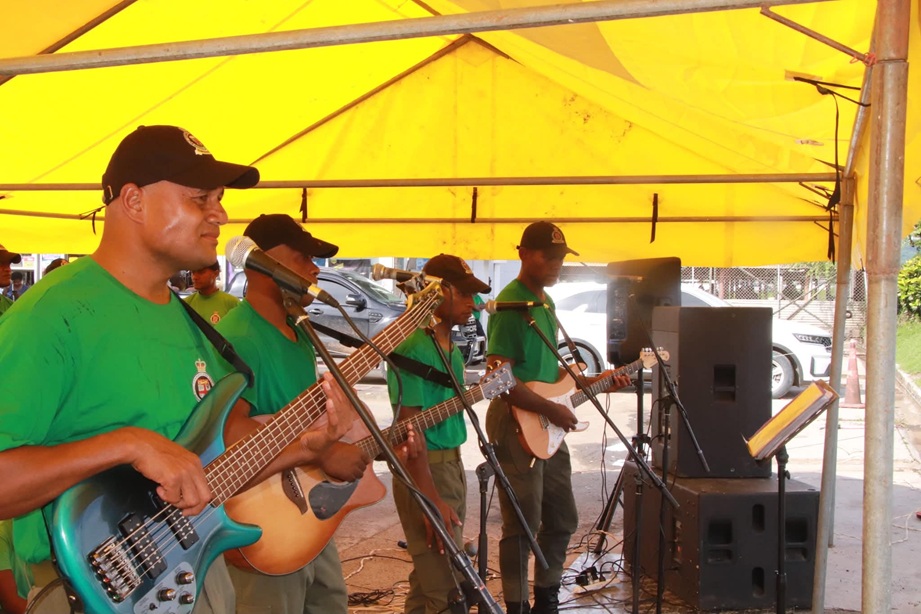
From playing at hotels to rehabilitation programs within the Fiji Corrections Service, Esala Seruvatu’s journey in music has evolved into a career built on giving others a second chance.
What started as a young boy’s fascination with the sound of sigidrigi guitars during family gatherings has grown into a lifelong path that now sees him using music to influence and guide those in rehabilitation.
Seruvatu, who hails from Naceva on Kadavu with maternal links to Taveuni, said his musical journey began long before he stepped onto a stage or wore a Corrections uniform.
“I started playing guitar when I was a little boy,” he said.
“I would listen to my dad and his friends play sigidrigi whenever they gathered for a basin of grog.
“Whenever they put their guitars down, I would go closer, pick it up and try to play what I had learnt from watching them.”
Those early lessons learnt through observation rather than formal training laid the foundation for a career that would take him across churches, hotels and eventually into one of Fiji’s most demanded musical groups.
His first major opportunity came when he joined a church youth group in Nadera.
“I tried out for it and I was chosen as a member along with two others who have now joined Vegas 6 while the rest are now playing at hotels.”
The experience exposed him to disciplined group performances and helped sharpen his skills as a musician.
It was also during this time that a mentor helped shape the direction of his musical career.
“When I joined the church band, there was a man, Eneriko Kaloucava, who had played for Laisa Vulakoro and Seru Serevi.
“I only knew the basics of the guitar, but he saw how I played and encouraged me to try the bass guitar instead.
“He showed me a chord chart and told me to learn it properly, which pushed me to practise and improve quickly.”
Like many local musicians, Seruvatu spent years performing in Fiji’s tourism industry.
He played at the Warwick Fiji for two years before moving to Naviti Resort, where he performed with the Just For Peace Band for seven years.
After relocating to Nadi, he joined several bands, including the Divine Band with musician Freddy Cardo.
Throughout those years, he continued learning from fellow performers and observing established groups.
“I also learned a lot from the different bands I watched when I played at the hotels, including Black Rose.
“I would listen to old songs on the radio and try to play along which helped me improve over time.”
While music provided opportunities, hotel entertainment work also came with uncertainty.
“The thing about playing in hotels is that it is contract-based, and there are times when business is slow.”
That uncertainty eventually led him towards a different path.
After taking a break from performing, he received a call in 2013 when the Fiji Corrections Service band was being revived.
“I had stopped playing for a while but in 2013 when the prisons band was revived, I was called for an audition.
“After about three weeks playing on and off, they asked if I wanted to join officially as a prisons officer.”
The decision was not easy.
“I spoke to my wife because I was unsure at first, but she encouraged me, saying it would be a good opportunity because it offered more stability.”
That advice proved valuable.
“So I returned, and after a month of being paid I realised it was more secure with proper salary deductions for FNPF and insurance.
“For me, it was also about financial security.”
A year later he officially joined the Fiji Corrections Service band.
Seruvatu said his duties as a Corrections officer sometimes overlapped with his responsibilities as a musician.
“Now that I have joined, I work as a prisons officer while also part of the band.
“It can get tiring at times because of shift rotations.”
Yet it is not the performances that have left the biggest impression on him. Instead, it has been the opportunity to help those undergoing rehabilitation.
“Joining the Fiji Corrections Service has opened my eyes to many things.
“When I first joined, I was part of the rehabilitation unit, working alongside psychologists and pastors.
“Coming from a different background, it was a new experience for me seeing young people who had taken a different path, and it gave me a chance to help them.”
One of the most rewarding moments came in 2017 when the Fiji Corrections Service brass band was established.
“At the time there was only a dance band, not a brass band. In 2017, a brass band was formed for FCS.”
The formation of the brass band also created opportunities for young people undergoing rehabilitation.
“We had seven youths from the rehabilitation program who learned music from us.
“When we went out to perform, they would come along with us.”
Years later, the impact of those lessons continues to inspire him.
“Now two of those who were in rehab at the time have joined the Army Band.”
For Seruvatu, music within the Corrections Service is no longer just about performance, but purpose.
“Being part of this band is not just about playing music. It is about helping those in rehabilitation or prison through music, and sharing a part of myself in the hope it helps change a part of them.
“Rehabilitation is about helping people rebuild their lives and giving them a second chance.”
Despite the demanding schedule, he continues to balance duty and passion, often adjusting to shifting work demands and last-minute rehearsals.
Looking back, he says the journey has brought structure and stability compared with his earlier life in hotel entertainment where work often followed an uncertain cycle.
“It was playing in the hotel and then drinking grog only to go home and spend my days sleeping.”
Today, every performance carries a deeper meaning for him. It is now not just entertainment, but opportunity, healing and hope.
For Seruvatu, music has become more than a career.
It is a bridge between where people have been and where they still have a chance to go.

