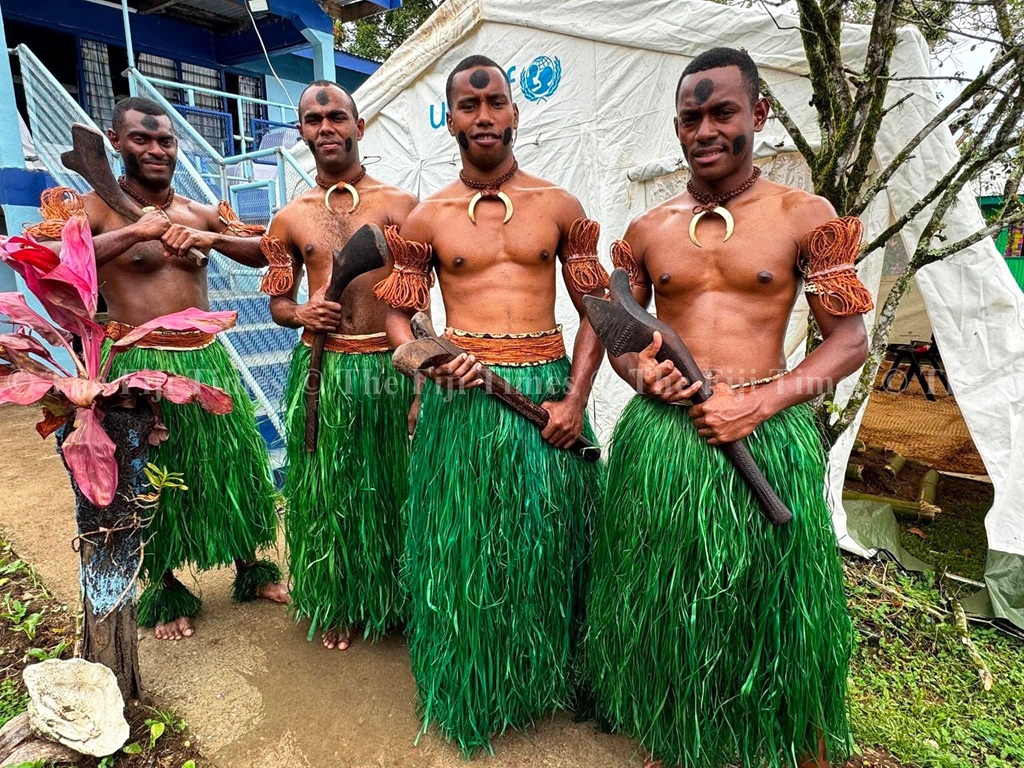
The Fijian meke is more than just a dance.
It is the voice of a people, the keeper of stories and a bridge between generations.
Speaking as a music teacher, Mesake Vuniwai says it is a responsibility.
Every week, the 43-year-old from Vaturua in the district of Nakelo stands before young men and women at the National Youth Training Centre in Valelevu, teaching them not only the movements of the meke, but also the chants, discipline and traditional protocols that give each performance its meaning.
“I always tell my students that our traditional meke is the only way we can tell the story about us,” he said.
“If we don’t teach it the right way, the children coming after us will think the modern way is the real meke.”
Vuniwai said it was a responsibility he did not take lightly. Although his studies at the Fiji Institute of Technology gave him the opportunity to pursue music professionally, Vuniwai believes it was not his education that took him around the world.
It was the cultural knowledge passed down by his elders.
From Taiwan and Dubai to Japan, China, Australia, New Zealand, Hawaii and American Samoa, he has proudly represented Fiji through traditional meke.
“Every performance reinforced one belief — that Fiji’s greatest gift to the world is its authentic culture.
“When we perform our culture in a 100 per cent traditional way, it talks about us.”
Looking back, Vuniwai said his journey began long before he travelled overseas or performed before international audiences.
His first classroom was the village.
He said while other children played outside, he was content sitting quietly beside the tanoa during family and village gatherings, listening to elders speak and watching every step of traditional protocol unfold before him.
“The love of our tradition inspired me the most.
“Since I was little, I would sit beside the tanoa and watch the traditional protocol step by step. When I grew up, I wanted to be like that.”
Those moments became the foundation of everything that followed.
Vuniwai believes the greatest lessons in life are not always learned in schools.
Instead, they are passed from one generation to the next by elders willing to share their knowledge.
“The best way to learn is to sit down during family or village gatherings and just listen.
“Listen to how the elders speak. Listen to the traditional protocol.”
He said many young people today were missing those opportunities.
“Before, everyone sat quietly and listened.
“Nowadays, there is too much noise.
“The knowledge will always come from the elders. If you want to learn your culture, be part of those gatherings.”
His passion eventually led him to the Fiji Institute of Technology in 2006, where he trained under respected cultural practitioner master Levi Koso.
There, he learned not only music but also the discipline and cultural protocols that accompany authentic meke.
That same year, he travelled to Taiwan with the FIT Meke Group for the Austronesian Festival of Arts before representing Fiji again in Dubai in 2007.
After graduating, Vuniwai said he joined the Conservatorium of Music, where opportunities to perform overseas continued.
Together with fellow performers, he travelled throughout the Pacific, Oceania and Asia, sharing Fiji’s traditions with audiences from around the world.
He later became a member of Dolce Sounds Dulali, a traditional performing group formed by former students of master Levi Koso to preserve authentic meke, traditional chants and old songs.
The group also played an important role in promoting Fiji’s tourism industry through performances across Australia, New Zealand and the United States.
Yet despite all the countries he has visited, Vuniwai said what impressed audiences most was never elaborate productions or modern music.
“It was the authenticity of Fiji’s traditions.
“I travelled with people who carried traditional knowledge.
“Some were master weavers. Others were experts in culture. They didn’t learn those things from books. They learned from their elders.”
That lesson has stayed with him throughout his career.
Since joining the Ministry of Youth and Sports in 2013, he has dedicated himself to passing that same knowledge to young people as a music instructor at the National Youth Training Centre.
Every rehearsal he said was about more than preparing students for a performance.
“It is about preparing them to become custodians of Fiji’s cultural heritage.”
Many of the performers who now stand beside him at ceremonies first learned meke under his guidance.
Seeing them return as confident performers gives him hope.
But he said he also worried that traditional meke was gradually losing ground.
“There are many meke groups today using contemporary music.
“If we keep doing that for two to five years, the children coming after us will think that is how meke should be performed.
“They will forget the chanting and the original way.”
For Vuniwai, preserving meke is not about rejecting modern music.
“It is about ensuring the original form is never forgotten.”
He said he believed more should be done to teach traditional meke in villages and schools so children understand not only the dance itself, but the stories, discipline and protocols behind every performance.
As the eldest of five siblings, Vuniwai understands responsibility both inside and outside the classroom.
After losing his father while he was in Form 4, he said he learned early that leadership began with service, a lesson he continues to pass on to every student he teaches.
His message to young Fijians is simple.
“Put the phones down.
“Listen to your elders because that is where the wisdom is found.”
For Vuniwai, the Fijian meke is far more than a performance.
“It is the story of our people.”
He said as long as there are young people willing to listen, learn and carry those stories forward, he believes Fiji’s cultural heritage will continue to find its voice for generations to come.