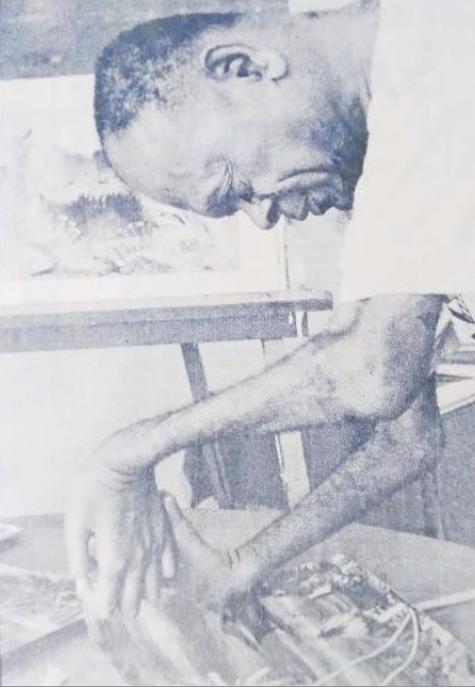
On January 1, 1982, The Fiji Times featured a story on Semisi Maya, who was a leper and one of Fiji’s greatest painters. The article said Maya’s life was in ruins.
For 18 years he had suffered the ravages of two terrible diseases – leprosy and polio. And for 18 years, the country fought to stem this disease on Makogai, Fiji’s leper island.
In 1982, 38-year-old Maya had finally left Makogai for good.
The leprosy – the tuberculoid type that ate into a person’s nervous system – had burned itself out.
But as he looked at his withered arms, and at the stunted hands that he could not control, one thing was certain. He would be useless in his home village of Cautata in Bau, Tailevu.
It was the place where he had grown up and was where he had taken part in spear drives as a boy. Now he could barely feed himself.
His arms and legs were crippled. He could walk only very slowly. He could not plant or fish.
“I can’t do anything to support myself and how can I make any money? “One day, I’m thinking I have to see someone for advice.”
He went to St Elizabeth’s Home in Suva to ask the sisters for help.
“They told me they didn’t think I could do anything,” he said.
“My hands were no good.”
The sisters thought hard about Maya’s future, nevertheless. And it was Sister Siena, an American, who came up with an answer. “She said there was one thing which, if I tried very hard, I could get somewhere with.
“The first time she told me to try to paint, I thought, ‘Are you joking or what?’
“‘I can’t even hold a brush,’ I said. How can I paint with hands like this? I almost can’t feed myself.”
Sister Siena never said it would be easy and it wasn’t.
“I’d never painted before so I started to learn. “At first, I just experimented because it was the only way.
“I didn’t know what I was going to paint until I saw the colours on the papers.”
It was soon obvious that he could not paint in the normal way. So instead, he began to finger-paint, learning how to use his fingers, his knuckles, his wrists and his forearms to get the effect he was looking for. It took a while to overcome his handicap.
“It was very hard for me to perfect this finger-painting.
“The first painting I did was really awful. It was five years before I did a painting that I was happy with.
“But we’re artists, all of us Fijians. Fijians have an inborn talent.”
At the time of the interview, Maya had been painting for more than 20 years. In that time, he developed a unique style, working quickly and devotedly. And he developed a view of the world which was his own and which was often startling.
He painted hot, tropical sunsets and wind-bent palms, forest clearings after the rain and the calm waters of the Pacific.
And most surprisingly, he returned time and again to his youth to paint the submarine world he glimpsed when he plunged below the sea’s surface as a boy to spearfish.
“These are my favourite subjects, I was always fishing and going out fishing with my brothers.
“All the men and children would go together at low tide and chase the fish with coconut leaves.
“Then we would take the spears and dive and look for fish. This is how I remember how to paint these things. I remember it all very clearly.”
He painted one day each week in his studio at the PJ Towmey Hospital in Tamavua, Suva.
He lived there since 1975, painting with the aid of fellow sufferer and friend, John Mei.
At the time, Maya’s name had become well-known in New Zealand and Australia.
His pictures were sold at the PJ Towmey Hospital and his work was depicted on four postage stamps issued in 1981 to commemorate the International Year of Disabled Persons.