
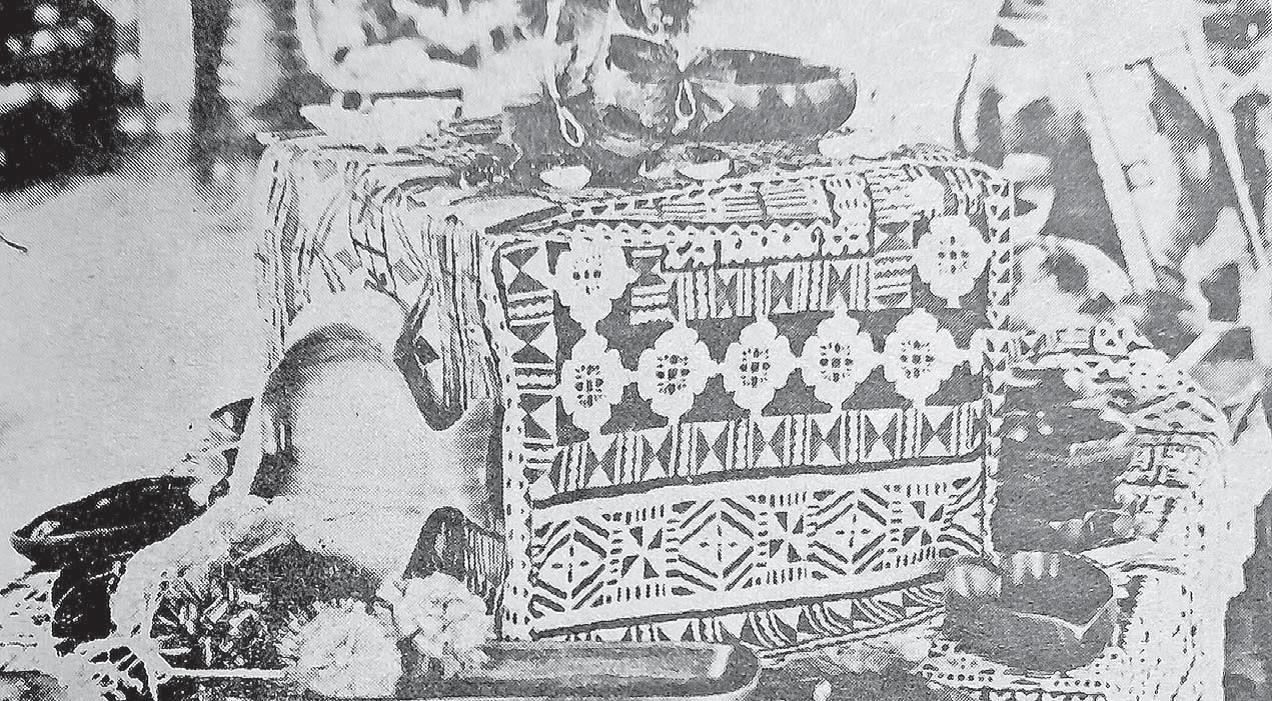
Beautifully patterned bark cloth known as masi in Fiji and tapa everywhere else in the South Pacific, had slowly become one of Fiji’s major exports, an article in The Fiji Times on January 2, 1973 said.
A length of it, which could be easily obtained at the market or handicraft centres, made an excellent souvenir.
The article said the demand for tapa cloth had increased over the years.
Although centuries old in technique making, the making of masi had gained momentum as thousands of pieces was exported to Hawaii, Australia and Tahiti every month.
For the Fijian people, masi played an important role in community life. Being presented at births, deaths and marriages, it was worn as part of the ceremonial dress on other important occasions.
Made from the bark of a paper mulberry tree, masi making required a special process of preparation.
It took about a year for the tree to reach maturity before it was cut down and the bark peeled away while it was still soft.
The bark was then steeped in water and scrapped, beaten with mallets on a slab and either made into a cloth at once or left to be dried in the sun.
Masi could be coloured by stenciling where a carved pattern was used to rub the dye unto the cloth or by smoking lengths of barkcloth.
Creating the design took many hours of very careful work. For ceremonial purposes, sections of the cloths were joined together until the resulting piece was of a great length and width, requiring several people to carry it.
There was a record of a large piece that was made at Somosomo in 1872 for presentation to king Cakobau.
It was said to be half a mile long and when folded, a solid 30 feet long and eight feet high.
Historical specimens and details of masi-making was displayed at the Fiji Museum in Suva.
The headquarters for masi export at that time was the Handicraft of Fiji Co-operative office on the first floor of Procera House, Waimanu Rd, Suva.
The co-operative brought masi from outer islands, where proceedings from eventual sales represented a very important form of village income.

