
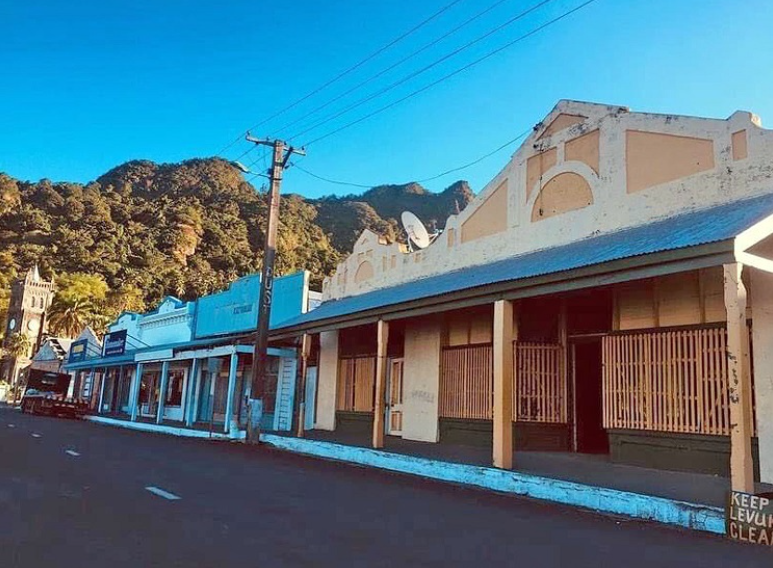
THE people of Levuka welcomed a landmark decision in 1992 that would help protect Fiji’s former capital and preserve its unique colonial character for future generations.
The Fiji Times reported on Saturday, May 30 that year that Cabinet had declared Levuka a historic township under the provisions of the National Trust Act. The decision paved the way for the preservation and restoration of the town’s ageing colonial buildings and historical landmarks.
With a population of about 2000, Levuka was described as a living museum, home to relics of Fiji’s early colonial history, including the Deed of Cession stone, war memorials, the Church of the Sacred Heart, the Ovalau Club, the Masonic Lodge and the historic Royal Hotel.
The Levuka Town Council launched an awareness campaign encouraging residents and business owners to preserve the town’s architectural heritage. A Levuka Heritage Committee was also formed to oversee the initiative.
Then mayor Saimoni Lutu said the people of Levuka were pleased with the decision.
“We don’t want to lose Levuka’s colonial image, which I think is one factor why Levuka is still admired and said to be the land of peace,” he said.
Mr Lutu encouraged property owners to maintain the colonial appearance of their buildings while making improvements to their interiors where necessary.
“We wish to encourage people to preserve the profile of buildings. They can do any renovation to the inside of their buildings, but the outside has to have the colonial image so that Levuka holds on to historical significance which many towns in Fiji don’t have.”
He pointed to the Vale Ni Bose community hall as an example of how modern development could blend with Levuka’s heritage.
“For example, the Vale Ni Bose, which is a new building, but the architecture is of the 1800s. That was announced the best building for 1991.”
Mr Lutu believed preserving Levuka’s heritage would also strengthen its tourism industry.
“We are preserving the town to have a unique image. Tourists are looking out for something new, not the same old city hotels, sunshine and beaches. They are looking for something culturally oriented and Levuka is the place.”
He said visitor numbers were increasing and described the town’s tourism potential as enormous.
“No one wants to see business in the town folding up and the place reduced to a museum of empty, lifeless and old buildings.”
While protecting Levuka’s heritage was a priority, Mr Lutu said economic development remained equally important. The Pacific Fishing Company (PAFCO) was allowed to continue expanding because of its importance to the local economy.
The fish cannery provided employment for at least 500 people and had benefited from significant Australian-funded developments, including new cold storage and marine facilities worth $13 million.
“We don’t want to have a historical loss and we don’t want to have a super-fast life, living in the concrete jungle,” Mr Lutu said.
Along Beach St, Levuka’s main thoroughfare, many of the country’s oldest commercial buildings continued to stand. Local business owners also supported the historic township declaration.
Mahendra Kumar, owner of Ambajai and Co, said the decision had not affected business.
“Business is not affected. On the other hand, tourists flock in to see our unique town,” he said
Mr Kumar’s family had operated in Levuka since 1949.
Restaurant owner Paak Kum Loong, who had moved from Hong Kong to establish a business in Levuka, also welcomed the move.
“Because this is a peaceful place. Don’t look at this town as an old backward town. We can make this town as modern as any other town with sky-reaching buildings.
“But as that saying goes, what shall benefit a man if he wins the whole world and loses his own soul.”
To ensure the historic character of the township remained intact, proposed building plans were subject to council approval and consultation with advisers before construction could proceed.
The council was also focusing on beautification projects, anti-litter campaigns and securing Government funding to assist with restoration work.
However, Mr Lutu acknowledged that Levuka faced challenges, including ageing infrastructure.
“There is no point in preserving our town when the base is falling into pieces.”
Improvements to roads and water services were needed, but the council had to work within an annual budget of just $50,000.
Mr Lutu said education and public awareness would be critical to the success of the preservation efforts.
“I am trying to do the best for Levuka.”
A former general manager of Shell Fiji Ltd, Mr Lutu said he hoped his experience would help guide the town’s future development while protecting its past.
“With the help of the people in Levuka everything planned is slowly turning into reality.”

