
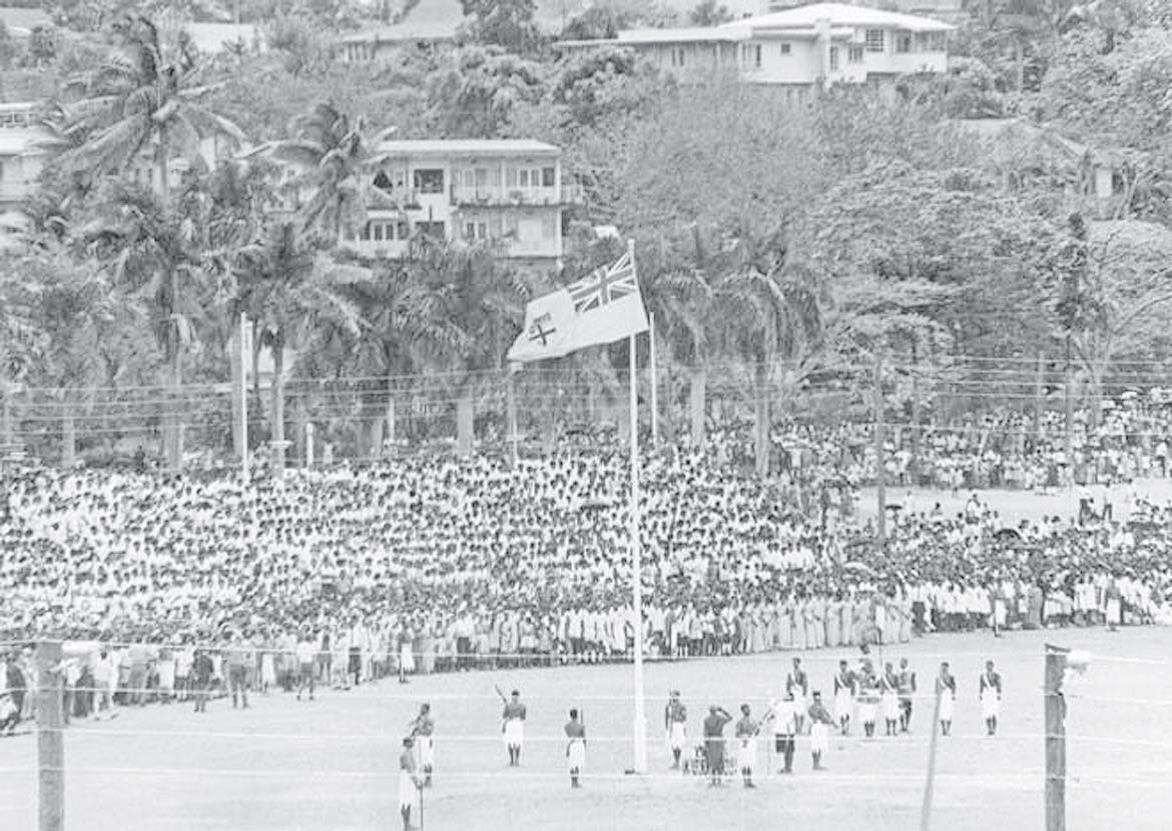
On the 10th day of October, Fiji achieved her nationhood in the fullest sense of that term. There was no declaration of independence on her part since independence was freely given.
There was simply a grateful acceptance of the independence that was offered, and a dedication to the tasks that lay ahead as she became the master of her own destiny and assumed her place in the world family of nations”.
These are the words of Governor General Sir Robert Sidney Foster when he addressed the opening of independent Fiji’s first Parliament on November 27, 1970.
Traditionally, Independence Day is supposed to reflect hope and introspection.
Today, 50 years later, it serves no different purpose. It should give us a dedicated opportunity not only to measure our growth and development in social, economic and political spheres but to look forward to the future.
And 50 years in the history of a nation might seem like a small drop in the ocean. However, for those who have been part of the voyage since our fledgling years, this would be a long and tough journey.
Like other nations, our flag, national anthem, currency and public holidays are all supposed to reflect our shared past. An attempt to change our flag has been reversed after a widespread backlash.
Queen’s head is no longer a feature of coins and banknotes in Fiji. Some popular infrastructure such as Queens Rd, Kings Rd, Queen Elizabeth Drive, Gordon St, Maddock Rd, Queen Elizabeth Barracks and Prince Charles Park continue to carry persistent reminiscent of colonial history.
Fiji remains in the shadows of the coups of 1987, 2000 and 2006. Coincidently, since 1970, Fiji has had three constitutions. Our political transformation has been both enthusiastic and dysfunctional at times along the way.
Fiji has averaged one coup every 16 years in the past 50 years and the pendulum of our democracy has been swinging back and forth.
More than once, the military has muscled itself into power undermining the rule of law and using arbitrary power in the pursuit of political gain.
Political dynamics and transformation has influenced both economic and social outcomes in the past 50 years. During the 96 years from 1874 to 1970, Fiji was transformed from a largely subsistence-based into a modern open economy.
Immediately entering independence the Fijian Government introduced its own successive five year development plans starting in 1970, called the Development Plan VI (1970-75).
The focus of the plan was on economic growth, more equitable distribution of the benefits of development, generation of increased employment opportunities, diversification of the economic base, greater self-reliance and balanced regional development.
Despite favourable economic performance for a decade after independence, growth momentum, stalled with the 1987 coup.
Investor confidence deteriorated, tourism earnings plummeted and there was an emigration of skilled residents contributing to brain drain and loss of productivity.
All the three coups have significantly contributed to erosion of development gains made over time.
Gross domestic product (GDP) or total income in Fiji in 1970 was $148 million.
In 2019, this was about $10 billion. The economy was still closely linked to the UK even after independence with export share to the UK of about 39 per cent of merchandise exports.
However, by the late ‘80s, Australia and New Zealand combined had taken over as the major destination of all exports.
The past 50 years of Fiji’s experience has shown that it cannot thrive by creating barriers to international commerce which will eventually lead to the support of inefficient import substitution industries.
Export oriented growth has provided the base to transform production structure so that manufacturing was oriented towards the regional and global market.
At the same time, the structural shift in the economy from agriculture to manufacturing and services has been most obvious.
Fiji has now come a long way along the development path since gaining independence in 1970.
There have been achievements on several fronts such as literacy rate, labour force participation rate, life expectancy at birth and child mortality but there continue to be gaps in achieving some core social and economic outcomes.
Most notable is poverty. The rate of poverty at independence in 1970 was 7 per cent. Since then it increased to almost five fold by 2002. Without taking COVID-19 into account, around a quarter of the population would be still in poverty today.
Other challenges such as the increase in squatter settlements have added new dimensions to the poverty agenda. By 2007 about 12.5 per cent of Fiji’s population was living in more than 200 squatter settlements around the country.
An important lesson to learn from Fiji’s experience is that, as a small island developing economy, the task of achieving social and economic development will not be easy.
On the social front, progress on the road to national unity has not been smooth as our ethnic divisions are deeply rooted in heritage and our past.
It is therefore important to genuinely listen to the concerns of all our ethnic communities. Only then we can create the trust needed to encourage cohesion, consensus and cooperation.
In the past 50 years, political instability, bad governance and natural disasters have provided three of the greatest challenges in terms of maintaining the economic and social development gains that have been made over time.
As a result, we have never fully realised the full economic and social potential.
Today, with half of our population below 30 years, there is a need to harness the potential of a young population to drive economic and social development towards increased prosperity and social cohesion.
Today, like any other October 10, the following stands out as relevant as ever; A land of freedom, hope and glory … Are we there yet?
* Neelesh Gounder is senior lecturer in economics at USP. The views expressed are not necessarily shared by USP or this newspaper.

