
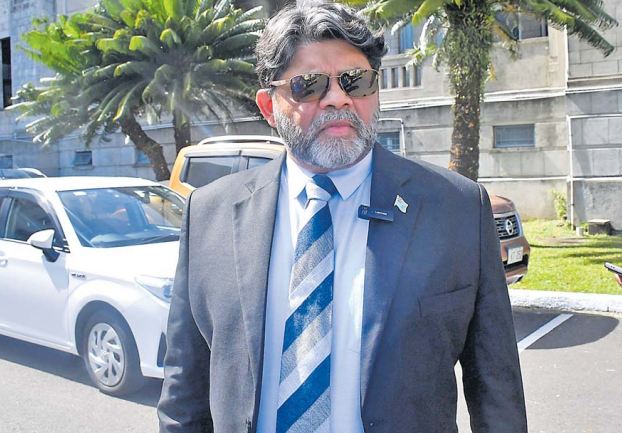
IN a major legal victory for two former high-profile public officials, the High Court has cleared former Attorney-General Aiyaz Sayed-Khaiyum and former Supervisor of Elections Mohammed Saneem of all criminal charges relating to a contract variation signed in relation to Mr Saneem’s remuneration.
In a highly anticipated judgment delivered yesterday, Chief Justice Salesi Temo found no evidence to support the State’s allegations of abuse of office and receiving a corrupt benefit, effectively concluding a high-stakes legal battle that has gripped the nation.
Mr Sayed-Khaiyum had faced a count of abuse of office.
The State alleged that between June and July 2022, while serving as acting prime minister and chair of the Constitutional Offices Commission (COC), he acted arbitrarily by executing a contract variation to unlawfully pay or waive additional deductible taxes on Mr Saneem’s back pay without the approval of the President or the COC.
In his analysis, Justice Temo said it would appear that 2.1 (aa) a varied clause in the second deed of variation was the foundation against Mr Sayed-Khaiyum. The State had interpreted the phrase “the Government will pay any additional deductible tax under the laws of Fiji arising out of the Officer’s back pay for the period commencing from the effective date (15/01/21) to December 31, 2021 as meaning that Mr Sayed-Khaiyum had agreed to pay or waive the additional deductible tax of Mr Saneem arising out of his back pay processed under the first Deed of Variation dated June 30, 2022.
“It would appear that the State’s above interpretation was flawed from the start,” Justice Temo ruled.
The phrase was subject to the following phrase: “under the laws of Fiji”.
He said under the laws of Fiji, every person who has a chargeable income for a year is subject to tax (section 8 of the Income Tax Act 2015).
Furthermore, he said no tax or fee may be waived or varied by the State, except as provided by written law (section 139(2) of the 2013 Constitution).
In addition, he said no law may exempt or authorise the exemption of a public officer from payment of any tax by reason of the office held by that officer (section 139(4) of the 2013 Constitution).
“Because of the above, the first part of clause 2.1 (aa) of the second (DoV), as a matter of contract law, ceased to exit. It was constructively deleted, as a matter of law.
“This is what the contracting parties agreed to, from the beginning. It was none of the Fiji Election Office’s officials’ business to put a flawed interpretation on Clause 2.1 (aa)and later unnecessarily reporting the same to police.”
Justice Temo said there was no evidence to support the State’s allegations and therefore, found no evidence that Mr Sayed-Khaiyum had abused the authority of his office and, in this case, he had not done any arbitrary act that was prejudicial to the rights of the Government of Fiji.
In Mr Saneem’s matter, he was charged with receiving a corrupt benefit for allegedly obtaining $55,944.03 in deductible tax relief on his back pay, which the prosecution argued was an unauthorised perk intended to influence his official duties as the supervisor of Elections.
An official FEO payment voucher dated July 21, 2022, showed that the $55,944.03 payment was reimbursement for the extra tax he had paid.
“So, it would appear that the $55,944.03 didn’t come from the Government of Fiji, it was reimbursement of his money that previously was mistakenly taken from him, that is, in the form of extra tax paid.”
Finding that the prosecution had not proven their cases against both men, Justice Temo said the problem started with a misreading of clause 2.2 (1) (aa) of the second DoV, which was part of the Contract of Service between the Government and Mr Saneem.
“FEO’s director of corporate service, Sanjeshwar Ram, misread the clause as meaning that ‘the Government will pay any additional deductible tax under the Laws of Fiji for (Mr Saneem’s) back pay in 2021’.
“Romika Devi, FEO’s financial controller, and then to Ana Mataiciwa, then Acting Supervisor of Election. (Ms Mataiciwa) consulted Mesake Dawai, then FEO acting manager legal.
“(Mr Dawai) recommended to (Ms Mataiciwa) that the matter be referred to the police. The police and their legal advisers did not pick up on the FEO’s flawed interpretation of clause 2.2 (1) (aa).”
Both men walked out of court fully cleared and smiling, with Justice Temo reiterating that the burden of proof rests entirely on the State.
Following the judgment, the former AG said the verdict meant the case should never be brought to court in the first place.
Mr Sayed-Khaiyum thanked his lawyers for standing by him throughout the legal proceeding.

