
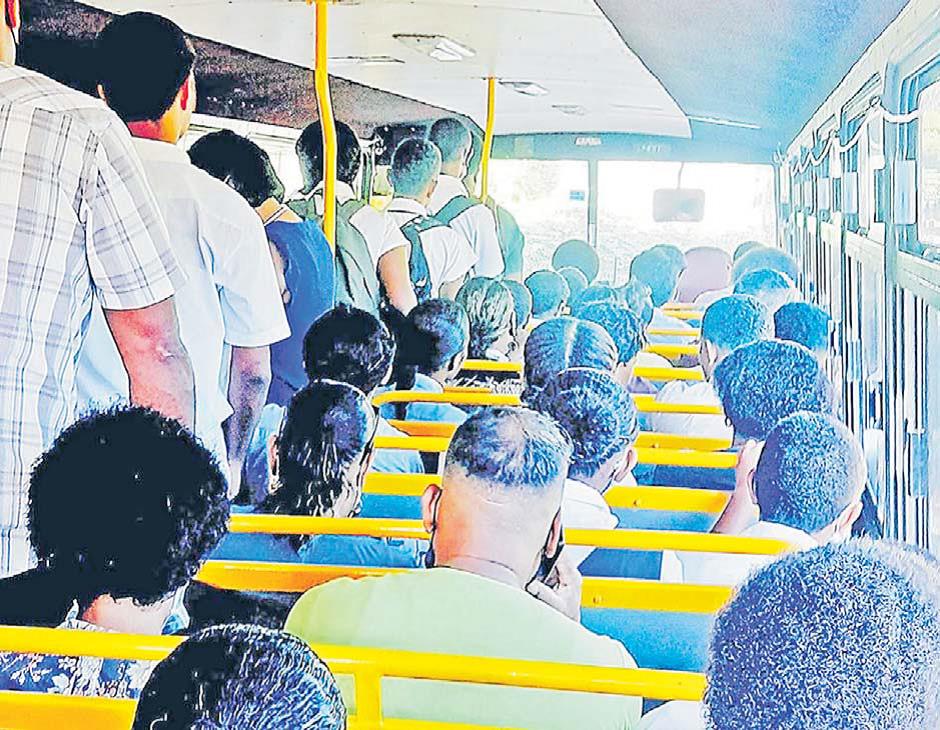
Fijians were lucky to have been ‘riding’ on the back of an industry, which has been a very unprofitable business – with many older family run bus companies going out of business – despite concerted efforts to survive.
These bus operators were able to survive and persist for this long, due to the great financial sacrifices of many families who put their personal wealth, farm, and other business profits into this enterprise, and tirelessly persisted in their effort to keep their business afloat through turbulent times.
Often struggling for many years, with buses almost becoming derelict, hardly service-worthy, with very large fuel and mechanical part bills in arrears – these mum and dad run businesses have finally gone to the wall.
Many have been ‘picked-up’ at a fraction of their real cost, by much larger enterprises – with no experience in the industry but with access to large amounts of cash – making the days of the small family run bus companies, nearly non-existent.
Many operators remained in the bus industry, giving it temporary sustenance and resuscitation over many years, in the hope for some miracles to happen in their industry, which could bring them back to profitability.
Sadly, this has not been the case and today the bus fares remain depressed by more than 100 per cent, with the industry in great peril and about to fold.
Fiji’s bus operators do not make large profits in their business industry.
They just exist in an industry, often passed down from their older generation as a business, when the industry was not that regulated and a family having a few buses in a remote village could easily service their community, with their labour of love.
The governments in power have expected the bus companies, to operate almost synonymous to a semi-business and a semi-social welfare entity.
They are expected to change two hats.
When the roads are poor or the fuel prices rise, they are quickly reminded of their social obligations, and responsibility to the poor, and those in rural areas.
This, despite deplorable road conditions. On the flip side of the coin, the government expects the bus operators to act, behave and to comply to the business model of the nation.
These entail the payment of VAT on their turnover of services, registration costs of buses, costs for fitness and vehicle inspections, road levy charges on each bus, third party insurance costs on each bus, public service vehicle (PSV) licence fees for drivers, wheel tax on each vehicle, special annual surcharge for any special unique features in the bus, costs for parts, mechanical, electrical and body and seat maintenance costs, and further running costs for the drivers, mechanics, garage boys, accountants, pay clerks, checkers, fuel, oil, and the list goes on.
The bus operators have never made any money – is not a generalisation but a fact – that hardly any Fijian will believe.
You may find this really a sad saga, and even question as to how the bus operators managed to get this far, in an industry, that appears to be “thriving” – by the look of packed buses, passing out of the busy bus stands about 5pm daily, after work.
The truth is somewhat very sad and even studies independently done over the years, have commented at the lack of support for the ailing industry, which has always been on the verge of collapse.
The Final Report, titled ‘Fiji Bus Industry Review’, prepared by Dr Sion Haworth and Paul Starkey Transport, Consultants, in October 2009, should be read for those interested.
It noted amongst other things: ‘Deteriorating road conditions increase operating costs, make some routes unviable. Operating costs have risen faster than income, resulting in an aging fleet that has compromised passenger safety.
The industry is at a critical stage, and could collapse due to the low profits, deteriorating roads and competition from carriers and minibuses. If this were to happen, the people of Fiji would lose an affordable bus service and the Government would lose revenue.
It is a fact that a business like the bus industry cannot survive only on a cost recovery basis, as there needs to be an injection of funds into the industry to allow for the profitability of the business so that the operators may be able to re-invest in the industry which will ensure the health and wellbeing of the bus services, by ensuring clean, good condition buses.
The main obligation of the bus operators will be to supply good conditioned buses at the required time and frequency, as stated in their LTA licence approval, condition.
The notion that children, schoolchildren, the sick and the old or pensioners should travel on subsidy will not be the concern of bus operators, who should get fully paid for these classes of travellers.
The FCCC should examine all cases of take overs, where small companies have been gobbled up by a larger company. Should the need be, the FCCC should examine their LTA approved route structure, to ensure that not more than a given percentage of routes have been given to each company.
Any route, that may have been acquired in the past five-10 years by predatory practice, will need to be returned, allowing for new or former entrants, to come back to the business, through the FDB loans scheme, approved for these businesses.
The issue of affordability is in the purview of, and may be looked at, by the government, and appropriate concession cards, provided to adults, pensioners, children, and school children — to allow them to travel — albeit at the same prices, albeit fully or partly subsidized by the government. Where partial fare subsidy has been approved, the difference will be paid in cash by the traveller.
The government and the community at large – in fact the entire nation, has been treating the bus industry as a social welfare agency, where the bus operators need to wear two hats, providing not only services cheaply, but simultaneously been obligated to service inaccessible roads, full of potholes, mud, or loose gravel – with the fear of losing their LTA route service authorisation, if they did not do as told.
The bus industry, as of right, needs to be given quickly and without wait, their bus fare increases, as despite all other entities having approvals for increases, the bus industry appears to be the last on the list. Fuel prices have increased many times, since the last bus fare increase.
Despite cumulative rises totalling bout 60 per cent, the bus industry waited on the side lines, and even to date has not seem to have received any help from the FCCC in the form of a quick approval.
The last increase was some years ago. This is very unfair indeed – at least an interim increase should be provided promptly by the FCCC to help the industry cushion the impact of the huge price rises, whilst it is still dilly-dallying about some economic model to work out the amount of increase.
- Dr SUSHIL K SHARMA PhD says he is a former British Aerospace, Royal Saudi Air Force, Bahrain, and Fiji Meteorological Service WMO accredited Class 1 Professional Meteorologist and Associate Professor of Meteorology, Fiji National University. The views expressed are his own and not necessarily shared by this newspaper.

