ON a Wednesday morning in Sigatoka, Mili Naituyaga was knocking on office doors, offering lunch for $10 a plate.
Days earlier, the former Fiji Airways flight attendant had learnt that her 30-year career in aviation was over.
The COVID-19 pandemic had brought the industry to a standstill, leaving her and thousands of others uncertain about their future.
But Naituyaga could not afford to remain defeated.
She had to find a way forward.
That Wednesday marked the beginning of Nadro Events Solutions, the catering and event-planning business she now manages from her home in Nadroga, serving clients across Fiji.
The Leadership Fiji 2013 alumna said losing her job became an unexpected lesson in resilience, adaptability and the importance of taking responsibility when circumstances change.
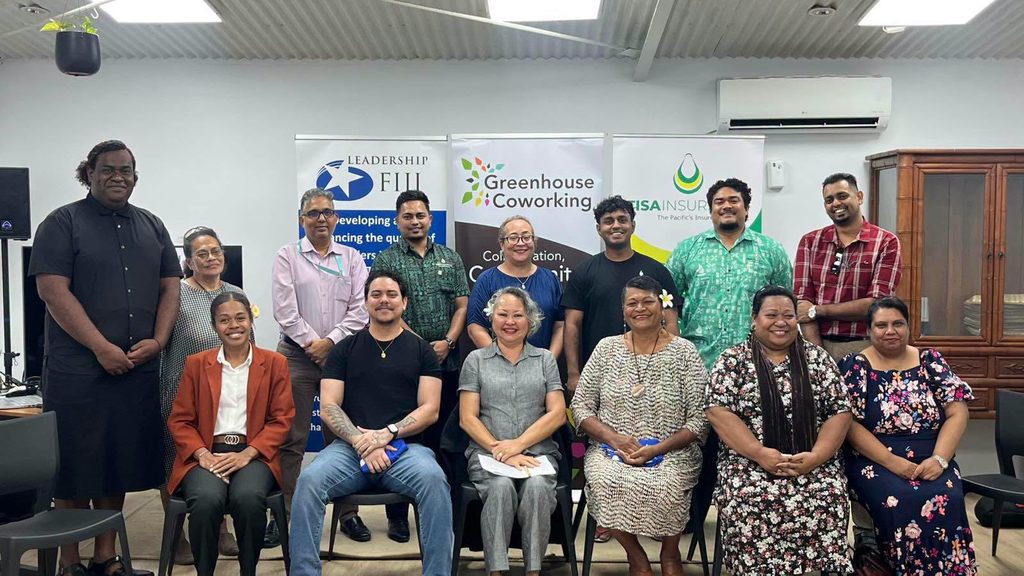
Speaking at Leadership Fiji’s Leaders Lounge under the theme “Legacy Through Story” earlier this week, she reflected on how a devastating setback became an opportunity to build something of her own.
“I always tell my family and my friends, with COVID, it was like a blessing to me,” she said.
At the time, however, there was little to celebrate. She had lost a career she loved and faced the challenge of rebuilding her livelihood from scratch.
Grabbing opportunities
Naituyaga began her career as a dive master and instructor at Shangri-La on the Coral Coast before joining Air Pacific in 1990. Over three decades in aviation, she developed skills in organisation, time management and customer service.
When COVID-19 struck in 2020, she was among the Fiji Airways employees whose employment was terminated.
She remembers a colleague, Rudolf, breaking down after reading an email informing staff of their termination while staying at her home in Sigatoka.
Her immediate response was to invite him to sit down and pray.
“Come here, come Rudolf, sit down, sit down, we just need to pray. You need to be strong, you’re here with me, don’t worry about anything,” she recalled.
The moment revealed her instinct to support others even while confronting her own uncertainty.
But she knew encouragement alone would not put food on the table.
By Wednesday morning, she was approaching banks and government offices in Sigatoka Town, offering to supply lunch.
She began with a $10 plate and a determination to make the venture work.
Mili registered Nadro Events Solutions and gradually expanded her customer base.
Today, the business caters for events across the Western Division, Suva and other parts of Fiji.
Her journey demonstrates an important leadership principle that when familiar structures disappear, resilience means recognising what remains and using it to move forward.
Lessons that endure
Naituyaga credited Leadership Fiji with helping her develop the confidence to navigate unfamiliar situations.
When she attended the program in 2013, she was still working for Fiji Airways.
The experience broadened her understanding of Fiji and exposed her to industries beyond her immediate professional environment.
She recalled learning about the sugar industry and agriculture during a Leadership Fiji trip, gaining insight into sectors that shape the livelihoods of many Fijians.
“I thank Leadership Fiji for moulding me to be a very strong woman, and to stand up,” she said.
That confidence became valuable when she had to reinvent herself professionally.
She later joined the Fiji Women’s Business Council and participated in the Academy for Women Entrepreneurs, funded by the United States Embassy.
Through the business council, she attended an Asia-Pacific convention in Malaysia, where she received recognition as the region’s most improved businesswoman.
Her success also reflects the value of transferring existing skills into new circumstances.
The discipline and customer-service standards she developed in aviation became central to her approach to catering and event management.
Although she still misses flying, entrepreneurship has given her greater control over her time and the opportunity to build a business of her own.
Her experience shows that losing a job does not erase the knowledge accumulated over a career.
Sometimes, leadership means recognising how that knowledge can be applied differently.
From survival to purpose
Another speaker at the Leaders Lounge, Asta Sonner, founder of Limitless Marketing and creator of the AI-powered customer-service chatbot Avaia, shared a different story of resilience.
Of Fijian and German heritage, with Rotuman connections, Sonner came to Fiji as a 10-year-old.
During his teenage years, his parents separated, leaving him without stable accommodation or adequate guidance.
Eventually evicted from his home, he lost his belongings and spent time living rough in Suva, sleeping in internet shops and relying on friends for shelter.
He recalled reaching a point where he was eating from rubbish bins behind student dormitories.
One night, sitting in the rain near Suva’s seawall, he looked towards a building glowing in the distance.
The moment forced him to confront his circumstances.
He realised that if he wanted a different life, he would have to take the first steps himself.
The following morning, he cleaned himself up, bought fresh clothes and borrowed a broken mobile phone from a friend.
Using YouTube, he learnt to prepare a curriculum vitae and began approaching businesses for work.
ROC Café gave him an opportunity.
He worked during the day and slept in an internet shop at night until he could improve his circumstances.
His subsequent career in marketing and technology developed through practical experience, new opportunities and a willingness to solve problems.
Sonner’s story highlights how resilience requires more than enduring hardship.
It involves making decisions, acquiring skills and acting when opportunities arise, even without a clear roadmap.
Responsibility beyond results
Sonner’s understanding of leadership became evident while helping a business improve its digital marketing.
After offering to manage its advertising for seven days without charge, he helped generate a significant increase in customer enquiries.
However, staff struggled to respond to the messages, leaving customers frustrated and employees overwhelmed.
He developed an artificial intelligence system to help manage the enquiries. It eased the workload and improved the business’s customer service.
But employees worried that the technology would eventually replace them.
Rather than dismissing their concerns, Sonner decided to address them.
He introduced a condition for companies using his systems: if an employee lost their job because of the technology, the contract would be terminated.
His approach was to train existing staff to work with the system and develop skills for the future.
“For me personally, leadership is about not just solving problems, but about taking responsibility for what happens after that and the impact it has on people,” he said.
His approach offers a lesson for leaders navigating economic and technological change.
Success should not be measured solely by immediate results; leaders must also consider the people affected by their decisions.
This principle connects Sonner’s experience with Naituyaga’s.
Both faced circumstances beyond their control and had to make decisions that considered not only their own survival but also the wellbeing of others.
The next step
Their experiences demonstrate that leadership is not defined solely by titles, qualifications or authority. It is revealed through adaptability, responsibility and the willingness to act when circumstances become difficult.
In Naituyaga’s experience, the loss of her aviation career meant starting again with a $10 lunch plate. She drew on existing skills, sought customers and built a business from the ground up.
For Sonner the determination to change his circumstances grew from the realisation that he could not depend on someone else to rescue him.
His work now reflects a commitment to solving problems while considering their impact on people.
Neither story suggests that hardship is necessary for success.
Rather, both show the importance of recognising opportunities, learning from setbacks and continuing forward when familiar paths disappear.
Adversity may change the direction of a life, but it need not determine its destination.
Sometimes leadership begins by comforting a distressed colleague.
Sometimes it means approaching a business for a job.
And sometimes, it starts with selling lunch because doing nothing is no longer an option.
Taking that next step becomes the beginning of a different future.