
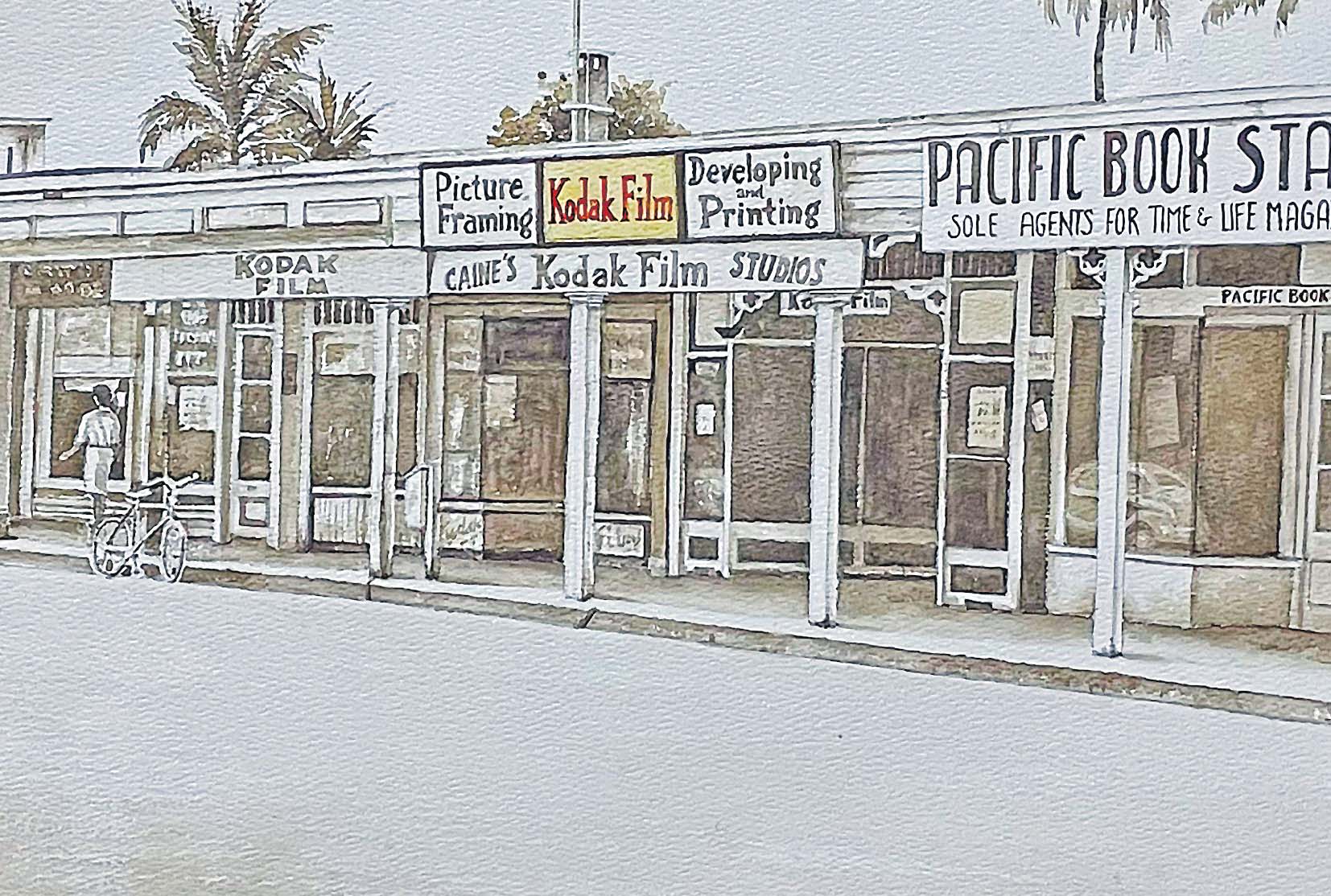
In the 1980s, the print media ruled supreme.
The printing industry was huge, and companies like Caines Jannif Pte Ltd provided the specialist tasks required to publish high-quality material.
Other than radio, the newspapers were the only way people could receive the news, advertisements and entertainment – in Fiji, at least.
The era marked the highpoint of Caines Jannif’s long operational history.
After making significant investments in scanning for large format printing, Caines Jannif became a 24-hour operation.
The heart of the company’s operations was centered in its building at the corner of Pratt St and Renwick Rd.
From the mid 1980s to the late 1990s, the company ran three eight-hour shifts to keep up with the demand of customers coming in to have their advertisements, posters, banners and even newspapers scanned up to size – while ensuring image quality and colour – before it was set on film and sent to the printers.
Caines Jannif was also into printing postcards, which accounted for a large portion of the company’s revenue.
They had a reputation for having the best colour.
In the early 80s, it was estimated that 20 million or more postcards were sold every year, and the company had been printing postcards from its founder Frederick William Caine’s days in the early 20th century.
Diversification from just being a photographic studio was something that began under Mohammed Ben Jannif, starting with investments into tyres.
While he was at the helm of the company, Caines Jannif also went into making placemats and coasters.
Original prints were glued and pressed on to ply board and cork.
The top was sprayed with mirotone, which would give the placemats and coaster a fine finish and ensure they could withstand the heat of a pot being taken off the stove and placed on them.
It was another big earner for the company, and to this day Caines Jannif remains agents for Mirotone sealers in Fiji.
However, the company they supplied found a way to have the same things produced overseas at a cheaper rate.
Subsequently, the company cut Caines Jannif out of the equation.
Eventually, Caines Jannif realised it could no longer keep all its main operations in the heart of Suva.
The big scanning machine which they got into their building in Suva by cutting a hole in the side and having a crane lift it through, had to be removed the same way.
It was then transported to their Raiwai warehouse where all the other manufacturing was taking place.
During that time businesses were struggling to operate with four hours of electricity everyday.
The power would come on for two hours, and then go off for two hours.
So, instead, a great generator was bought to power all the operations at their warehouse.
The mixed operations at the Raiwai warehouse continued unabated until technology caught up and allowed printers to publish from desktops.
Back in the heydays of print, technology still required images to be transferred on to film to make plates that would print the images.
When computer-to-plate (CTP) imaging technology became available, allowing the plates to be created as output from desktop publishing applications, the printers no longer relied on Caines Jannif for their scanning services.
Kelsey Jannif says this was the moment she knew things were going to decline.
Within a month of CTP coming into use at one printer, all the others caught on and switched.
Where they were previously running 24 hours a day to keep up with the demand, the scanning operations glitched out.
An entire industry practically vanished.
Caines Jannif carried on with large format printing and, for a time, it was the dealer for Apple in Fiji.
With all this extra space in the warehouse, they opened a trendy showroom for their i-products, which sat on par with Apple Stores around the world.
By now digital cameras were taking over from film and manual processing was replaced by digital processing.
Again, Caines Jannif picked up the new technology and made it work.
Everything changed in 2018 when a fire destroyed most of the machines in their Raiwai warehouse.
Ms Jannif says it was devastating.
“We had a 60-inch printer, a 60-inch laminator, and we lost both in the fire,” she says.
The loss of these key pieces of equipment meant Caines Jannif lost most of its capacity to do those jobs and earn revenue.
“We lost all the materials, we lost the capacity to do those things,” Ms Jannif says.
Mind you, Caines Jannif had been making investments in equipment and upgrades over the years.
“To replace all that equipment at the time was just not feasible,” Ms Jannif says.
“There was no way we could do it.”
Since its inception, photo framing had been a big part of its business.
“All the machines we used for our frame making were lost,” Ms Jannif says.
This was industrial frame-making, so it was not like picking up pieces of timber, knocking them together and slipping a photograph inside.
The moulding cutter would carve out the specific shape needed for the frame, the pieces were then cut and assembled in different sizes for different sized prints.
“Our big frame moulding cutter needed at least 15 meters to maneuver the wood around inside.
“The machine itself was three meters long, and you needed more on either side to get the wood in and out of the machine.
“It really did require a big space in the warehouse.”
Over the years Caines Jannif had done moulding for projects that required standard framing – like the pictures that hang in hotel rooms with similar frames.
Depending on what photos you wanted to display, the Caines Jannif photo archives were filled with beautiful images for purchase.
Most of the negatives were housed at the Raiwai warehouse and destroyed in the fire.
Today the company has about 15 staff members, as opposed to the 100 or so they employed at its height.
They still provide photo printing and framing services, and with a limited, but still sizable photo archives, Caines Jannif operates like a gallery consultancy.
“We go in and measure the space they want to hang photographs in,” Ms Jannif says.
“We look for images that suit the customer request in our archives. We scan them, print them out and frame them for our clients.”
Caines Jannif is in its 119th year and is the oldest retailer in Suva City.
While it may not have the same reach it once had, the impact that the company has had through photography, printing, manufacturing and retail have been felt by generations of Fijians.
It traded in moments that were captured on Kodak.

