
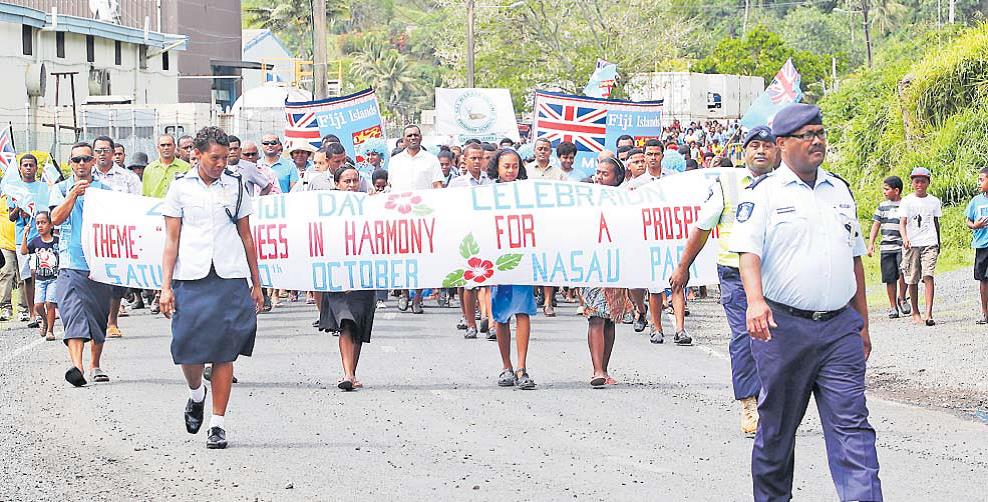
Monday is a national holiday to mark our independence as a nation. It should ideally be a time of reflection – a day when we take stock of our 52-year journey towards nation-building. Independence means freedom – in our case this meant shaking off the yoke of colonialism and foreign rule and taking charge of our own destiny.
As a free country, we joined the comity of nations that embrace the democratic principles enshrined in the Universal Declaration of Human Rights (UDHR).
The UN Declaration is regarded as a milestone document in the history of human rights. It sets out a common standard of achievements for all peoples and nations.
A total of 30 fundamental Human Rights are universally protected and recognised. Amnesty International describes the Declaration as “a …global road map for freedom and equality”.
It embodies such fundamentals as the right to freedom of expression, association and assembly, the right to political and civil freedoms, and such basic concepts as the right to life, education, clean water, health and so on.
This is the yardstick we use to determine just how free our people are. Our imposed 2013 Constitution embodies these fundamental freedoms in its Bill of Rights.
But today as we set out to celebrate yet another year of our “freedom” as a nation – it is fitting to ask just how many of these rights are still intact – that we really enjoy as a people?
Are we a free people? Do we enjoy all those freedoms enshrined in the Universal Declaration of Human Rights? I am sorry to say this is not the case anymore.
We are not a free people. Indeed, fear, not freedom, is the dominant force in our lives today.
Fear of speaking out freely, fear of victimisation, fear of discrimination, fear of detention and of persecution should we become too vocal in our criticisms.
Our Bill of Rights has been lauded as exemplary. But in reality key rights embodied in it are effectively undermined by the continued enforcement of certain draconian decrees. I will look at a few examples.
Workers’ rights
The UNDHR has been the springboard for other human rights treaties and conventions. Fiji has ratified a significant number of these and are under obligation to honour them. Among these are the core conventions of the International Labour Organization, i.e. Conventions 87 and 98 to ensure protection of workers’ rights. Also important is Convention 29 which prohibits all forms of forced and compulsory labour. Convention 87 safeguards the right of workers to freedom of association and protection of the right to organise that guarantees their right to form and join trade unions. Today in Fiji, our trade union and workers rights, as they existed prior to 2006, have been grossly tampered with and restricted. Trade unions are merely tolerated as part of Fiji’s international obligations but are no longer given status as equal social partners in a tripartite setup, and carry little clout. Some anti-worker measures were later relaxed following intervention from the ILO under the Employment Relations Act, but in practice some key worker and trade union rights remain abrogated. The right to peaceful protest, for instance, is not there in practice as shown by government’s consistent refusal to permit the Fiji Trades Union Congress to hold street marches and protests. The Public Order Act is often invoked to prevent such peaceful demonstrations of workers’ rights. Trade union officials are denied their civil and political right to form and participate in political parties and to stand for national elections. The formation of in-house unions since 2009 is a strong attempt to weaken and emasculate the trade union movement and leave workers at the mercy of employers. In the civil service, workers no
longer enjoy job security with the implementation of shortterm contracts. They have lost their right of appeal against unfair promotions, transfers and disciplinary action. Convention 98 specifically protects the rights of workers to collective bargaining, a right which is denied to public service unions in practice despite the Employment Relations Act.
Media freedom
It is well known that the media in Fiji works under serious restrictions. The existing culture of repression and censorship has taken a heavy toll on media freedoms and its ethics of honest, fair and balanced dissemination of news and opinions. International organisations have repeatedly called on Fiji to repeal the Media Industry Development Decree 2010 which subscribes harsh fines and jail terms for journalists found breaching it. Although this has since been modified, the penalties imposed remain harsh enough to prevent the media from operating as independently and freely as expected. Reporters Without Borders (RSF) sees Fiji as the worst place in the Pacific region for journalists. In its 2022 ranking in the World Press Freedom Index, it placed Fiji 102 out of 180 countries, with an overall score of 56.9 out of 100 – down 47 places compared with its 2021 rankings – hardly a record to be proud of!
Political rights and freedoms
Several recent amendments to the Political Parties and Electoral Act raise concern. They are designed to further tighten constraints placed on political parties to raise funds and campaign in a free and fair environment. First: removal of the right of candidates and political parties to appeal to the High Court against decisions of the Registrar of Political Parties and the Supervisor of Elections. Second: amendments sneaked in through the Financial Management Act, require political parties, candidates and activists to immediately provide financial details of any promises made to the electorate. Such requirements are, no doubt, meant to harass and prevent the opposition from mounting effective election campaigns. They stoop to the ludicrous when political parties are made to account for even the sale of a roti parcel as a fund-raising measure. At the last sitting of Parliament (early September), legislation was rushed through that empowers the Supervisor of Elections to demand that a person or political party hand over for scrutiny all information or documents he may ask for. No justifi cation has to be provided. The measure has been strongly criticised as draconian. There is no right of appeal to the decision of the Supervisor except to the Electoral Commission. Further, opposition parties are forced to campaign in an environment of fear and intimidation. Labour has complained of at least two occasions when police officers went around asking inane questions of party candidates and supporters following its campaign meetings. While opposition parties undergo rigorous scrutiny, the ruling FijiFirst party is free to offer all kinds of inducements and freebies – clearly seen in the domain of vote-buying – but are subjected to no investigations. In such an environment can one expect general election to be free, fair and credible? There are other constraints, some legislative, some regulatory that bring into question the state of our democracy in Fiji – we lack the space to deal with them here. Suffice to ask: Is this the kind of flawed democracy that we want in Fiji? One must understand that rights and freedoms cannot be viewed in isolation. A breakdown of democratic systems, that safeguard the effective running of a country, will inevitably lead to social and economic failures!
- MAHENDRA CHAUDHRY is leader of the Fiji Labour Party and a former prime minister of Fiji. The views expressed in this article are the author’s and not necessarily the views of The Fiji Times.

