
The old political debate about whether later arrivals to Fiji should still be considered “visitors” has resurfaced after an aspiring politician recently referred to Fijians of Indian descent as “visitors” on the International Day of the World’s Indigenous Peoples on August 9th.
Many have asked for my thoughts on this – here they are. Please note that three terms are used here for Fijians of Indian descent: Indian or girmitiya for pre-independence in 1970, Indo-Fijian for pre-2013 when the Fijian of Indian descent were first constitutionally recognised as Fijians and; Fijians of Indian-descent post-2013.
This is in order to demarcate a clear ethnic category for discussion purposes.
The background
Fiji is a multicultural country with two major ethnic groups – indigenous Fijians (55 per cent) and Fijians of Indian descent (38 per cent). Peaceful co-existence has been a feature of life in Fiji even though ethnic tensions have surfaced in times of political crisis.
The main bone of contention has rotated around whether Fijians of Indian descent have the same rights as indigenous Fijians especially in wielding political power as a later settlers in Fiji.
This stems from deep-rooted inter-ethnic distrust. Fijians of Indian descent have been largely unsuccessful in gaining indigenous Fijian trust.
Likewise, despite repeated attempts by numerous indigenous Fijian leaders, Fijians of Indian descent have felt marginalised from the corridors of power in a country that they have accepted as their own. A relook at history is warranted in order to understand how this came about.
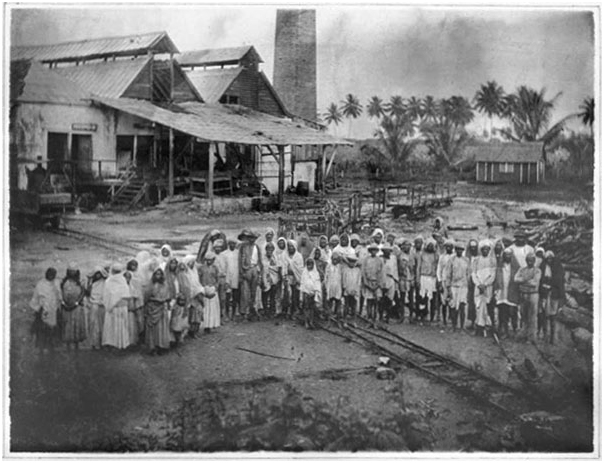
When the Indians arrived in Fiji as indentured labourers between 1879 and 1916, their main aim was to earn money and return to India after five years as promised, the colonisers had other plans for them.
It needs to be noted at this point that the measles epidemic of 1875-76 had decimated the Fijian population by more than 30 per cent. Moreover, Fijians were considered to be unsuitable for menial labour.
Thus the colonisers had to hold Indian labour back in Fiji. A number of draconian as well as insidious measures were used by the Sahibs to deny them free return passage to India after five years.
They were promised free passage back after 10 years. The second five years weakened the resolve to return.
Many had forged an existence in an unforgiving environment that they had helped tame. Thus the girmitiya chose to remain in Fiji even though a large number (40 per cent) did return to their homeland.
Indian expectations
When girmit finally came to its unpleasant conclusion in 1921, opportunities opened up to become contracted cane farmers and other types of simple labourers. There was also need for trade in fruits, vegetables, etc.
Saturday bazaars were a much-anticipated social event. Small shops popped up as business immigrants began to arrive from India. As the Indian presence grew, their expectations and demands also grew.
They learnt first-hand that they had to struggle for any positive considerations from government. They were denied access to education, so they built their own schools.
They realised that they had to fight for political rights moving the focus to representation.
Here again, there was unending acrimony from the planter community who had their own fears of Indian designs.
In the lead-up to independence, the two constitutional conferences pitted the Indians against a coalition of Fijians and Europeans where this latter category pitched themselves as some sort of “protectors” of indigenous Fijian interests against sinister Indian schemes.
In the end, surprising cross-ethnic goodwill between Ratu Mara and S M Koya led to independence in October 1970.
That goodwill evaporated soon afterwards when Ratu Mara proposed affirmative action in education for Fijians.
It appeared like there was no middle ground as the National Federation Party dug in and refused to budge saying that Indo-Fijians also needed education scholarships. From there onwards, adversarial politics based largely on ethnic lines characterised political conduct in Fiji.
Through each other’s eyes
All of the above made the Indo- Fijian look ungrateful, greedy, antagonistic, ill-mannered, cantankerous and acrimonious. It needs to be noted that the ethnic Fijian conception and understanding of Indo-Fijians was based on historical experiences. They saw subservient coolies who did not show any warrior-like tendencies in the face of physical atrocities.
Then they witnessed a preoccupation with frugality, saving and investment. They could not understand the need for future security in investing in education and tangible assets.
They even viewed Indo-Fijian schools as a “foreign” concern. Their language, food, attire and lifestyle were all very different. Even on the religious front, they had different gods.
On the other hand, the Indo- Fijian was also forming a conceptualisation of indigenous Fijians.
They saw a primitive people who lacked sophistication and lived a largely indolent life that was heavily patronised by the colonial government.
They also saw that the very things that were denied him were being given to the ethnic Fijian without any struggle. Education was a key point of contention.
This conception of being “better” gained strength as Indo- Fijians tussled with the colonial government and gained small concessions, progressed in education both locally and abroad, and began to prosper in the largely petty business sector.
As they accumulated wealth and success, the ethnic divide became a chasm. There were a number of compounding factors in this unhealthy, and potentially explosive, multi-cultural brew – these are discussed next.
Compounding factors
One, there were different levels of educational achievement between the two communities.
Schools were set up along ethnic lines in an environment of government neglect and adversity.
The Indo-Fijians prioritised education and sent promising candidates overseas amid great family sacrifices, leading them to become prominent in many of the professions in Fiji.
On the other hand, the ethnic Fijians lagged in education largely because they did not see the need for it in the same manner as the Indo-Fijians in a modernising Fiji.
The colonial government adopted paternalistic policies that restricted indigenous Fijians from developing the tools necessary to progress in a monetising economy.
The resultant discrepancy in progress became a huge concern post-independence in 1970.
Indigenous Fijians were restricted by law from leaving their villages and experiencing life within the fast-evolving economy.
This constrained them from understanding the changing needs that they had to meet. It also made them more dependent on political patronage. Independence and self-progress were uncomfortable ideas to them.
Confining indigenous Fijians to villages prevented the shared conditions of existence that is critical in the formation of crosscultural understandings that then help forge bonds for true multicultural societies to emerge.
The two major communities in Fiji largely lived two different lives and formed two different worldviews that would haunt them later.
Indo-Fijian material progress could not be viewed and understood by indigenous Fijians as the fruits of hard labour, frugality and focused saving and investment.
They also could not understand the Indo-Fijian need to “show” progress through physical assets and personal professional progress.
This appeared like “showing off” and bragging.
The visible reality of Fiji in the lead-up to the 1987 coup featured Indo-Fijians dominating the civil service (albeit at the lower levels), dominating the business sector (largely at the lower and middle levels), dominating the professions (doctors, lawyers, teachers), dominating the transport sector, etc. – they were everywhere!
All this required some politician with oratorical skills and a passionate antipathy towards Indo-Fijians to move ethnic Fijian sentiment to resentment and hatred.
Thus Indian/Indo-Fijian success began to be seen as the result of some sort of wrongdoing, manipulation, dishonesty and theft. This was the intellectual, social, economic and political demarcation between the two communities at the time.
It was this lack of any meaningful shared existence, coupled with cross-cultural misconceptions, misunderstandings and misrepresentations between the two communities that led to simmering tensions that emerged at critical junctures in Fiji’s progress to nationhood.
It is this that has fuelled the storm that has arisen in Fiji’s teacup recently.
- SUBHASH APPANNA has been writing occasionally on issues of historical and national significance. The views expressed in this article are not necessarily those of The Fiji Times.

