
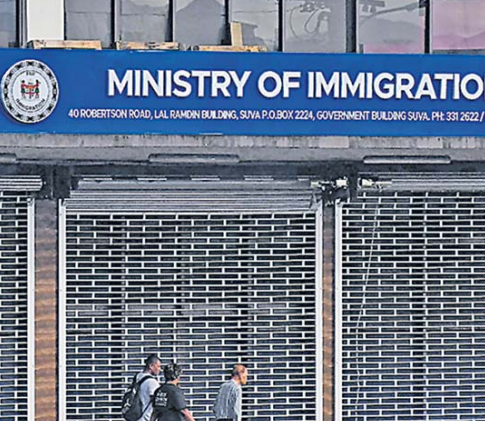
A total of 135 removal orders were issued to immigration overstayers in Fiji between 2019 and 2023, but only 47 were enforced, according to figures tabled in Parliament last Friday.
The data, provided by the Department of Immigration to the Standing Committee on Foreign Affairs and Defence, highlights an ongoing gap between removal orders issued and those carried out.
The report shows 50 removal orders were issued in 2019-2020, before dropping to 14 in 2020-2021. The number then increased to 33 in 2021-2022 and 38 in 2022-2023, bringing the four-year total to 135.
Enforcement figures were significantly lower throughout the reporting period. Authorities enforced 24 removal orders in 2019-2020, followed by just two in 2020-2021. Enforcement improved to 21 cases over the final two reporting years, contributing to a total of 47 enforced removals.
According to the report, removal orders fluctuated over the four years, reaching their lowest point during the COVID-19 period before steadily increasing again.
The Department noted that enforcement activity also improved in the later years but continued to lag well behind the number of removal orders issued.
The report concludes that while Fiji has increased its efforts to address immigration overstayers, a significant gap remains between identifying individuals for removal and successfully enforcing those orders.
Immigration rakes in $23.38m
Revenue generated by Fiji’s Department of Immigration almost doubled over four years, reaching a record $23.38million in the 2022-2023 financial year as demand for passports, permits and visas surged following the reopening of international borders.
The figures were provided to the Standing Committee on Foreign Affairs and Defence and tabled in Parliament last Friday.
According to the Department, total revenue stood at $12.36million in the 2019-2020 financial year before falling sharply to $7.17million in 2020-2021, reflecting the impact of the COVID-19 pandemic on international travel and immigration services.
As border restrictions eased, revenue rebounded strongly to $15.13million in 2021-2022 before climbing to a record $23.38million in 2022-2023.
The report attributes the recovery to increased demand for passports, permits and visas as international travel resumed and labour mobility opportunities expanded.
Passport services remained the Department’s largest source of revenue throughout the reporting period and recorded the strongest growth after the pandemic.
Permit revenue also remained a significant contributor, recovering steadily as businesses resumed recruiting overseas workers and economic activity strengthened.
Revenue from visa applications, citizenship services and search fees accounted for a smaller but consistent share of the Department’s earnings across the four financial years.
The Department said the figures demonstrate a clear pattern of disruption during the pandemic, followed by a rapid recovery driven by increased mobility and higher demand for immigration services.
It also credits improved service delivery and processing capacity for supporting the sharp increase in revenue while maintaining operational efficiency.
Passport applications triple after COVID
Passport applications in Fiji more than tripled following the reopening of international borders after the COVID-19 pandemic, with the Department of Immigration receiving almost 134,000 applications over 2022 and 2023 alone.
Figures provided by the Department to the Standing Committee on Foreign Affairs and Defence and tabled in Parliament last Friday show passport demand remained relatively stable between 2019 and 2021 before surging as international travel resumed.
The Department received 20,737 passport applications in 2019, 18,573 in 2020 and 18,852 in 2021.
Applications jumped to 64,841 in 2022 and rose further to 68,946 in 2023.
Passport issuance closely matched demand throughout the reporting period, with 19,459 passports issued in 2019, 18,846 in 2020, 18,546 in 2021, 63,720 in 2022 and 67,752 in 2023.
According to the report, the sharp increase in applications followed the reopening of Fiji’s borders after the pandemic and was further driven by growing participation in overseas labour mobility schemes.
The Department said the increased demand reflected more Fijians travelling overseas for employment and other opportunities.
Despite the sharp rise in applications, the report states the Department maintained high processing capacity and continued to issue passports at a rate closely matching demand.
The Department also clarified that it does not routinely deny passport applications.
Instead, applicants who do not meet the eligibility requirements such as individuals who have acquired foreign citizenship are guided through the appropriate citizenship processes.
Under the Passport Act, passports are issued only to bona fide Fiji citizens who meet the legal requirements.

