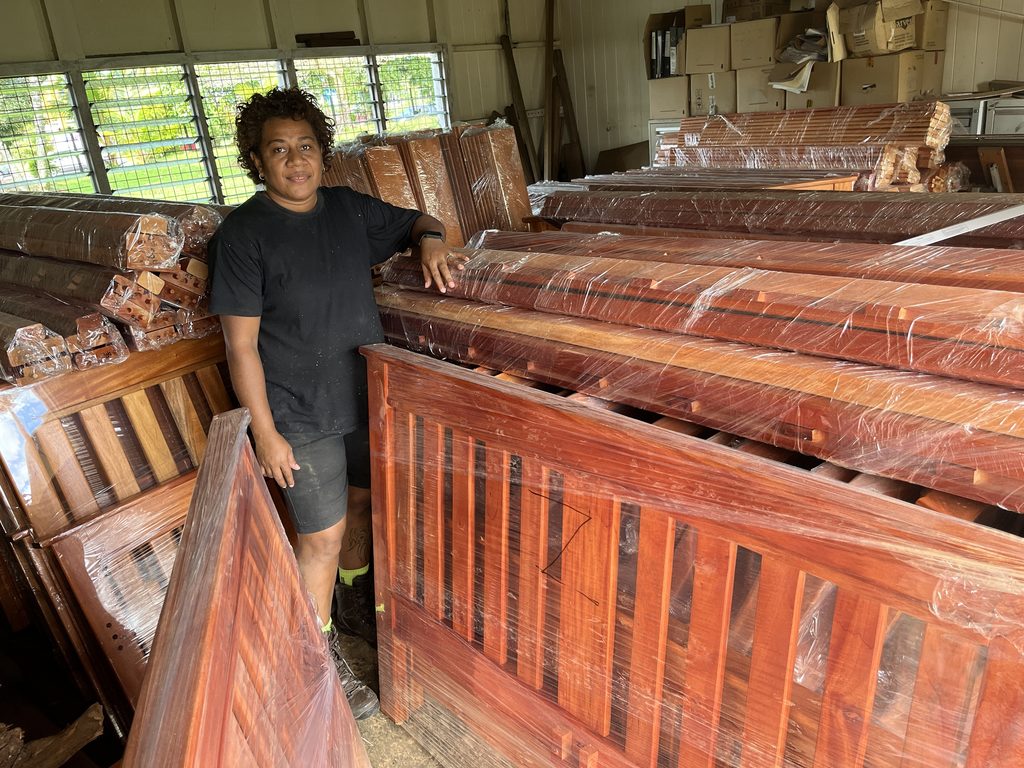
The whine of a circular saw cuts through the morning air at a joinery workshop in Nasinu.
Stacks of timber line the walls. Fresh sawdust carpets the floor while men move heavy Mahogany planks.
In the middle of the bustle stands Adi Viniana Labalaba.
For the woman from Sote Village in Vugalei, Tailevu, the journey to becoming a joinery workshop manager was never part of a carefully crafted plan.
“I dropped out of school at a time when life in the village was a challenge and many women ended up selling at the market,” she said.
“I had no idea what I wanted to do in life, not even a career path in mind. But God had a plan and purpose in my life and He steered me in the best direction.”
Today, the mother of four manages her family’s furniture and coffin-making business operating from the Forestry Department compound in Nasinu, proving that determination can sometimes achieve what formal qualifications cannot.
Finding purpose
Viniana comes from a family of six siblings and has maternal links to Cautata Village. After leaving Baulevu High School in Form Six, she struggled to find direction.
She enrolled in a computer course to occupy her time but could not continue because of financial difficulties.
For a while, she remained unemployed in the village, uncertain about what lay ahead.
One turning point came in 2011 when she met her husband from Naila Village.
Marriage brought stability and a growing family, but her future career remained unclear. Then an opportunity emerged from an unexpected source — timber.
The mahogany legacy
Around the same time, Sote Village began harvesting its mahogany resource.
Her father became involved in timber milling, working through a village enterprise shared by the villages of Sote, Savu and Naimasimasi.
Years later, a change in business strategy led the family to look beyond timber harvesting and milling.
Instead of allowing off-cuts from sawn timber to go to waste, they began exploring ways to add value to the resource. That decision led to the establishment of a furniture-making business in 2025.
Her father oversees operations, her brother manages the timber mill at Nukurua Forest Station in Tailevu, and Viniana runs the joinery workshop with help from a brother,
What makes her story remarkable is that she never received formal training in carpentry and joinery.
“I just learned on the job, mostly by observing and helping my dad and having an inquisitive mind and a willing heart.”
Today, she makes coffins, wooden chests, beds, ornamental products and other furniture.
Holding her own
Being the only woman in the family’s furniture-making business has never intimidated her.
Instead, she views working in a male-dominated environment as another challenge to overcome.
“You must command respect, work extra hard and focus on your professional growth,” she said.
“Always be willing to learn new things and never be afraid to ask questions.”
Viniana believes many women shy away from joinery because of the machinery and tools involved.
“I think women have a lot of fear working with machines and tools that can easily cause injuries,” she said.
“But after you learn how to use tools and machines and have confidence, you can do anything that men do.”
For Viniana, confidence is built through knowledge, experience and the support of like-minded people.
“The important thing is having a good support network and working with people who will encourage you to move on instead of bring you down.”
She also believes women bring unique strengths to the industry.
“We are able to look at things in detail and we can really do exquisite ornamental furniture to enhance home décor and aesthetics.”
Building bigger dreams
The family business is already supplying around 120 beds a month to Courts Fiji, but Viniana believes the journey has only just begun.
Plans are underway to relocate the joinery workshop from Forestry Department premises to family-owned land in Kasavu.
The long-term vision is even bigger.
“We envisage the day we will be able to sell furniture from our own shop,” she said.
“Right now we are merely supplying 120 beds per month to Courts.
“We would like to make furniture and sell them ourselves, perhaps run a hire-purchase furniture business in the future.”
“That sounds ambitious but I believe if we put our hearts and minds to it, we can achieve our dreams.”
Lessons beyond timber
Running a business has taught Viniana lessons that extend far beyond woodwork.
Time management and financial discipline, she says, have become essential ingredients for growth.
Those values were instilled by her father, who insists on punctuality and prudent financial management.She believes many indigenous Fijian businesses struggle because spending often takes priority over investment.
“There needs to be prioritisation,” she said.
“We spend money all the time, sometimes on things that are not important. That mindset needs to change if iTaukei are to do well in business.”
It is a lesson she hopes future generations will embrace.
Giving back
Viniana credits much of the business’s growth to the support it has received from Government through training, mentoring and operational assistance.
“Without government support, we would not have reached this far,” she said.
“We thank the staff of the Department of Forestry in Nasinu for their tremendous support and guidance.”
At home, she is already preparing the next generation.
Her four children are slowly being introduced to the business and the values that have carried the family this far
“I want them to get an education and come back to contribute to the business,” she said.
As sawdust settles across the workshop floor and another piece of timber is transformed into furniture, Viniana’s story sounds the reminder that careers do not always begin within four classroom walls.
Sometimes they first begin in uncertainty.
Sometimes they begin with a woman determined to prove that talent has no gender.
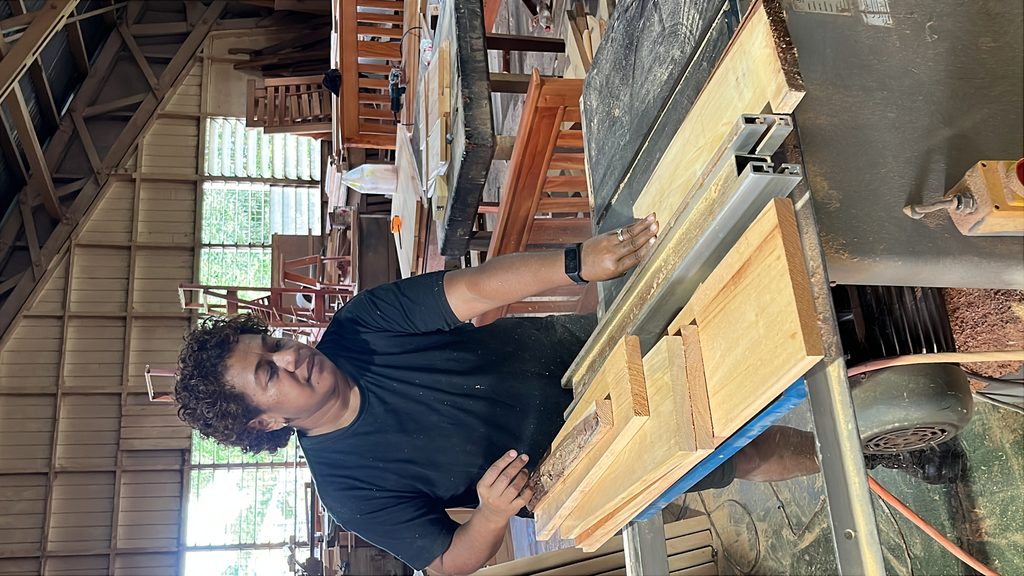
Putting timber in place, ready for sawing. Picture: ANA MADIGIBULI