

Fiji is experiencing extreme labour market conditions due to our skills and labour crisis.
In 2024, the UN warned that Fiji was regressing on SDG8 – decent work and economic growth.
As employers counter multiple challenges relating to employment, business and economic growth, they are asking – what is taking so long to re-instate their 1 per cent Fiji National University (FNU) training levy, to its initial purpose?
About 5320 registered businesses who employ more than 300,000 Fijians are asking the same question.
How much of training funds have employers lost
Since 2019, employers have lost an average of $22 million a year on up-skilling and re-skilling their workers.
Between 2019 and 2024, employers accessed less than $15.2 million of the $152.4 million contributed to the FNU Levy, after administrative cost deductions by the Fiji National University (FNU).
(Refer to table 1)
To train and upskill their workforce, employers have accessed an average of just $2 million a year – approximately 10 per cent of their total FNU Levy contributions.
“To put this into perspective, on average, this translates to $376 per contributing employer or $7.00 per worker,” said Edward Bernard, the chief executive officer of the Fiji Commerce & Employers Federation (FCEF).
He further states that not being able to fully access their own resources is not adequate or sustainable for employers to mitigate against the loss of their workers to Australia and New Zealand, low productivity, and absenteeism.
Breakdown of employer funds from 2019 – 2024
Since 2019, $137.1m of employer funds have been diverted towards areas unrelated to skills development.
(Refer to table 2)
Forty per cent ($60.9m) of employers 1 per cent FNU levy has been diverted to the Accident Compensation Commission of Fiji (ACCF).
Going towards costs for accidents on roads, schools, and workplaces.
Fifty per cent ($76.2m) has been diverted to the Ministry of Health for the free private doctor’s scheme.
The impact of this unilateral decision made by the last government has proved counter-productive to skills development, innovation, and business and economic growth.
Development opportunities lost as a result
Local employers have struggled to invest in staff development to boost productivity.
Businesses competing regionally, globally, or even with cheaper local imports are feeling the impact.
Those fortunate enough to manufacture for global brands must meet international standards to maintain their supplier contracts.
Local employers and industries have struggled to develop and lead innovative, high-impact training programs that support advanced skills development, business competitiveness, and accelerated economic growth.
The benchmark Apprenticeship and Trade Testing scheme, once admired by our regional neighbours, now faces significant resourcing challenges, limiting its ability to prepare students for the workforce.
As a result, employers’ efforts to ensure students are job-ready are being hindered.
“I started my management training straight after high school under an innovative initiative called the Trainee Managers Scheme, initiated by the then Emperor Gold Mines,” Mr Bernard said.
“The scheme targeted high school graduates that eventually saw a high uptake of highly skilled local managers, including the mine’s first local general manager and was entirely funded through the 1 per cent training levy,” he said.
Businesses can no longer leverage training and internal progression as a strategy to attract and retain workers. Thousands have left to work in Australia and New Zealand, and about 20,000 potential Fijian workers are registered with the National Employment Center (NEC) for overseas deployment.
“This inadequacy of the labour market is resulting in companies competing with each other for limited skills and labour in the market, impacting the progress of many MSMEs and even Government.”
This has contributed to no or slow improvements to Fiji’s employment rates.
According to preliminary findings from the 2023–24 Employment & Unemployment Survey, Fiji currently has 18,073 unemployed people.
In the last eight years, our national unemployment rate has only reduced by 0.10 per cent, from 5.50 per cent to 5.40 per cent, while our youth unemployment rate has actually increased by 0.20 per cent, from 18.10 per cent to 18.30 per cent.
“At the same time, more than 740 companies are bringing in foreign workers to mitigate the skills and labour crisis,” Mr Bernard said.
What do employers want?
The employers want two things.
Firstly, they want the urgent re-instatement of 100 per cent of their FNU levy to its initial and intended purpose.
Using employer funds intended for skills development for other purposes, has done substantial harm to Fiji’s labour market, business and economic growth.
In 2025, the former Minister for Finance announced an inquiry into the current 1 per cent FNU Levy.
Secondly, they want the establishment of an independent body with more employer say.
After all, employers are the key contributors both financially and in job creation. With the rapid changing demand for skills and innovation, the employer’s direct involvement will allow training institutions to respond more efficiently and effectively to the supply, and balance of Fiji’s labour market.
Training institutions need to be more labour demand focused – concentrating on updating their curriculum, building staff capacities, and procuring modern training equipment and facilities for student.
n GAYLENE KAMALI is the Manager Advocacy and Corporate Communication with FCEF. The views expressed in this article are not necessarily the views of this newspaper.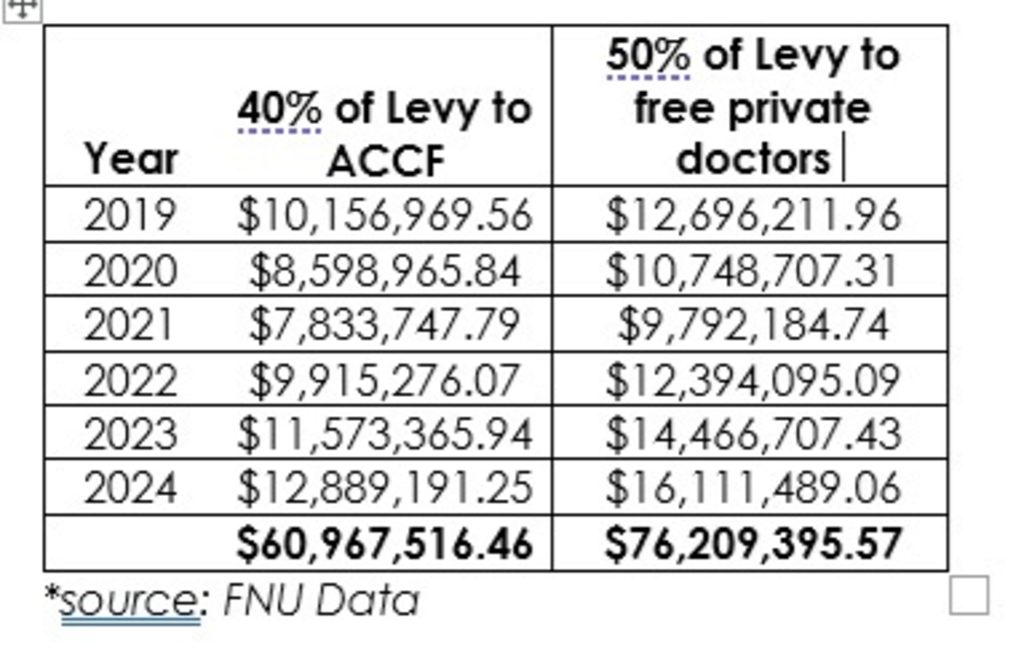
Levy data. Picture: FNU

