
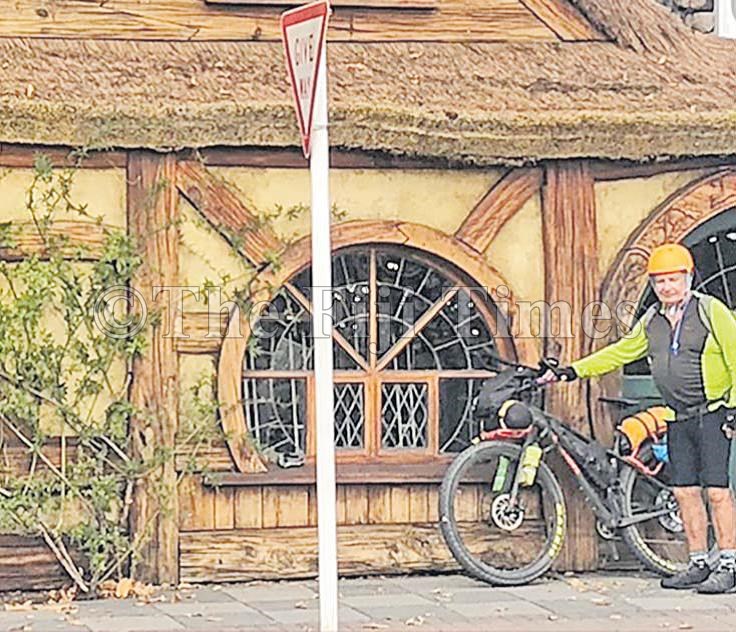
GOING into the second week of the Tour Aotearoa 30-day challenge puts everything in perspective for John Townend as he tries to maintain the cycling momentum for another week.
The Cape Reinga to Miranda Hot Spring journey was behind him and his focus had shifted swiftly to completing the next challenge of 475km from Miranda Hot Springs to Raetihi, North Island.
“I was a bit late getting up at the Holiday Park at Miranda Springs, and so didn’t have time to bathe in the hot springs and quickly I pushed onto the Hauraki Rail Trail.
“Although quite straight and boring in parts I enjoyed the trail, not only the separation from road traffic, but the multitude of bridges across drainage ditches and side roads. The route even included a tunnel specifically for cyclist.”
He said from there cyclist reached Paeroa, a town famous for the New Zealand’s soft drink lemon and Paeroa (L&P) which was invented in 1907.
“Back then the soft drink consisted of lemon and carbonated water from Paeroa which contained natural salt,” he said.
With his rear giving him trouble something that would be experienced by cyclists who have been cycling for two weeks, John decided to stop at a motel at Paeroa.
“The manager was very helpful, processing my laundry and I slept intermittently,” he said.
“In the morning I got a new tub of Sudacrem cream from the chemist across the road so that I was properly prepared for the soreness ahead. I followed the trail out of town and battled on longer on the Hauraki Rail Trail in open countryside all the way to Te Aroha where the trail finished innocuously at a railway station.
“I worked my way out of Te Aroha where I followed the remnants of the Hauraki Rail Trail which followed the road along the way to Matamata. I stopped at the first motel I could find because I was pretty tired and bought food from a supermarket next door which included precooked curry that only needed to be heated up in a microwave.
“The shopkeeper was a Fijian who was from Labasa. After taking a picture at the next control point I then headed out of town into gentle hills that passed by the local cycling club. John was fortunate to have met a lithe English doctor named Tim who was out running with his dog. Tim had immigrated to New Zealand three years ago.
“I begged him for an Elastoplast for the pain which was becoming difficult to bear. He kindly provided me with a plaster and a tube of Bentadyne (a brown antiseptic liquid which stings) but was quite effective in drying up infections,” he said.
After a bit of cycling along a highway and passing the Hobbiton movie set, John entered the Waikato River Trail where there was a separation from the road traffic.
“This was a beautiful section of the ride and eventually we arrived at the Rhubarb Cafe in Arapuni. This was important for me, for I was a regular customer at the Rhubarb cafe in Fiji. The owners were pretty knowledgeable about the tour having featured in the coffee table book which has encouraged so many people to enrol for the tour.
“They directed me along the revised route towards Manganiko. I soon set off again over the rolling hills, with multiple false summits, which was heartbreaking to any cyclist, particularly if you are as unfit and tired as I was. After a long climb alongside a lake, I finally found my way downhill to Manganiko.
“It was here that I learnt of accidents which had already occurred on the tour. A cyclist had been seriously injured in Auckland because of the sun stroke. Another one had hit a pothole on the Timber Trail and broke her collarbone.”
Before leaving Manganiko John stopped by the lakeside where there was a special pump arrangement for cyclists.
“The bicycle seemed to have moved a lot quicker on tarmac surfaces after the tyres had been pumped, but not so much better on the gravel, as every bump was keenly felt.
“This was supposed to be the day of a long hard climb up to 800 metres but it was not as bad as it looked in the tour guidebook.”

