
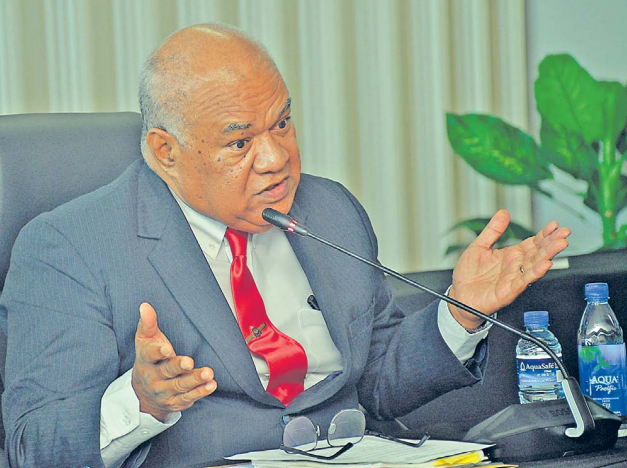
AMENDING the immunity provisions in Chapter 10 of Fiji’s 2013 Constitution would be “disastrous,” Chief Justice Salesi Temo told the Constitution Review Committee yesterday.
Justice Temo cautioned that revisiting these entrenched provisions, which the Supreme Court has affirmed cannot be challenged, could destabilise national progress.
He emphasized the importance of prioritising reconciliation and stability over reopening historical grievances.
He made the statement after CRC committee member, Conway Begg, referred to a Supreme Court position that the immunity provisions in Chapter 10 are entrenched and cannot be challenged or reviewed by the courts.
“Yes, a lot of our citizens have suffered because of all the unlawful actions since 1987,” he said.
“For us to disturb that could create problems. So do you want to move forward or create problems?”
Justice Temo said that while many individuals had been affected by past events, the broader interest of the country lay in moving ahead rather than reopening historical grievances.
“Sometimes in our personal life you are hurt, unnecessarily victimised.
“But forgive and forget. We must move forward.”
Justice Temo warned that changing the clause could reverse hard-won progress and represent a “move backwards.”
He also referred to Fiji’s historical context, noting that conflict and power struggles were not new, and should be understood alongside the country’s cultural realities.
“So the challenge is move forward. And that’s why we did not touch Chapter 10.”
However, he acknowledged that the Constitution Review Commission remains free to consider the issue.
Chief Justice proposes constitutional change
THE Constitution should allow the Chief Justice and the President of the Court of Appeal to step aside
from the Judicial Service Commission when its decisions are challenged in court, so they can
continue presiding over major cases.
This was the key proposal put forward by Chief Justice Salesi Temo in his submission to the Constitution Review Committee yesterday.
He said judges who take part in decisions through the JSC are later unable to hear court cases that challenge those same decisions, as their prior involvement automatically disqualifies them.
“The problem for us, given our experience with the COI, the DPP, is the involvement of the Chief Justice
and the President of the Court of Appeal in the JSC,” Justice Temo said.
“By virtue of their membership in the JSC, both officials are disqualified from presiding over matters
in the High Court, Court of Appeal and Supreme Court where decisions of the Commission are being
challenged.”
Justice Temo described the situation as unfair, noting that the public does not benefit when the judiciary’s
most senior legal officers are unable to take part in determining important legal disputes.
He pointed to cases such as the dispute involving former FICAC Commissioner Barbara Malimali, where he was unable to sit on matters before the Supreme Court despite having a full understanding of the legal issues involved.
“We propose an amendment to Section 104 of the Constitution, to allow the Chief Justice and the
President of the Court of Appeal to appoint nominees to sit on the JSC in their place.”
Under this proposal, a nominee, such as a Supreme Court judge, Justice of Appeal or High Court judge,
could act on their behalf, enabling the Chief Justice and the President of the Court of Appeal to step away
from JSC decision-making when necessary.
“This would allow them to remain eligible to preside over court proceedings that arise from JSC decisions,
while maintaining the integrity of the judicial process.”
Temo pushes for judicial reform
THE constitutional provision governing judicial appointments is facing criticism for allegedly
discriminating against local judges.
Under the current system, Fijian judges must retire at 75, while foreign judges can continue serving
beyond that age.
Chief Justice Salesi Temo raised the issue during submissions to the Constitution Review Committee,
focusing on Section 110, subsections one and two.
He explained that since the 2013 Constitution came into effect, this rule has disadvantaged local judges,
while contracts for judges from countries such as New Zealand and Australia have been extended past
75.
“We have to tell a Fijian judge at 75, you have to go by virtue of Section 110, Subsection 2,” Justice Temo
said, noting that this appears to violate Section 26 of the Constitution, which prohibits discrimination
based on age.
He argued that experience and wisdom, gained over decades, are critical in judicial roles, and that capable
judges should not be forced to retire solely because of age.
Justice Temo proposed amending Section 110 to allow reappointment of judges who have reached
retirement age, subject to their capacity to perform judicial functions, calling the current system illogical
and inconsistent with the principles of fairness and equality enshrined in the Constitution.

