
A COMMUNITY-BASED maritime security program piloted in Kadavu is aiming to strengthen coastal surveillance in Fiji by training villagers to support law enforcement in monitoring illegal activity and improving safety at sea.
The initiative, announced by Policing permanent secretary Berenado Daveta, focuses on addressing gaps in patrol coverage across the country’s extensive coastline, which officials say cannot be fully monitored by police or military resources alone.
“In Fiji there’s about 11,000 kilometres of open beaches,” Mr Daveta said.
“Cannot be patrolled by the police or army. So we ask our community.”
He said the program is built on community engagement through traditional structures rather than external imposition.
Consultations were carried out through provincial systems and chiefly channels before implementation.
“I actually had to go to the Great Council of Chiefs here to ask for their blessings on this program.
“Village-level crime prevention committees were established in Kadavu, a pilot site which is a red zone for marijuana cultivation.”
The program, supported by the United Nations Development Programme and funded by the United Kingdom, integrates maritime training with local governance structures.
According to Mr Daveta, selected villagers receive training in boat licensing, basic vessel maintenance, and maritime safety, enabling them to operate as part of a broader coastal “security cluster” while carrying out everyday fishing and transport activities.
“They come across a yacht, they know what to do, take a picture, send it to a wire or whatever, to check whether their boat has been checked or not.
“If the boat is confirmed not to have been checked or cleared, they then notify the police so it can be intercepted or further investigated.”
Mr Daveta says the approach combines “human security” and national security objectives, with villagers acting as “eyes and ears at sea” while coordinating with police when suspicious activity is detected.
Fiji-US move to improve information sharing
THE maritime security threat in Fiji’s waters is constantly changing, requiring closer co-ordination and intelligence sharing to effectively target illegal activities such as drug trafficking.
United States Military Group Chief for Fiji Commander Nate Baladad said the challenge is particularly significant in the Pacific, where vast ocean distances complicate surveillance and enforcement efforts.
Commander Baladad said the operating environment was highly dynamic, requiring both countries to work together to identify emerging threats and deploy resources effectively.
“As part of ongoing bilateral operations, a United States Coast Guard officer will be embedded within Fiji’s Maritime Essential Services Centre (MESC),” he said.
“As you know, the offshore where the malign actors are operating, that’s constantly changing.”
Commander Baladad said this move was aimed at improving information sharing and helping both countries develop a more complete picture of maritime threats across the region.
He said authorities could not simply focus on a fixed location because criminal activity continually shifts across the region, making real-time co-ordination essential.
“I’d say it’s dynamic, to say the least.
“I think it’s going to take more collaboration, more co-ordination, and more communication in order to really drill down on who these actors are and making sure that we have the right folks on board with the right authority in order to prosecute that mission.”
He noted that the scale of the Pacific meant law enforcement and security agencies would need to improve how they conduct operations in order to reach areas where illicit activity is occurring.
The current operation forms part of broader maritime security co-operation between Fiji and the United States under a bilateral agreement signed in 2018.
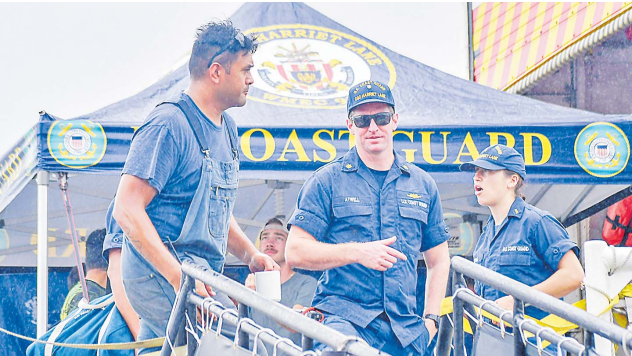
USCGC Harriet Lane Commanding Officer Commander Justin M. Matejka said regular joint operations help strengthen Fiji’s maritime enforcement capabilities while also allowing personnel from both countries to develop the skills and working relationships needed for future missions.
He said conducting exercises together on a frequent basis helps ensure authorities can operate more effectively and seamlessly when opportunities arise to work jointly at sea.
Five to join US vessel for joint patrol
FIVE Fijian officials from the Fiji Navy, police, fisheries and maritime surveillance agencies will join a United States Coast Guard vessel for the joint patrol targeting maritime crimes.
The officials will join the USCGC Harriet Lane when it departs Fiji in the coming days, with the patrol forming part of broader security cooperation between Fiji and the United States.
According to USCGC Harriet Lane Commanding Officer Commander Justin Matejka, the patrol will be conducted under the authority and direction of the embarked Fijian officers, with the United States vessel providing the platform for the operation.
The deployment will also include professional exchanges between US personnel and Fiji’s Maritime Surveillance Rescue Coordination Center, focusing on search and rescue practices, maritime surveillance and maritime domain awareness.
“Where we’ll be sharing and discussing practices in search and rescue and other areas of interest in terms of maritime surveillance and awareness,” Cmdr Matejka said.
“This shared engagement is key to expanding our mutual capacity to confront direct threats, whether they are natural or otherwise, to Fijian sovereignty.”
He said the patrol would target activities including illegal fishing and narcotics trafficking, while helping build a stronger network of regional partners committed to maritime security in the Pacific.
United States Military Group Chief for Fiji Commander Nate Baladad said the patrol was one component of a broader year round partnership between the two countries.
He said cooperation extends beyond joint maritime operations to include maritime domain awareness initiatives, capacitybuilding programs, targeting efforts and infrastructure support.
“There is a newly constructed boat ramp that we partnered with Fiji on to launch and recover small boats,”
Cmdr Baladad said.
“They’re actually conducting training with the small boats that we delivered about a month ago.”
He said the joint patrol and shiprider operations represent an important part of the partnership but are supported by a wider range of ongoing activities designed to strengthen Fiji’s maritime capabilities.

