
“O Bua ga o Verata, o Verata ga o Bua” (Bua is Verata, and Verata is Bua).
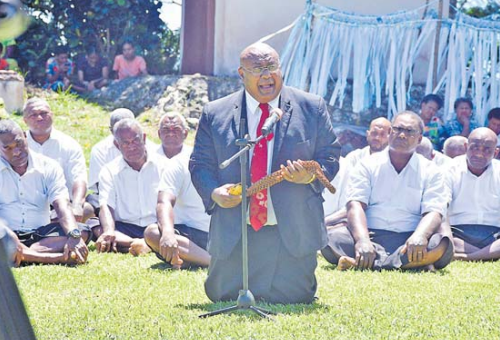
This is a slogan that was on the lips of many that attended the soqo ni cara sala (a traditional ceremony for renewal of familial relationships and rekindling ties) that was held in Ucunivanua Village in Verata, Tailevu, on Friday.
The sacred event marked the homecoming of the descendants of Buatavatava, the grandson of Lutunasobasoba, who was exiled by his father, Ratu Rokomautu, for his resistance to customs and traditions.
A team from The Fiji Times was at the event and spoke to Ratu Isireli Vesikula, who explained the history behind the occasion.
According to Ratu Isireli, Buatavatava was the eldest son of Ratu Rokomautu — the eldest son of Lutunasobasoba — and was also the chief of Verata.
As a child, Buatavatava was sent to Tubalevu Village in Namara to be raised by his uncles, who cared for him and prepared food for him daily.
“As the upbringing continued, Buatavatava grew older and wiser,” Ratu Isireli said.
“He began to notice the elaborate feasts that were being prepared at the great house by his uncles, the guardians and nurturers, to serve him.
“He also began to defy his father’s orders and would question and criticise traditional practices such as the slaughtering of animals for feasting — a tradition highly valued by the land.”
This created tension between him and his father until eventually his father summoned him and instructed that he leave at once, find a place where his father’s name was unknown, and make it his new home.
“The young chief did not say another word.
“He simply asked his father, ‘Which canoe should I take for my journey?”
Ratu Isireli said Buatavatava was given a branch of a ‘bua’ (frangipani) tree and instructed to plant it on the land he would call his home.
He eventually arrived at Cakaunitabua, where he established his chiefly seat, beginning a new chapter for his people.
On Friday, that journey came full circle, and the canoe that once sailed from Verata returned laden with gifts and magiti (food).
Leading the procession was Turaga na Tui Bua Ramakutu Nagagavoka, who is a direct descendent of Buatavatava’s eldest bloodline.
The procession was received at Ucunivanua by Turagalewena o Ratu Ilaitia Dreuvuata, who welcomed them on behalf of the Vanua o Verata.
The day began with a church service before the traditional ceremonies unfolded.
A isevusevu (customary offering) was presented by Mr Nagagavoka, followed by the presentation of a tabua (whale tooth) as a boka in remembrance of their ancestors who have passed on.
This was followed by a series of traditional rituals, including the traditional yaqona ceremony for Mr Nagagavoka and the presentation of a traditional meke (dance) that recounted Buatavatava’s journey back to Verata as his father, Rokomautu, reached old age.
Mr Nagagavoka and the people of Bua then presented their gifts of fine mats, magiti, and the distinctive ibe kuta, symbols of Cakaunitabua.
He also presented 10 whale’s teeth to Ratu Dreuvuata to seek his forgiveness on behalf of Buatavatava — in a traditional ceremony known as matanigasau.
Ratu Dreuvuata accepted the offering, reaffirming that the chiefly bond between the two houses — Verata and Bua — remains strong and unbroken.
Ratu Isireli spoke passionately about the importance of the gathering, saying it was a moment not only for Verata and Bua but for Fiji as a whole.
“We have prepared well.
“There is a lot of work going on in our tikina, and even the women are having their soli. There are several big events we are handling, and at first, we thought only the village – Ucunivanua – would take care of the soqo ni cara sala.
“But then we realised that this is more than just a village event — this is an event for all of Fiji, especially since we are returning from the chiefly province of Lau, where the chiefs, including the Tui Nayau and Tui Lau, were formally installed.
“So, we saw this as an opportunity.”
He said this was an opportune time to renew and strengthen chiefly relationships, “ties that had been lost for a very long time”.
The traditional ceremonies ended well into the afternoon.

