
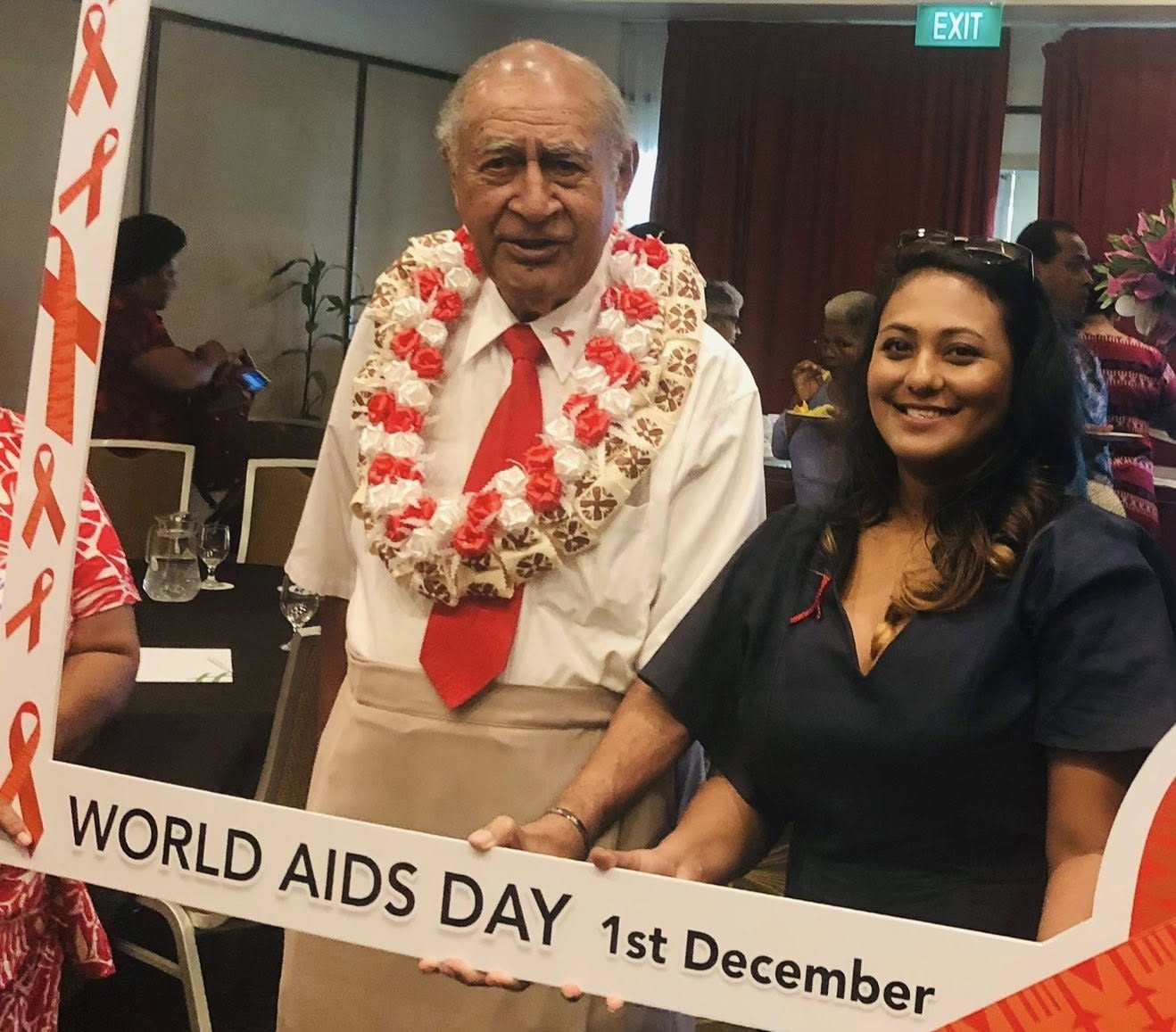
I held off writing or sharing anything about our dear Ratu Epeli Nailatikau, as I needed time.
My entire career with UNAIDS has been centred around him.
This tribute is a collective of reflections from those, past and present, who have been part of the HIV response.
Remembering our dear Ratu.
In the HIV response, we often speak about leadership. But what made Ratu Epeli truly exceptional was not just that he led, it was how he led.
He was present.
Not only in the high-level rooms, not only in moments of ceremony, but in the spaces where it mattered most. With communities. With HIV clinicians, public health professionals, and most importantly, with those living with HIV.
He wore his red ribbon every day.
Not as a symbol for others to see, but as a quiet, constant reminder of his commitment.
It was never performative. It was personal. It was deliberate.
And over time, it became a part of who he was.
He did not simply lend his voice to the cause, he stood within it.
He chose to be close to the work, to the people, to the realities that many would rather keep at a distance.
A UNAIDS colleague once described him as their “secret weapon”, someone who could bring visibility, credibility, and dignity to the HIV response, not only in Fiji, but across our region.
From the Vuda meeting that helped lay the foundation for the Pacific’s regional HIV strategy in the early 2000s to co-leading the Commission on AIDS in the Pacific, he understood, long before many others did, that this was not just a health issue, it was about humanity, dignity, and justice.
He served in multiple roles with UNAIDS, as a Special Representative and later as a Goodwill Ambassador, carrying the message of compassion, inclusion, and responsibility across Fiji and the Pacific.
He also played an important role in shaping Fiji’s HIV response at a legislative level, contributing to the foundations of the HIV Act, where he strongly advocated that HIV treatment should be accessible and free for those who need it.
He supported the lifting of HIV-related travel restrictions in Fiji, reinforcing that people living with HIV should never be defined or limited by their status.
These were not just policy positions, they were reflections of his values.
And today, as we respond to a more complex phase of the HIV epidemic, we stand on those foundations.
Without them, we would have faced a far more difficult path and risked losing many more lives.
And at a time when stigma was high, he made a simple but powerful choice to stand publicly, shoulder to shoulder, with people living with HIV.
That image, carried in the newspapers, did more than any speech ever could. It told a nation that there is nothing to fear in compassion.
He embraced the full spectrum of our communities, the whole rainbow of people.
Whether it was standing alongside advocates, engaging with sex worker communities, or showing up at events many in his position may have avoided, he signalled clearly and without hesitation that you belong.
I want to share one story that has stayed with me.
A PLHIV advocate told me how he came to visit her at an antenatal clinic when she was expecting her first child, not out of obligation, but simply to check in, to ensure that everything possible was being done to keep her baby safe from HIV.
And he returned again for her second child.
That level of care, that level of presence, is something you cannot teach. It comes from who you are.
Across all the stories shared, what stands out most is not just what he did, but how he made people feel.
He walked into HIV clinics unannounced, not for recognition, but simply to check in, to encourage, and to remind both staff and patients that they were not alone.
If he heard that HIV medication supplies were running low, he would personally go to the medical supplies at FPBS in Vatuwaqa to follow up. And you can imagine what he had to say.
He sat in technical discussions, in guideline reviews, spaces far removed from ceremony, because he understood that real impact is built in those details.
And sometimes, it was in the promises he quietly kept.
After a brief conversation at an international conference, he told a group that works with sex workers he would visit them.
No fanfare. No guarantees.
And two years later, he did.
That was the kind of man he was.
He often said, when asked what we should do when someone we know is diagnosed with HIV. In his words, he would say, “embrace them. Rally around them. Do not leave them out in the cold, that is the worst thing we can do.”
Even in times when HIV numbers were low, he would remind us never to become complacent, to always keep our eye on the ball.
He was also very proud of his visits to schools across Fiji during his Presidency, speaking directly to young people about HIV, ensuring that the next generation had the knowledge, awareness, and confidence to protect themselves and others.
And in his own way, he made sure the message was never forgotten, often carrying both a female and male condom in his pocket, which he would bring out even during speeches at international events that were not about HIV.
As a UNAIDS Goodwill Ambassador, he carried this commitment beyond Fiji, across the Pacific and beyond, speaking with honesty and conviction to leaders about inclusion, dignity, and leaving no one behind.
He used his voice, and his standing, not to avoid difficult conversations, but to step directly into them.
For me, this is also deeply personal.
As a young person new in my role, navigating the weight and responsibility of this work, he was my strength and my pillar.
Before his days as Speaker, he would visit me weekly. And even when he took on one of the highest offices in the land, he still made time to check in.
He was someone I could turn to for advice, for direction, and for reassurance.
I admired him deeply. I valued him immensely.
And I know how incredibly blessed I am to have worked alongside him.
And yet, for all his titles and achievements, when we would go around the room in meetings and introduce ourselves, he would simply say, “Epeli Nailatikau, Villager.”
That humility stayed with me.
And of course, many of us will remember that he had a way of quietly disappearing.
When he was Fiji’s President, here in Suva, he was known for slipping away from his security detail.
And I experienced this myself when I was meant to be his chaperone at a conference in Europe.
I went looking for him, and after what felt like 19,000 steps in heels, I still could not find him.
Later, he told me very calmly, “When I want to be found, I just stay in one place.”
And somehow, he was right.
What struck me most was that the man we knew here in Fiji was exactly the same man the world saw.
At the International AIDS Conference in Amsterdam, I would proudly introduce him to people only to realise they already knew him.
Young activists. Community leaders. Heads of State.
In Fijian, we would say, pote.
He carried Fiji with him, with humility and dignity, wherever he went.
In a world where it is easy to lead from a distance, Ratu Epeli chose something different.
He chose to be close.
He chose to care.
He chose people.
And in doing so, he made Fiji, and our Pacific region, a safer, kinder, and more compassionate place for so many.
His legacy will live on not only in institutions or in history, but in the lives he touched, the barriers he broke, and the dignity he gave to others.
Vinaka vakalevu, Dhanya vaad, Faieksea, Thank you Ratu.
May we carry forward your example, with the same courage, the same humility, and the same unwavering commitment to humanity.

