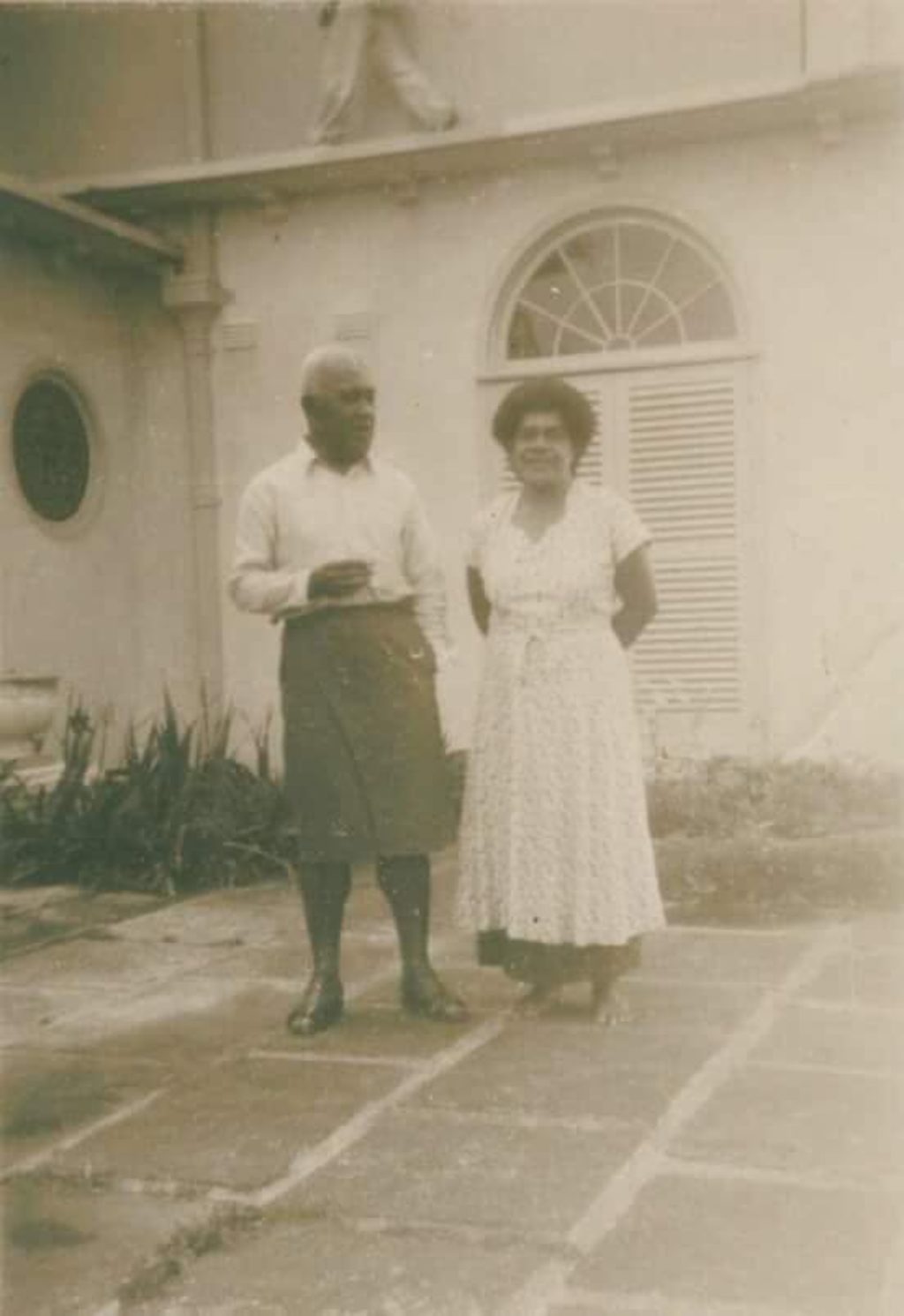
The biography does little to situate Ratu Sukuna’s protectionist policies in the context of the broader colonial development strategies.
Through Ratu Sukuna’s reform of the Fijian administration in 1940, the paternalistic communal control of the iTaukei was strengthened further and more deeply entrenched under the tutelage of chiefly hegemony.
At one level, it was a system of social control and at another, according to Nayacakalou, it was: a system empowered by law to organise some of the activities of the Fijian people for their own social, economic and political development as well as for the preservation of their traditional way of life (1975:85).
Although Ratu Sukuna saw it as a means of creating a more ‘autonomous’ governance system for the ITaukei and simultaneously weakening direct British control, the latent impact on the iTaukei collective psyche was nevertheless that of gullible dependency on colonial institutions such as the Great Council of Chiefs, Fijian Affairs Board and Native Land Trust Board, on which Ratu Sukuna had considerable influence.
The amplification of indirect rule through reform bolstered Ratu Sukuna’s hegemonic clout further as the undisputed ITaukei voice.
The reification of the colonial institutions above had long-lasting impact on iTaukei self-perception. Originally inspired by Sir Arthur Gordon’s social Darwinian orthodoxy of a dying culture that needed to be saved, the iTaukei were for paternalistic reasons cocooned further into a rigid subsistence life with little opening for social mobility, whether it be in commerce, education or professional life.
Although there were semicommercial ventures that Ratu Sukuna encouraged, these operated within the ambit of communalism under the tutelage of chiefs who held supervisory positions as development officers (Ratuva 2013).
Some of these ventures included the setting up of the cooperative movement (Soqosoqo Cokovata ni Veivoli) under the Co-operative Ordinance of 1947; the Fijian Banana Venture in 1950; the Fijian Development Fund (Lavo Musuki in Veivakatorocaketaki) by Ordinance No. 14 of 1951; the creation of economic development officer positions in 1954 (following the incorporation of economic development agenda into the Fijian administration); and more rigid control of the galala (independent farming) system (Spate 1959).
Moreover, although he did not have any training in development the same way as Ratu Mara (who studied at the London School of Economics after Oxford), he was still keen on grassroots socioeconomic development, even if his ideas on this were rudimentary: the village community, more especially the large village community, being of native growth and an attempt to solve the local problems of life in its own way, is the most natural, the most convenient and cheapest unit of administration … The village system has failed economically not from any inherent weakness nor from maladministration. It has failed to improve materially the life of the people because of the lack of markets for its crops (Scarr 1980:140).
Education was only available to selected chiefs like Sukuna in the beginning, and to other chiefs later, while the majority of the iTaukei were deprived of western education and were expected to be loyally subservient to the whims of the colonial and traditional masters.
While Ratu Sukuna encouraged technical training for basic skills like carpentry, he was weary of those with higher educational qualification and warned against the potentially subversive influence of the commoner intelligentsia who would be bent on ‘undermining and confusing authority to their own ends’ (Scarr 1980:146).
Commoner scholars such as Ravuama Vunivalu and later Dr Rusiate Nayacakalou did not get any government support and had to rely on private sponsorship by Morris Hedstroms for overseas university training.
Rather than nurturing iTaukei potential for economic advancement and self-empowerment, the incubation and domesticating strategy by Ratu Sukuna undermined their social mobility at a time when other ethnic groups were making headway into commerce, education and professional positions.
Subsequently, when the rigid system of control was lifted and opportunities began to open up after the 1960s reform recommended by Nayacakalou, the iTaukeis found themselves lagging behind other ethnic groups in the areas of commerce, education and professional achievement.
This bred grievances that were later articulated in more open ethnonationalist expressions and violence. Near desperate affirmative action measures were put in place to address some of the more overt manifestations of ethnic disparity but with mixed success (Ratuva 2013).
One of the forgotten ironies of Ratu Sukuna’s legacies was that his great visions and policies to ‘protect’ the iTaukei had the effect of disempowering and undermining their potential for progress.
The responsibility was left with Ratu Sir Kamisese Mara, whom Ratu Sukuna groomed as successor, to disentangle and address the multidimensional socioeconomic and sociopolitical problems nurtured under the Sukuna reign.
The obsession with the mythical character of Ratu Sukuna has blinded us from seeing the implications of his social reforms and policies.
While it is unfair to blame Ratu Sukuna for later problems, the circumstances at the time, often invoked by fear of perceived Indo-Fijian political threat and compounded by the British paternalistic colonial designs of making natives politically and culturally submissive, may have provided impetus to his protectionist vision.
Nevertheless, rather than emancipating the iTaukei from the excesses of colonial domestication, Ratu Sukuna’s ideas and policies simply reinforced colonial hegemony.
Colonial Fiji was an apartheid-type colonial state with Jim Crow–type laws that kept non-whites away from public spaces such as swimming pools, private clubs and other European-designated places; fraternization with ‘natives’ was a social sin to be avoided.
Ratu Sukuna was no Gandhi to fight off the scourge of colonialism nor a Martin Luther King to clamour for civil rights; he was intent on assimilating the iTaukei into the British legal and political regime while making himself their dominant voice within the rubric of the colonial political paradigm.
This was reflected in his scorn for democratic elections and preference for the system of nomination of iTaukei representatives for legislative council membership. Unlike the fully fledged democratic election that the Indo-Fijians had demanded and achieved by 1931, the system of nomination acted as a social control mechanism that ensured that no iTaukei with unwanted political beliefs would emerge and thus pose potential threat to Sukuna’s dominance.
Scarr observed that in the legislative council: when Indian members formally pressed for political equality between three races, Ratu Sukuna, again claiming to speak for all Fijians, had emphasised that they felt they were well-treated under the present regime, and said they looked for the next two, three, even four generations to European leadership. He had no wish to see the communal division broken down, as Indian politicians claimed to want, though he would happily eat curry with anyone (1980:110).
In Sukuna’s own words: We have come to the parting of ways and looking ahead in the light not only of our own interests but also of those to whom we handed over this country, we choose, with the full support of native conservative and liberal opinion, the system of nomination believing that along this road and along it alone, the principal of trusteeship for the Fijian race can be preserved and the paramountcy of native interests secured (Fiji Legislative Council 1935).
Sukuna had virtually uncontested control over the iTaukei voice, iTaukei aspiration and iTaukei vision for the future. He favoured slow reforms and was always wary of iTaukei nationalists whose ideologies ran counter to the dominant chiefly discourse of respectful and subservient engagement with the colonialists (see Norton 2013).
The denial of democratic rights by the colonial state and Ratu Sukuna had profound implications on ITaukei future attitudes towards democracy in the context of Fiji’s changing multiethnic society. Even after universal suffrage, which allowed ITaukeis to vote for the first time in 1965, there was still a perception that Fiji’s democratic system was only legitimate as long as it continued to serve the political aphorism of ‘paramountcy of ITaukei interest’.
Although this view continued to be contested and evolved incessantly over the years, the suspicion of democracy being against ITaukei interest prevailed in various degrees, as manifested publicly during the 1987 and 2000 ethnonationalist coups.
Furthermore, as Scarr suggested, Ratu Sukuna was not too keen on multiculturalism, perhaps a learnt behaviour from the British, and saw intercultural engagement in simplistic terms such as eating curry together with Indo-Fijians. This is despite the fact that he had Indo-Fijian friends such as Gujarati lawyer S. B. Patel, who had once worked with Mahatma Gandhi before migrating to Fiji where he became a significant player in politics.
Ratu Sukuna’s position relating to other ethnic groups may have also influenced ordinary ITaukeis he came into contact with and possibly inspired some ethnonationalist feelings over the years in explicit or subtle ways.
However, there were other forces shaping the lives of the ITaukei and many pursued their daily lives with minimal influence by Ratu Sukuna. Amongst these were the emerging ITaukei proletariat, such as the unionised dockworkers and mineworkers, whose bread-and-butter concerns and loyalty to their class interests outweighed Ratu Sukuna’s cultural and political appeal.
- STEVEN RATUVA is a distinguished Professor, author, an award-winning political sociologist and global interdisciplinary scholar. This article was sourced from: Ratuva, S. 2017. Man vs Myth: The Life and Times of Ratu Sukuna. Fijian Studies: A Journal of Contemporary Fiji 13:3–15. Republished with the kind permission of the Fiji Institute of Applied Studies.Note from the author: I took leave from the University of the South Pacific (USP) in 2002–03 to take up a fellowship position in the State, Society and Governance in Melanesia program (now the Department of Pacific Affairs) at The Australian National University (ANU). I returned to USP to join the Pacific Institute of Advanced Studies in Development and Governance. Since then, and even after leaving USP for New Zealand, I have maintained a close relationship with ANU.