
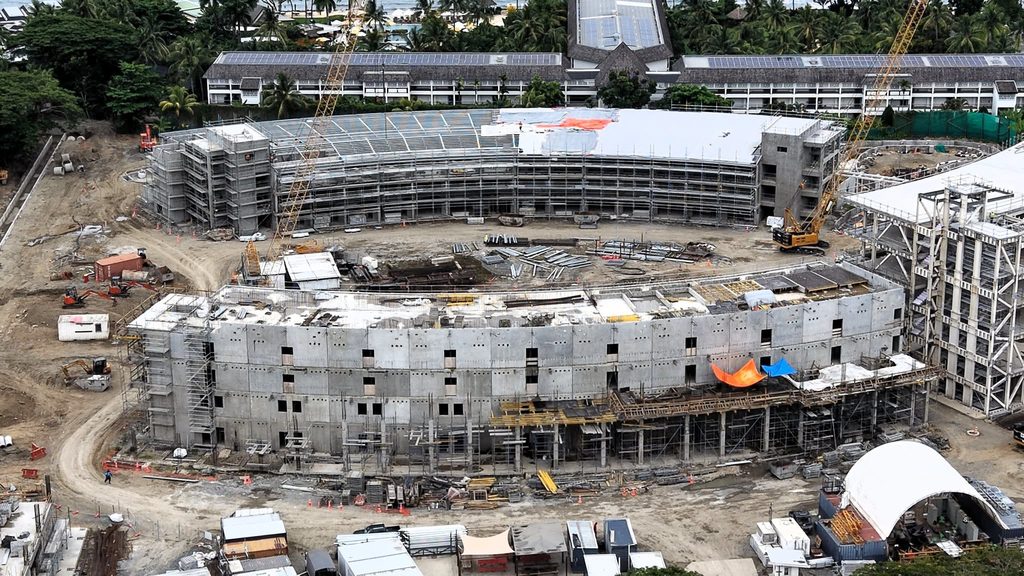
Fiji’s tourism industry is in the middle of one of the most ambitious accommodation expansions this country has seen in years – which might be a good problem to have. Government has set a target of roughly 4000 additional hotel rooms to support a goal of 1.25 million visitors and four billion dollars in tourism earnings by 2027, with the tourism minister pointing to accommodation capacity as the constraint that must grow to support rising demand.
Ambition of that kind should be welcomed, and I say that as someone who represents an industry that has spent years arguing that Fiji’s growth potential exceeds its current bed stock. But ambition on its own does not build a hotel or fill it with skilled staff and visitors hungry for local experiences. It is important, therefore, to discuss just how we’re actually tracking against that target, and on the one issue that continues to determine whether these numbers translate into rooms on the ground rather than plans, or half-finished construction sites, sitting idle for months and sometimes years.
Delivered supply between 2025 – 2027 will amount to 1800 rooms in total – from eight rooms in the North to the eventual opening of The Westin’s 246 rooms and 27 suites along with the Vatu Talei (127 rooms and 48 suites) in Denarau, The Sebel Nukuloa’s 76 rooms in Wailoaloa (slated to open this year), and the Radisson Mirage in Naisoso – all reflecting real confidence from operators and developers willing to commit capital to this market. Once construction is confirmed for at least another five small to medium resorts in 2027, we can expect a steady, but realistic increase in room inventory by 2030 of approximately 500 a year. If we’re lucky, that might translate to around 3300 rooms. By 2030.
That’s our honest, but basic math calculations, because we believe our infrastructure and supply networks deserve straight numbers rather than a rounded-up sense of progress. Governments’ own recently announced tourism construction progress figures, which should be the cleanest yardstick available, showed sixteen projects under construction as of June 2025, expected to deliver just over 2200 additional rooms against that stated need of around 4000 by 2027. That means, on Government’s own accounting, roughly 2200 of the 4000 rooms needed were in construction as of the middle of last year, leaving a gap of about 1800 rooms still to be committed and built. While that is a meaningful contribution to the 2200 under construction, it is nowhere near the full 4000 required, and the Westin situation is a live reminder that even projects already counted in that 2200 figure are not guaranteed to land on schedule.
The remainder is presumably spread across the balance of what Government has described as a fifty-three-project pipeline worth around three billion dollars, most of which have not had individual room counts confirmed in public reporting. And we have not seen a published running tracker of rooms delivered against rooms needed, so any percentage figure attached to this progress is our own calculation from the numbers available, not an official statistic, and should be read with that caveat in mind.
None of this is a criticism of the ambition itself. It is simply a reminder that the gap between a stated target and delivered rooms is still wide, and that the projects in between a groundbreaking ceremony and an opening night are where the real story of this expansion actually sits.
Investment Fiji’s own account of the investment climate supports what our members tell us constantly. Fiji has shifted its investment policy toward a more facilitative approach, with a new facilitation committee and digital tools aimed at improving transparency and reducing bureaucracy, and Investment Fiji reports it managed 522 projects worth $F8.7 billion over the past three years.
Of the 212 investment projects currently active, valued at approximately $6.2b, only six are under construction, while 73 sit in pre-development and 53 remain in the planning phase. That is a genuinely strong pipeline of stated interest. It is also a pipeline where the overwhelming majority of projects have not yet moved past planning into anything resembling a foundation being poured.
Government’s own investment climate reporting has for years acknowledged this same pattern, describing general difficulty establishing businesses and implementing large investments as a considerable risk to growth, alongside a welcoming policy environment that nonetheless leaves investors facing lengthy and costly bureaucratic delays before anything gets built.
Such tension requires Government’s frank recognition and a commitment to address it openly. Investment Fiji can say correctly that interest in Fiji as a tourism investment destination is strong. The Ministry of Tourism can say correctly that 4000 rooms are needed and that incentives and infrastructure upgrades are being put in place to attract that capital.
Both of those things can be true, and both are being said with good intention. But an investor does not experience Government as a single, coordinated voice. They experience it as a series of separate desks, each operating under its own timeline, its own interpretation of the rules, and often with limited visibility and even less care into what the desk next door is doing. One ministry can be actively courting an investor with talk of streamlined approvals and a facilitative new posture, while a completely separate arm of the civil service sits on that same investor’s paperwork for months, working through a process that has not caught up with the message being sold at the front door.
It is the exact experience FHTA hears about repeatedly, from operators who have expressed genuine interest in opening a hotel or extending an existing one and have found themselves stuck navigating exactly this kind of internal disconnect.
This is why Ease of Doing Business remains one of the things we consistently fight hardest for, and what that actually means is not asking for shortcuts or for paperwork to disappear (this happens without our input). Proper documentation should still be filled out and filed correctly, and due diligence should still be done properly.
What we are asking for is that it should not sit on someone’s desk for months gathering dust while an investor waits, follows up, waits again, and eventually loses interest in Fiji altogether and takes their capital somewhere with a faster answer. We say smoother deliberately, not easier. Those are two different things that Government understands the difference between too, even if the machinery does not always reflect it yet.
So here is where we eventually land. I am genuinely optimistic about what this room expansion could mean for Fiji’s tourism sector, and the openings already delivered over the past three years prove this is not just talk.
But optimism has to be matched with internal coordination that investors can actually feel, not just hear about in a conference address, and with honest reporting when projects hit real difficulty along the way.
If Government’s target of 4000 rooms is going to translate into 4000 rooms rather than a headline figure that quietly slips past 2027, the right hand and the left hand of the civil service need to know what each other is doing and be held accountable.
An investor’s file needs to move through that system with the same energy that goes into announcing the target in the first place. That is not too much to ask of a country that already knows, better than most in this region, exactly how much tourism is worth to it.
n FANTASHA LOCKINGTON is the CEO of the Fiji Hotel and Tourism Association. The views expressed are not necessarily those of The Fiji Times. To share a comment or thoughts on the article, please send an email to info@fhta.com.fj

