
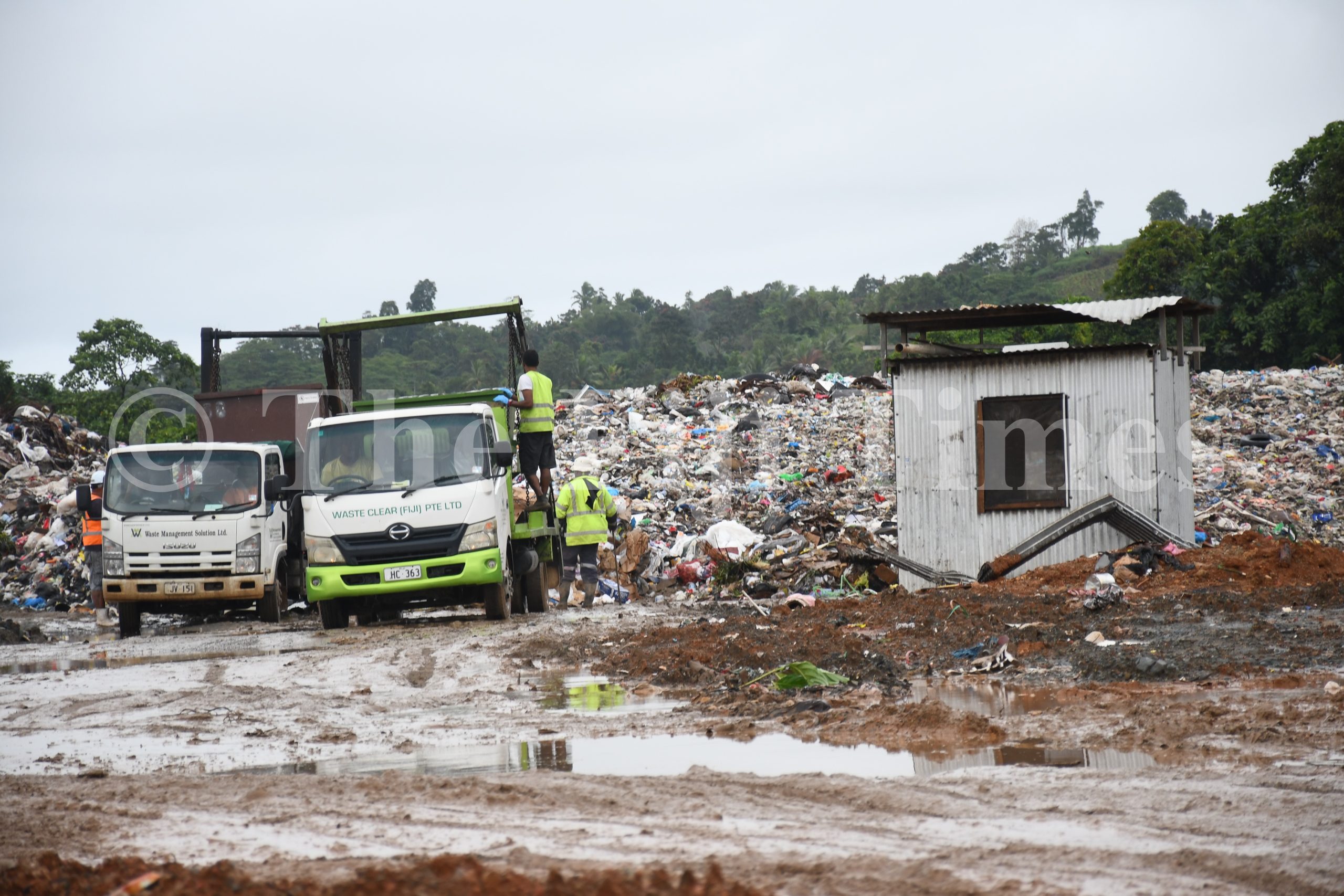
Torrential rain is leading to increased methane gas emissions from the Naboro landfill.
However, Mark Hirst-Tuilau, the landfill manager, assured that the landfill itself is not currently causing significant environmental impacts.
In an interview with this newspaper, Mr Hirst-Tuilau explained that once waste enters the landfill, “nothing lives”, and the primary by-product is leachate, which is liquid produced as organic waste decomposes.
He emphasised that the facility effectively manages this leachate through an aerobic digestive system.
“We treat it through an aerobic digestive system, and then by the time it goes out to the wetlands and then out into the creek, then the quality of the leachate is well within any environmental limits that we have,” Mr Hirst said.
“So that’s not an issue for us.
“Our biggest issue out there would be rainfall because of the serious amount of rain we get.”
He explained that the accumulation of rainwater is contributing to gas production, a situation exacerbated by the landfill’s long history of operation, now spanning about 20 years.
To address the methane emissions, Mr Hirst noted that plans are in place to implement a gas trapping system.
“There is a project coming up very soon where we will trap that gas and then we’ll flare it off because obviously it’s methane, not good for the environment, but we’ll trap it, flare it, turn it into CO2, then measure the quality and quantity of the gas and maybe turn it into a waste-to-energy system after that.”
He said the landfill was originally designed for a lifespan of 50 years, with a targeted density ratio of 800 kilograms per cubic meter.
Presently, the landfill is achieving densities of 1.3 to 1.4 tonnes per cubic metre, effectively doubling its capacity.
“So by doing that, we’re extending the life of the landfill by almost twice.
“You can understand that. So instead of being 50 years, we reckon it’ll be close to 100 years.”

