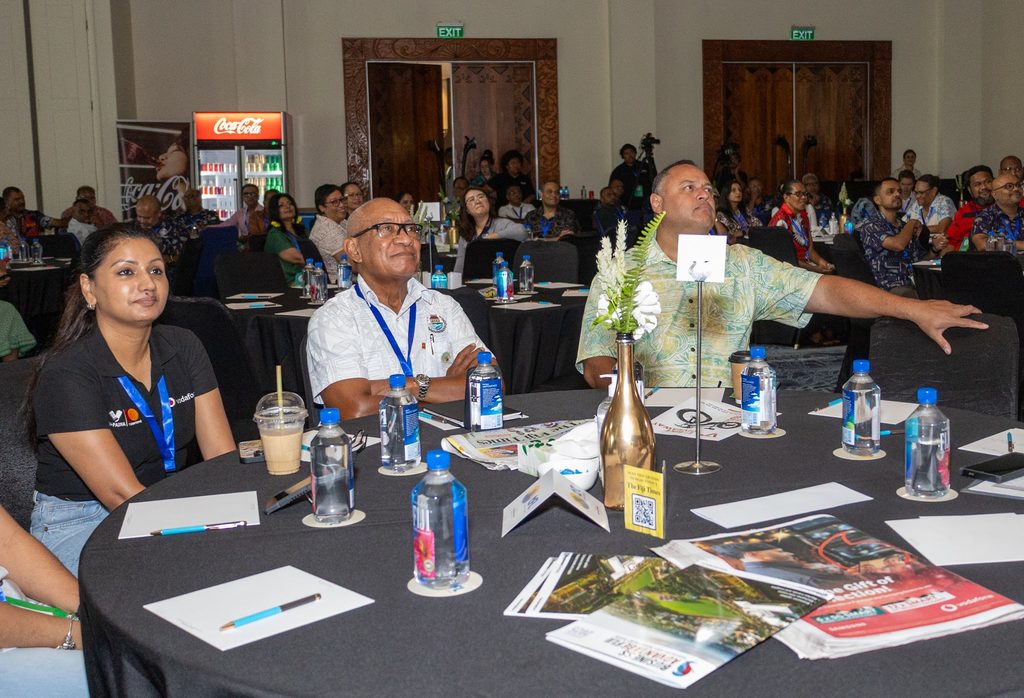
TOPEX has never been intended as a conference where difficult issues are raised, discussed and then left in the room.
The Fiji Commerce & Employers Federation is intentional in planning its flagship event, the Top Executive Conference. The issues selected for discussion reflect the experiences of businesses, FCEF’s advocacy priorities and the wider economic environment.
The outcomes help shape FCEF’s workplan. Where practical solutions emerge, the Federation continues the work through its Councils, working committees, policy submissions and engagement with Government, regulators and development partners.
With TOPEX 2026 now just over a week away, the carefully curated programme is finalised. Here is a preview of the important conversations that will take place.
Building forward
TOPEX 2026 will be officially opened by Chief Guest, Prime Minister Sitiveni Rabuka.
This will set the foundation for a programme focused on improving Fiji’s economic position by strengthening the environment in which businesses operate.
Under the theme ‘Building Forward: Capitalising on Opportunity, Partnering for Growth’, the program brings together experienced business leaders, technical specialists, policymakers and international speakers.
Their role is not simply to deliver presentations. They will challenge assumptions, share practical experience and contribute to discussions on the decisions Fiji must make to improve investment, productivity, employment and growth.
Session 1 – Keynote: Leading through uncertainty
The first session will examine the role of leadership in uncertain conditions.
Keynote speaker Bruce Sullivan, Leadership and Culture Development Specialist will explore how leaders can remain energised, lead confidently and identify opportunities while managing the immediate demands of their organisations.
Session 2: The 5 per cent challenge: How does Fiji accelerate growth?
The program will then turn to Fiji’s economic outlook.
Fiji’s transition towards a higher-income economy requires annual economic growth of approximately 5 per cent.
However, the Asian Development Bank has revised Fiji’s projected growth to 2.2 per cent in 2026 and 1.9 per cent in 2027.
Jonathan Pryke, Principal Operations Specialist with the Asian Development Bank, will examine the major economic headwinds and what businesses and Government can do to strengthen competitiveness and resilience.
Session 3: Trading up: Building Fiji’s export competitiveness
The third session will focus on trade.
In 2025, Fiji recorded exports of $2.53 billion against imports of $7.38bn, resulting in a trade deficit of $4.85bn.
Former permanent secretary and Chief Trade Negotiator Shaheen Ali will join FCEF board director Vinay Narsey to examine how Fiji can expand exports, enter new markets and gain greater value from its trade relationships.
The discussion will also consider how Fiji can strengthen domestic production and protect employment while remaining open to competition and regional trade.
Trade arrangements should ultimately help Fiji produce and export more, attract investment and increase the participation of Fijian businesses in regional and international markets.
Session 4: Doing more with the people we keep: AI, productivity, and the cost of doing business in Fiji
The fourth session will examine how artificial intelligence can help organisations improve productivity and make better use of limited workforce capacity.
Chitra Andy Rajan, ANZ Small and Medium Business Lead at Microsoft, will present a practical approach to identifying costly workflows, introducing appropriate governance, training employees and measuring results.
This will be followed by Session 5: The Boardroom Blitz, a fast-paced session requiring participants to make and defend difficult choices involving technology, investment, talent, productivity and Fiji’s future.
The intention is to move leaders beyond familiar answers and encourage clearer thinking about the decisions confronting their organisations and the economy.
Session 6: Turning Fiji’s economic potential into growth
Session six ends day two of the event, bringing together permanent secretary for Finance Shiri Goundar, Nama Fiji director and owner Debra Sadranu and R.C. Manubhai chief executive officer Dr Uppiliappan Gopalan.
Their discussion will focus on where Fiji’s next wave of economic growth can come from and how investment opportunities can be translated into increased production, stronger local industries, exports and sustainable employment.
It will also examine the conditions businesses need to scale and how stronger collaboration can turn economic potential into measurable results.
Session 7: Wages and employment: From legislation to practice
The third day will begin with the practical implications of changes to employment legislation once the Employment Relations Act (2025) has been passed. The national minimum-wage review and calls for an $8-an-hour living wage.
Employment lawyer Jon Apted will examine how these developments may affect current and future business operations.
FCEF supports fair wages and decent work. These outcomes must be supported by credible wage-setting processes, improved productivity and the ability of businesses to remain operational and continue employing people.
The program will return to productivity in its final panel. Representatives from the National Training and Productivity Centre and the private sector will examine progress towards the National Productivity Master Plan’s target of average annual productivity growth of 3.2 per cent and the realities businesses face when trying to increase output.
Session 8: Removing the roadblocks: Making Fiji attractive for business
TOPEX will also place Fiji’s business environment under examination.
According to the World Bank’s 2025–2026 Enterprise Survey, businesses in Fiji take an average of 114 days to obtain construction-related permits and 31 days to secure operating licences. Senior management spends an estimated 10.4 per cent of its time dealing with government regulatory requirements.
Deputy Prime Minister Manoa Kamikamica will participate in a discussion on the reforms underway and the priorities needed to make Fiji more attractive for business.
A further panel involving senior officials responsible for employment, commerce and local government will examine how policy translates into practice and where approvals, compliance requirements and service delivery can be improved.
Bringing Government and business representatives together allows both sides to better understand the constraints they face and identify workable solutions.
Session 9: Scaling success: Learning from Fiji’s business leaders
TOPEX will also draw on the experiences of business leaders who have built, expanded and sustained successful enterprises over the years, despite challenges.
Narend Narayan of Innovative Circuits Engineering in the United States, Warwick Hotels and Resorts founder Richard Chiu, and Rise Beyond the Reef co-founder and executive director Janet Lotawa will discuss investment, exports, international markets and the conditions businesses need to scale.
San Carlos mayor Pranita Venkatesh will close the conference by bringing an international and diaspora perspective to leadership, partnerships and Fiji’s connection to global opportunities.
The work after TOPEX
FCEF uses the issues, recommendations and possible solutions raised during the event to inform its workplan and advocacy.
Some outcomes require further research. Others may lead to policy submissions, working committees, direct engagement or continued collaboration with Government and relevant agencies.
That is why TOPEX remains an important part of FCEF’s work to strengthen Fiji’s private sector and improve the country’s economic position.