
No matter how far the Girmitiyas were from their homeland of India or how brutally oppressed they became under the indenture system, they never abandoned their deeply held religious beliefs and cultural practices.
Their struggles and pains only emboldened them to persevere and ensure the continuity and survival of their future generations.
The Sunday Times team travelled up the dusty Sawani-Serea Rd to the village of Serea in the heartland of the lush and green Naitasiri province to visit a location on the outskirts of the village that was once the site of a Hindu temple built by Girmitiyas who had settled there in the 1900s.
We also had the opportunity to speak to Sarojni Devi, who is a descendant of those early settlers. She continues to live and breathe on the land her ancestors toiled and cultivated and considers herself a proud woman of Serea.
The team presented a sevusevu to seek permission from traditional landowner and chief, Na Gone Turaga na i Taukei Waimaro, Ratu Viliame Rarogaca Ravuilagi, who accepted our request and agreed to personally accompany us to the site of the temple ruins and the home of Ms Devi.
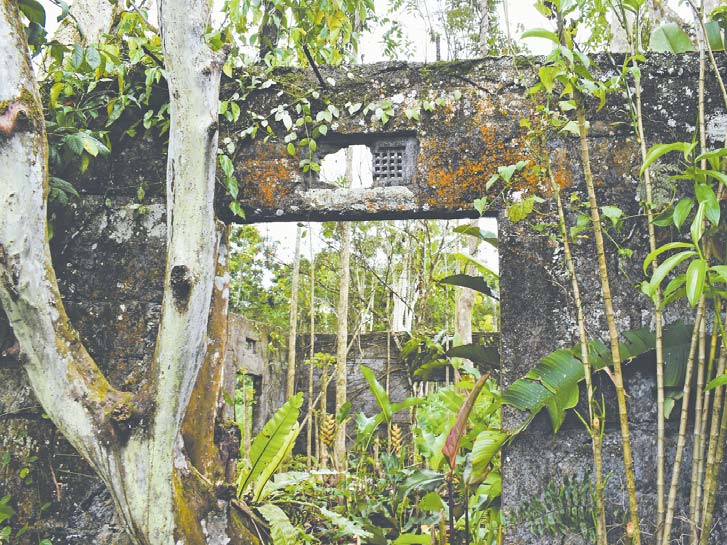
Approximately 500 metres from the village of Serea, located along the boundary of a flourishing dalo farm owned by Raynil Kumar known fondly by villagers as Mosese or Moji, are the remains of a modest Hindu temple.
According to the people of Serea, was built to be the central place of worship of Girmitiyas who had made their way to Serea from Kiuva in Tailevu.
The Taukei Waimaro, Ratu Viliame Ravuilagi revealed said the temple was possibly one of the oldest structures in Serea.
“When I was born, which was a long time ago, the temple was already here, and I remember clearly how it used to be a place the Indo-Fijians at the time would gather and worship,” Ratu Viliame said.
“There was always a strong sense of community and togetherness among them and the temple became a central place where they would come together, preserve and respect their traditional and religious customs.”
We parked our vehicle by the main road and after a short 15-minute walk through thick shrubs and vegetation, we reached the temple site.
I could help but feel a sense of mysticism after walking through the remains of the shrine.
It sits right in the middle of a valley, surrounded by mountains. Standing next to the structure, I could see why it was chosen to be the gathering place to give thanks and pay homage for the gifts of nature and community.
“However, as our Indo-Fijian brothers and sisters in the area began to build their own homes and personal shrines in their individual compound, they no longer gathered at the temple, and gradually it descended into the state it is in now. They would worship in their own spaces and continue to do so today,” Ratu Viliame said.
A staunch Hindu devotee who continues to live in Serea to this day resides only a short walking distance from the temple ruins. Sarojni Devi is originally from Naitata, Navua, but now a proud woman of Serea who enjoys life in the Naitasiri highlands and is content with its slow-paced but abundant way of life.
It is believed the temple was built by a European settler in Serea known by locals as “Misi Vilive” (Messrs Philip) who recognised the need for his Indian workers to continue to practice their religious and cultural traditions.
In its glory days, the temple would have been the melting pot of Hindu farmers within Serea territory who gathered there for their periodic religious worship and choral service. This demonstrates the importance of religion in creating mental and social structures, by influencing the way people perceive the world, inculcate values and provide sense of belonging.
Today, the concrete structure lies in the shadow of its former self, smothered by thickets and shrubs, from wild plants of the ginger family to towering African tulips.
Sarojni or Tinai Vaseva, the name she is affectionately known by to the people of Serea, first settled down there after she married the love of her life, a dairy farmer named Shiu Narayan.
Tinai Vaseva was born in 1947 and spent her formative years growing up in Naitata, Navua. In 1968, she married Shiu, who was originally from Vunidawa in Tailevu but had settled down in Serea with his parents and tended to a farm. Together they have five children.
The 78-year-old spoke in iTaukei and reflected on the struggles the Girmitiyas faced. She did not mince her words as she spoke openly about how her forefathers were deceived into boarding ships from British India, endured a harrowing oceanic journey for three months in cramped and squalid conditions, and then faced the full brunt of colonial brutality as they toiled on farms across a country that was virtually unknown to them.
While some returned to India after indenture, the majority stayed behind and have become part of the social fabric of Fiji, contributing to our development and progress.
“All in all, for those of us who have made a life here living among the indigenous Fijians, we are extremely grateful for the love and acceptance we have received over the years. Up here in Naitasiri, even though we are two races, we are one people,” she said.
Tinai Vaseva shared that because of Serea’s remoteness, her family’s main source of income and sustenance was farming, especially dairy.
“My husband, Shiu, was heavily involved in the dairy industry. In 1972, he won a tender and secured a 100-acre piece of land in Naisole, he bought a few cows and started his dairy business.”
“We would supply about 90 to 100 litres of milk a day back then, 50 to 60 litres in the morning and 30 to 40 litres in the afternoon. This would earn us about $500 which was quite a lot of money back then,” she said.
Substantial earnings enabled the couple to expand and renovate their home, expand their farm, and put their children through school.
Shiu passed away in 1987, but Tinai Vaseva continued running her husband’s dairy farm with the help of iTaukei landowners, who assisted her by taking care of the more labour-intensive farm work and caring for the livestock.
Eventually, her eldest son, Janen Narayan left school at form five (Year 11) to take care of the family’s dairy farm and look after her.
Tinai Vaseva revealed that her younger son, Ritesh now runs a grocery shop in Serea. Her eldest daughter is also a shopkeeper in Vunidawa, another has migrated and now lives in Canada, while her youngest daughter now lives with her.
The Serea woman continues to honour her late husband’s memory by looking after their home and farm.
“The natives of Serea are my blood as well, despite the turbulent times Fiji has gone through they have kept me safe and treated me as one of their own.”
“I love Serea. This is my home, there is no other place I would rather be. This place has sustained me and my family for generations and will continue to do so until I am no more,” she said with a smile.
History being the subject it is, a group’s version of events may not be the same as that held by another group. When publishing one account, it is not our intention to cause division or to disrespect other oral traditions. Those with a different version can contact us so we can publish your account of history too — Editor.

