
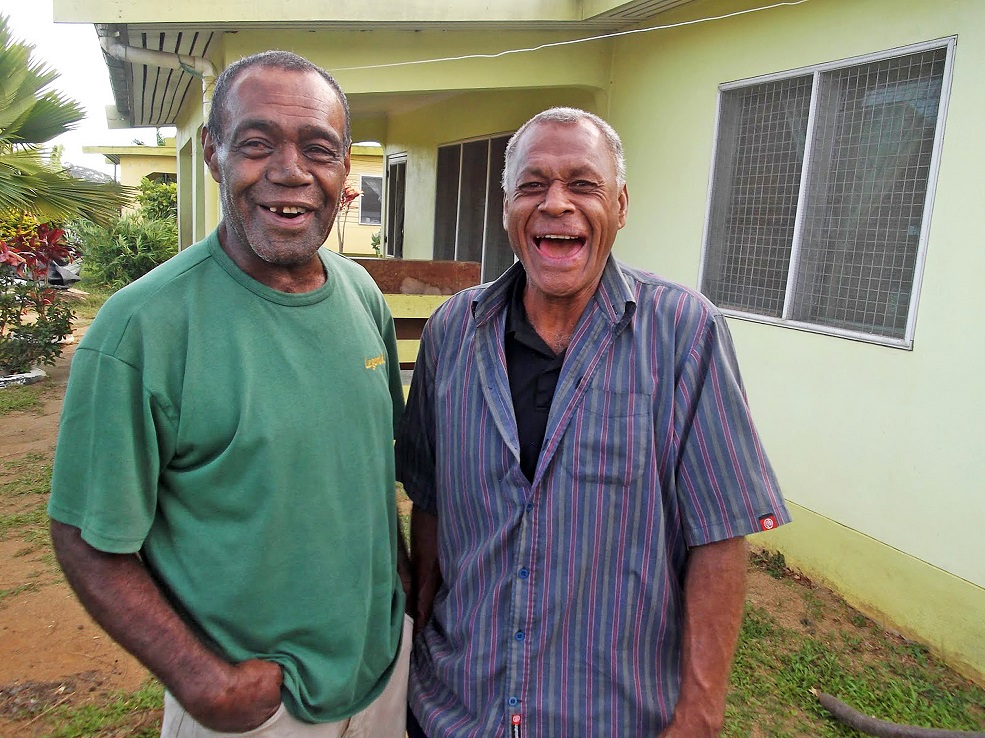
In these modern times with the widespread use of the internet and social media, young boys or girls with sports skills have many opportunities to catch the eye of talent scouts.
But wind the clock back 40 or 50 years, things were very different. To get noticed, you had to make an impact at every outing and all the time.
Your prowess on the sports field had to become the stuff of legends. Word of mouth plus a story or two in The Fiji Times and an action picture often went a long way towards creating many of the sports legends of the ‘60s, ‘70s and ‘80s.
However, things were even more of a challenge if the person in question was not even aware of how good he or she was. Such was the story of Fijian soccer icon Henry Dyer.
“I never knew I had it in me,” he said.
Dyer may have felt that way but there was no doubt that soccer would feature in his life from his early childhood while growing up in Namoli Village, Lautoka.
The 60-year-old said he never knew he had talent until he was discovered by football scouts in Nadi.
They considered Dyer “a precious gem that just needed to be polished.” His story goes way back to the late ‘60’s where he grew up in Navutu, a squatter settlement on the outskirts of Lautoka before later moving to Namoli Village.
“Sports was a common thing for us kids in the area. In the afternoons we would get together and play soccer, rugby and pani.”
However, life was not a bed of roses for the towering Nadi forward while growing up. After his parents separated when he was only six years old, he was sent to live with his grandmother in Namoli Village.
“Since my mum was from Namoli, which is my koro-ni-vasu, I was warmly welcomed into the village and enjoyed all the years I stayed there.”
The surname “Dyer” was adopted from his great-grandmother, Helen Dyer, who came to Fiji with her family in the early 1880s as sandalwood traders.
“Her father was married into one of the chiefly families in Macuata and this was where she got her chiefly status. She was also married in Bau and had children and most of them were males.”
When her husband passed away a few years later, Ms Dyer moved to Nadi to find employment.
“That was where she met my great-grandfather, Meli Kuba of the yavusa Navatulevu from the village of Nakavu. She had my grandfather Anare Tuidraki and his sister Makareta Bau.”
The two had their names changed by their parents to Henry and Margaret Dyer in order to make it easier for their children to find jobs within the colonial system.
“If they had a European surname, it would be easier for them to find work because there were only European employers during this time.”
His grandfather worked in the sugar mill in Lautoka while his grand-aunt was married into the Watkins family.
“My father married my mother, Vasiti Yalayala of Namoli Village, but she was originally from Rewa.”
Dyer attended Drasa Avenue Primary School, formerly known as Lautoka European School, and this was where he experienced his first years of competitive soccer.
“While in the village, we would always be playing soccer with some of the Indian boys in the area because they were the ones who always had soccer balls.
“That was probably where I started to play the game for the first time.”
While at Drasa Avenue, he represented the school at district competitions and continued to do so as he progressed through school.
“We managed to become champions in our district and were considered heroes of the school.”
Dyer later attended Ba Provincial for Form One (Year 7) to Form Six (Year 12).
“I became very interested in rugby during my teens and I even represented different teams formed by Namoli.
“I also managed to get into the Lautoka Colts team in my late teens and played a few games with them as a half-back.”
But his football skills overshadowed that of the oval-ball game and Dyer represented the Ba Provincial soccer squad in Form Three (Year 9) right up to his final year in high school and although they did not win any district competitions, they managed to defeat prominent soccer schools such as Tilak, Natabua and Lautoka Muslim.
In 1978, Dyer was selected into the Lautoka Secondary Schools soccer squad that defeated Nadi in the final of the Secondary Schools Inter-DistrictChampionship that same year.
“I managed to score a goal in the final and it was probably around this time when I started to realise this ‘God-given’ talent that I had.”
Straight after that game as they were dispersing from Prince Charles Park, he was approached by Bobby Tikaram from Airport Soccer Club in Nadi.
“He came and asked me if I wanted to play for his club but I refused because I wanted to complete high school first.”
After high school, Dyer was unable to further his education or pursue tertiary studies because he never really set himself up to do so. Completing high school was considered sufficient for children in the village at the time, he recalled.
Every once in a while, Dyer would visit his mother who was living in Martintar, Nadi.
“She married again to a man called John Pettit who was always welcoming whenever I visited them.”
In the afternoons, Dyer would often go to the Airport Grounds (Nadi Sports Association Grounds) for a game of touch rugby.
“One afternoon when I was playing there, Bobby Tikaram of Airport Soccer Club spotted me and started to approach me.”
Tikaram asked Dyer if he was the same kid he had approached years ago in the Secondary School IDC in Nadi.
“I said yes and he immediately asked me if I still wanted to join his club. He told me that if I played, he would buy me a pair of soccer boots. I instantly agreed.”
He joined the Airport Soccer Club in 1981 and helped the Nadi reach the IDC final where they played against Ba at Prince Charles Park in 1982.
Although Nadi had the upperhand of playing in their home ground, they lost to Ba in the penalty shoot-out during extra time.
After his IDC with Nadi, Dyer was selected into the national team under then coach Rudi Gutendorf, a German national who was the Fiji Football team manager that same year.
“The training we received from Gutendorf was some of the toughest training I’ve been through.
“At times he would hire a bus and take us to the steep gravel goals in Namosi and would make us train there.
“Most players couldn’t handle the type of training he did and would drop out of the team.”
The following year he was selected into the national team that went to the South Pacific Games that was held in Apia, Samoa.
The national team had a very impressive run at the 1983 SPG where they thrashed the Solomon Islands 10-nil in their first pool game.
They also managed to defeat Papua New Guinea 2-nil in the quarter-finals and edged New Caledonia 2-1 in the semi-finals.
“I can only tell you that the team we took that year was one of the fiercest teams ever formed in Fiji. Some players in the team were goalkeeper Savenaca Waqa, Tony Kabakoro, Abraham Watkins, Abdul Maanan and Jo Tubuna. All the players were familiar with each other’s style of play and were all on the same page.”
Unfortunately, their winning streak was cut short when they lost to Tahiti in the final, 1-nil. By this time, Dyer had become a national star in football while playing for Fiji and his Nadi side.
He was known for his ferocity and toughness on the field, having had a rich rugby background while in Lautoka.
“Since I used to play rugby a lot, I was always told by many players that I had a very rough and strong style of playing and because of that they were usually scared of me.”
In May of 1985, Fiji was scheduled to have a friendly test match against renowned Newcastle United, a prominent football team in the Premier League, the highest level of European league.
The 1985 Newcastle United side consisted of star players such as John Ryan, Derrek Bell and Steve Carney to name a few.
According to Dyer, their friendly match against the English visitors was the highlight of his soccer career after they defeated the star-studded team 3- nil.
“Though I can’t really remember the specifics of that game, winning that match was probably one of the best games I have ever played.”
Two months later, he was part of the national squad that went on a tour to New Zealand.
The same year, Dyer switched allegiance after being drafted into the Lautoka district team. He represented the Blues for about three years before returning to Nadi in 1988. He continued to play for Nadi before retiring from soccer in the early 1990s.
“I had my wife and kids by then and I needed to get a decent job in order to take care of them, that’s why I had to retire from football.”
Looking back to all the IDC competitions Dyer had taken part in, he said Ba was the toughest team he had played against.
“Yes, I think Ba was one of the strongest teams I’ve played against. And if I had to point out one of my toughest opponents, it would be Labasa’s Simon Peters.”
Dyer said while playing with teammates on the field, special bonds had been created and friendships made that have last to this day.
“Every now and then, when a former player gets sick or is about to leave Fiji, we would get together and go visit them.”
However many former soccer greats have passed on and the mere thought of the times and the experiences together brings him to tears.
“I have become very good friends with some players on the field. And yes many of them have passed on, but that’s life.”
In 2020, Dyer and other former football legends were inducted into the Fiji Football Association Legends Club where they were acknowledged for their contributions to football in the country.

