
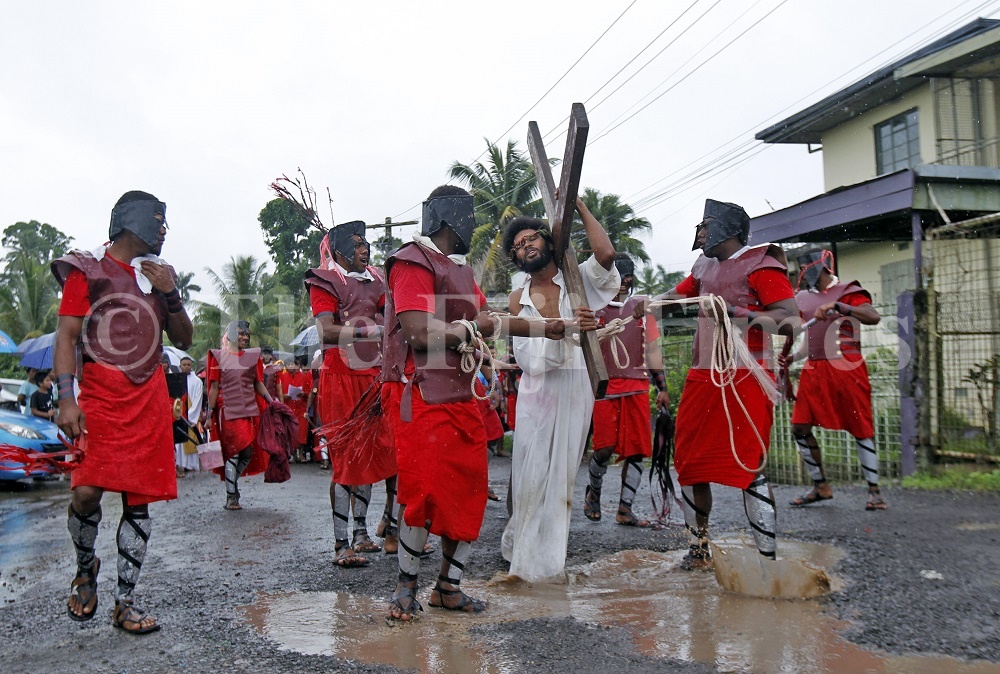
Good Friday celebrates the Passion of Jesus Christ. Passion comes from the Latin word ‘passio’ which means passiveness, non-activity, absorbing something more than actively doing anything.
In the Christian literature the passion refers to Jesus’ life from the Last Supper to his death on the cross. From the moment Jesus enters into the Last Supper and begins to pray at Gethsemane, he stops being the actor.
He is no longer the one who is doing things for others, instead he is the one who is having things done to him. In the Garden of Gethsemane, soldiers arrest him, bind his hands, lead him to the high priest and take him to Pilate.
He is beaten, humiliated, stripped off his clothes and eventually nailed to a cross where he dies. Jesus was active for three years, but from Gethsemane became passive. He has entered into his passion. Jesus gave us his ‘active Life’ as well as his passion – his passive life.
Even in his suffering and dying, Jesus was ministering to us. In other words, Jesus was ministering to people in his vulnerability. The Cross and the Power of Vulnerability. The Cross of Christ reveals that God works far differently than do our movies and our imaginations.
God never overpowers anyone. God’s power is not associated with power, energy, or authority. God’s power works in vulnerability. St Paul teaches that ‘When I am weak then I am strong.’ (2 Cor 12:9-11).
The Greek word for vulnerability is exousia. Exousia can only be explained through an image. A strong man and a baby in the room – who is more powerful? The baby possesses a different kind of power, a far deeper power; one that can move things that muscles can’t move.
The baby has exousia – authority. The baby’s vulnerability is a greater power. It does not need to outmuscle anyone. The baby invites.
The Cross reveals the power of God in this world, a power that is never the power of muscle, speed, brilliance, physical attractiveness or an authority that leaves another no choice.
The world’s power works this way, movies show this kind of power. God’s power invites and empowers people to participate. It’s the power of vulnerability that has the last words. It is the power upon which love and community can be created because it alone softens rather than breaks the heart.
The power of vulnerability enables us not to give in to bitterness and grow vicious when we fail, our dreams crushed, helpless, make mistakes; rather we admit to our brokenness and helplessness.
The Cross of Christ tells us that at those moments of painful helplessness when we can’t impress or overpower anyone that we begin acting in a divine way. We are beginning to live the passion of Christ. To be vulnerable is an attractive power.
This is why the Christian faith tradition teaches that we are saved by Jesus’ passion (his death and suffering) rather than his activity of preaching and miracles. The Passion and through Climate Change Fiji and small island nations are vulnerable and front-line victims of climate change and extractive industries.
We contribute the least to carbon emission but we suffer the most. We are also vulnerable to the exploitation of extractive industries. Our voices are missing in global climate change discussions. Like Jesus we experience the ‘passion’.
We are helpless. We are oppressed and exploited. However, our experience and stories of vulnerability as victims of climate change and economical exploitation can save Mother Earth. The world and its leaders need to listen and be affected by our lifethreatening stories so that they stop using fossil fuel, mining and logging.
Our stories of vulnerability can bring about an ecological conversion that is key to the stoppage of carbon emission. The climate change conferences are full of scientific, academic and money knowledge, but change is slow to come.
We need another language that touches and interrupts human hearts and minds. We need the dangerous stories of vulnerable people who are victims of climate change and extractive industry. We must bring these stories to the centre of global climate change discussions.
Small island nations can reveal the power of Christ’s passion. They can be the instruments of saving Mother Earth.
• The ARCHBISHOP PETER CHONG is the head of the Catholic church in Fiji. The views expressed are his and not of The Fiji Times

