
History will always hold great significance because of its influence in our present and for Levuka Town that is the case being Fiji’s most significant colonial history site. The town has a colourful history.
In local history books taught in both primary and high schools, you would read about the growth of outpost for whalers, missionary settlers, shipwrecked sailors and rogues. Books such as Fiji, the Land and the People and Fiji in The Pacific depicts how Fiji became an important point in the South Pacific for traders in 19th century.
Also how Levuka became Fiji’s first capital between 1874 and 1882.
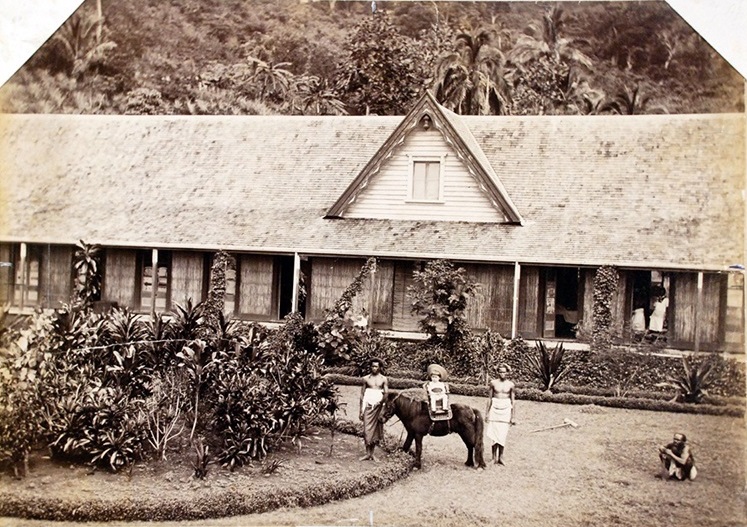
One such historical and monumental building was the Nasova House which had been the main Government House for the very short-lived Cakobau government from 1873 to 1874 and later as the residence of Fiji’s first British Governor.
Nasova House is located near Nasova Bay and is south of the historic town and over a period of 22 years it had served several functions socio-politically and judicially.
But let’s talk more about its complexity as researched by Robbin Chatan in his journal article published in the International Journal of Historical Archaeology in 2003 — titled ‘The Governor’s vale levu, Architecture and Hybridity at Nasova House, Levuka Islands.
Chatan’s research shared that under the Bauan chiefdom led by Cakobau, the attempt was to integrate the Fijian chiefly hierarchy with the western democratic principles.
Chatan said that two articles in The Fiji Times from 1871 and 1873 stated that the original existing structure proved to be unsuitable and the Government then began to survey land and the construction of the new Government house began.
He said the article stated that the design and specifications were done by a local architect and surveyor John Holmes with a strong European framework filled by Fijian reed-work walling.
“It awarded the tender to erect the external and internal framework to a local building firm, Messers Wilson and Murchie at an estimated cost of $2100 Fijian,” he wrote.
“An article in the Fiji Gazette describes the general plan for this building as a quadrangle with two wings measuring 84ft by 24ft and the central building 102ft by 24 ft.
“All three sections of this structure were surrounded by a verandah measuring 8ft in breadth.
“This unique structure that conceptually integrated European and Fijian architectural elements represented a substantial government investment of labour and capital, at a time when the Cakobau Government was experiencing internal instability.”
When Fiji was ceded to Great Britain, Article 6 of the Deed of Cession stated, “That all the existing public buildings, houses and offices, all enclosures and other pieces or parcels of land now set apart, or being used for public purposes, and all stores, fittings and other articles now being used in connection with such purposes are hereby assigned, transferred and made over to Her Majesty.”
The Nasova building was a significant real estate and Sir Arthur Gordon altered and expanded it to its new purpose as the Government House when he arrived in June 1875. Gordon, who is known to be decisive in the shaping of Fiji’s history and Chatan as per research from other scholars, said he appreciated the Fijian elements of the building and in a letter to Lady Gordon described it as physically and mentally enjoyable.
“The rooms are large, numerous and may be made very comfortable and pretty in fact so far as we gentlemen are concerned, they are very comfortable already but will need a little alteration for you and the chicks,” Sir Gordon wrote.
Chatan explained that Gordon made changes to the north and south wings including the central building where the former parliament house in the north wing transformed into a dining room well suited for ceremonial reception purposes.
“He converted the old offices of the King and his Privy Council in the central building into the main domestic quarters, with a suite of rooms that included seven bedrooms.
“The Governor and his staff took over the rooms in the south wing as offices and those at the west end of the wing as domestic quarters for the household’s Indian stewards.
“The addition of a suite of interconnected buildings of various sizes and functions including one known as the drawing room expanded the domestic space at Nasova House necessary for civilised residence.”
The article stated that the garden was filled with exotic and diverse vegetables around a flagpole in the open central square in the front of the house.
“A second garden at the back included a household vegetable garden and poultry coup.
“Other amenities afforded the Governor’s residence at Nasova included a supply of fresh spring water piped in from a reservoir situated behind the complex up in the coastal hills.
“As his official residence, it represented and symbolised the epitome of the colonial British class hierarchy in Fiji.
“Period documentary descriptions further indicate that Nasova House was well furnished and decorated including extensive displays of Fijian ethnographic objects in the dining and drawing rooms.
“The household was efficiently run with a corps of ‘Hindoo’ (South Asian) and uniformed Fijian domestic servants that performed with grace.”
Chatan gathered that the visit of the Royal Squadron with the Royal Princes Edward and George in 1881 was the ‘most notable event held at Nasova.’
“This occasion required the construction of an additional wooden structure to accommodate the two princes during their stay in Levuka.
“Nasova House remained the residence of the Governor in Fiji until the removal of the colonial government to the new capital of Suva on August 29, 1882.
“The Fiji Times heralded the departure of the Governor and his entourage from Levuka as an official hegira that would leave the town rather dull for some time to come.
“A reporter to The Fiji Times wryly noted that the removal of these structures at Nasova will reduce the block to its original three sides of a hollow square and pave the way for gradual dissolution.”
It was recorded that the building originally had thatched roofs, had high maintenance and during one particular incident on March 1876 roof repairs involved about 100 men who were mostly prisoners.
“In 1877 the thatched roofs of the government buildings at Nasova were removed and replaced by western shingling.
“On January 5 and 6, 1895, a hurricane hit Levuka with devastating winds that caused extensive damage.
“Government records indicate that the north wing completely collapsed, a portion of the verandah and roof were blown down and the remaining building sustained irreparable structural damage.
“It was subsequently demolished and the reusable timbers and fixtures were salvaged for other public buildings throughout the colony.”

