
Fourteen years ago, on December 10, 2011, we pressed our whole lives into four suitcases. Clothes, documents, a few pots wrapped in newspaper, my old school reports. What went into those bags was practical. What sat on top of them, even if no one could see it, was hope. I had just finished high school. I was leaving behind cousins who felt like siblings, friends I thought I would grow old with, and streets that knew the rhythm of my footsteps better than I did.
The day before we flew out, I sat in The Fiji Times office in Lautoka and typed my last article as an intern. Fluorescent tube light, the smell of newsprint and cheap ink, the sound of someone slapping a stack of papers into place. When I handed my piece to my editor, she asked me, “So what now?” I was eighteen and full of that particular brand of confidence that comes only once, before the world starts answering back. I smiled and said, “To the stars.” It sounded dramatic and filmi in the moment. I did not realise the universe was going to take me literally.
As a descendant of girmitiyas, that move to New Zealand was not just about visas and better salaries. It carried the weight of other journeys. My ancestors stepped onto ships with nothing but a cloth bundle, a name that could be mispronounced, and a faith that someone, somewhere, would treat them better than the plantation. A century later, we walked through Nadi airport with trolley bags and passports, still carrying that same stubborn belief that life could soften, even a little. We were not running away from Fiji. We were walking with our girmitya blood, trying to stretch their story further than the cane fields.
Growing up in Fiji was simple and full, never poor in the ways that mattered. I remember dust lifting off the road whenever a truck rattled past near MGM School, that particular brown-grey cloud that stuck to your socks and your tongue. I remember the first fat raindrops on hot soil in Saru, the way the ground hissed and released that smell only island kids understand, like the earth sighing in relief. I remember standing on Ram Asre Rd, looking down at Tilak High, Arya Samaj Primary and Vomo St, tracing my own life with my eyes as I walked home.
There was a time we studied under a kerosene lantern, the flame trembling whenever someone opened the door. I played Snake on my father’s old Nokia, the rubber buttons almost worn smooth. At the start of the school year, we covered exercise books with brown paper and leftover gift wrap, smoothing out every crease as if neat books could guarantee neat futures. On Saturdays, we dressed up for town in our best clothes, even if we were only going to buy pins, shampoo, and a small packet of bhuja. These are not fancy memories. They are the bones of who I am.
Fiji gave me my first language for kindness. It taught me to greet neighbours properly, to take food when someone died, to never let a visitor leave without tea and something fried. It gave me my sense of humour, my stubborn pride, my ability to read a room without anyone saying a word. It is still in my accent when I am tired, in the way I say “eh” without thinking, in the way I look for curry leaves in foreign supermarkets.
When we landed in New Zealand, I thought I was walking into a country made entirely of chocolates, snow, and opportunity. A place where the streets would smell like cocoa and every shop would look like those glossy TV ads. What I found was quieter and better. I found an unexpected kindness. I had prepared myself for racism, for doors closing in my face. Instead, Aotearoa opened more doors than I knew how to walk through. Teachers said my name properly. Classmates listened when I spoke. The country handed me not just a future, but a mirror. In that mirror I saw a brown Fiji-Indian boy who was allowed to want things, who was allowed to take up space.
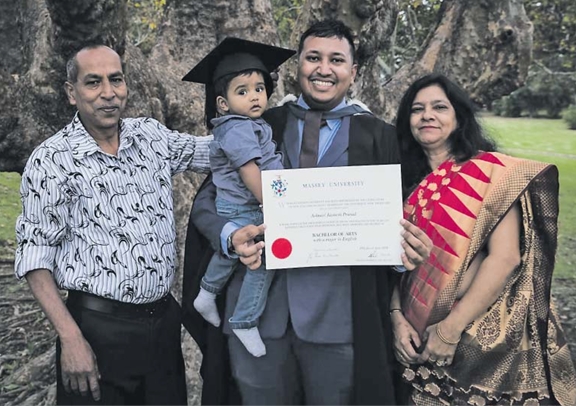
New Zealand gave me an identity that was bigger than “from Lautoka” and “good in English”. It gave me a degree, a profession, and the strange courage to stand in front of a room full of children and say, “Today, we are going to learn.” It taught me how to exist in spaces my grandparents would never have been allowed to enter.
Leaving Fiji in 2011 felt like the next necessary step. Leaving New Zealand earlier this year felt different. Less like escape, more like stepping from one ledge to another without checking how far down the drop is. Each country took something from me and gave something back. Fiji told me who I was. New Zealand showed me what I could become.
Today, as a teacher, I walk into school carrying both nations with me. The marks from the white-board marker on my fingers is Saru dust. The patience in my voice belongs to every New Zealand teacher who saw me before I saw myself. From Fiji I bring respect, humility, the belief that every child deserves to feel like someone is on their side. From New Zealand I bring ambition, inclusion, the idea that the world can bend a little to accommodate a child, not just the other way around. My heritage is not a footnote. It is the spine that holds the teacher in me upright.
On December 10, 2011, we stepped onto that plane as four hopeful members of the Prasad family: my parents, my brother, and I. Today, as I write this, it is December 10, 2025. On December 9, we celebrated the first birthday of my youngest nephew. We are seven now. Our family tree has new leaves, tiny fingers clutching cake and balloons, laughing in accents that already sound a little different to ours.
From the dusty streets of Saru to the green spreads of New Zealand, and now to the crowded trains and neon nights of Tokyo, our journey has been stitched together with love, fatigue, arguments over money, shared plates of curry, and the quiet relief of knowing we still have each other. It is not a perfect story. It is ours.
Fourteen years is not a small number. In our stories, fourteen years means something. Even Shri Ram returned to Ayodhya after his fourteen years of vanvaas. Sometimes I wonder if my exile has an end date or if this is simply who I am now, a permanent migrant, always halfway between here and there. In chasing some vague idea of “better,” I sometimes realise the only place my heart ever knew as home was much less complicated. Home was Lautoka. Home was Fiji.
A part of my heart is still under the ber ke ped in Saru, where the dust clings to your slippers and the wind carries gossip from one verandah to another. Another part sits somewhere in Kashmir in Lautoka, that little pocket of the town that held so many of my childhood afternoons. A fragment of my mind is still on those roads, watching the sugarcane trucks groan past, smelling the mixture of rain, dust and masala drifting out of someone’s kitchen. Maybe those pieces will live there permanently. Maybe that is the price of leaving: you never arrive anywhere whole again.
But there is a strange comfort in that ache. My heart hurts when it remembers what my seven-year-old eyes saw. It keeps me honest. It stops me from believing that shiny cities and big salaries can replace the sound of Hindi film songs on low volume on a neighbour’s radio, or the announcement of “Lautoka, Lautoka” from the bus conductor, or the sharp whistle of a pressure cooker next door.
I live far away now, but inside me the country is still awake.
“… aye watan watan mere abaad rahe tu
main jahaan rahun, jahaan mein yaad rahe tu…”

