
IT began on a remote island in the Yasawa Group and it ended in the heart of Fiji’s oldest city. Between February 25 and March 2 2026, the King’s Baton criss-crossed Fiji’s mountains, oceans and communities in a whirlwind activation period that was as deeply cultural as it was sporting. What the Baton carried, however, was no ordinary cargo. It bore the soul of an island nation – painted, carved and woven into its very form.
Fiji’s Baton is unique. For the first time in Commonwealth Games history, every nation received its own Baton to customise. Fiji’s three-sided ashwood baton became a canvas for three extraordinary artists, each telling a different chapter of the national story.
The first side belongs to celebrated artist Anare Somumu. Born in the cane fields of Labasa and one of the first South Pacific artists to exhibit at the International Art Biennale, Anare painted the full truth of Fiji, not just its postcard beauty. The Fiji Banded Iguana and the Tagimoucia flower speak to the nation’s precious endemic species. Waves represent Fiji’s trials – coups, Cyclone Winston, COVID-19, while shark teeth rising above them symbolise resilience. Footprints mark the journey of a diverse people walking together, and the rising sun is a reminder that every new day begins in Fiji.
The second side was crafted by Kavara, a sustainable artisan brand led by Christine Pickering. Using resin on wood, Kavara captured the wasawasa – the open ocean with flowing resin, shells gathered from Fijian beaches, sand from the outer island of Rotuma, and at its heart, the drua: the great ocean-going vessel of Fijian ancestors. “The ocean is at the heart of who we are as Fijians,” Pickering said.
The third side was brought to life by Sigavou Studios, led by Maria W. Rova. Her team of four young artists painted sailing canoes riding ocean waves, the Kasaqa frigate bird that guided ancestors to new lands, endemic orchids, mokosoi flowers, the sacred whale’s tooth tabua, and i-seru barkcloth motifs forming a traditional border. Three sides. Three artists. One Baton. One Fiji.
When that Baton began its journey on 25 February, it did so in spectacular fashion, not in a city stadium, but aboard a boat, crossing the pristine waters of the Yasawa Islands to reach Soso Village on Naviti Island. It was the first time the King’s Baton had ever been unveiled on a Yasawa island, away from mainland Fiji. There, in a moving traditional ceremony, the Baton was formally presented to the Minister of Youth and Sports, Hon. Jese Saukuru.
The following day in Suva brought one of the Relay’s most diplomatically significant moments. At Albert Park, Heads of Missions from Commonwealth nations, from Australia and India to Nauru and the Solomon Islands gathered for a first-of-its-kind Mini Baton Relay, physically carrying the Baton themselves. It was not ceremony from a distance; it was diplomacy in motion. The day continued into a wreath laying service at the National War Memorial. Later that day, the baton visited Naitasiri Highlands, where the Baton reached the highland communities for the very first time, visiting Naitasiri High School and Soloira District School. For students there, seeing the Baton in person was transformative, turning the Commonwealth Games from something distant into something real and possible.
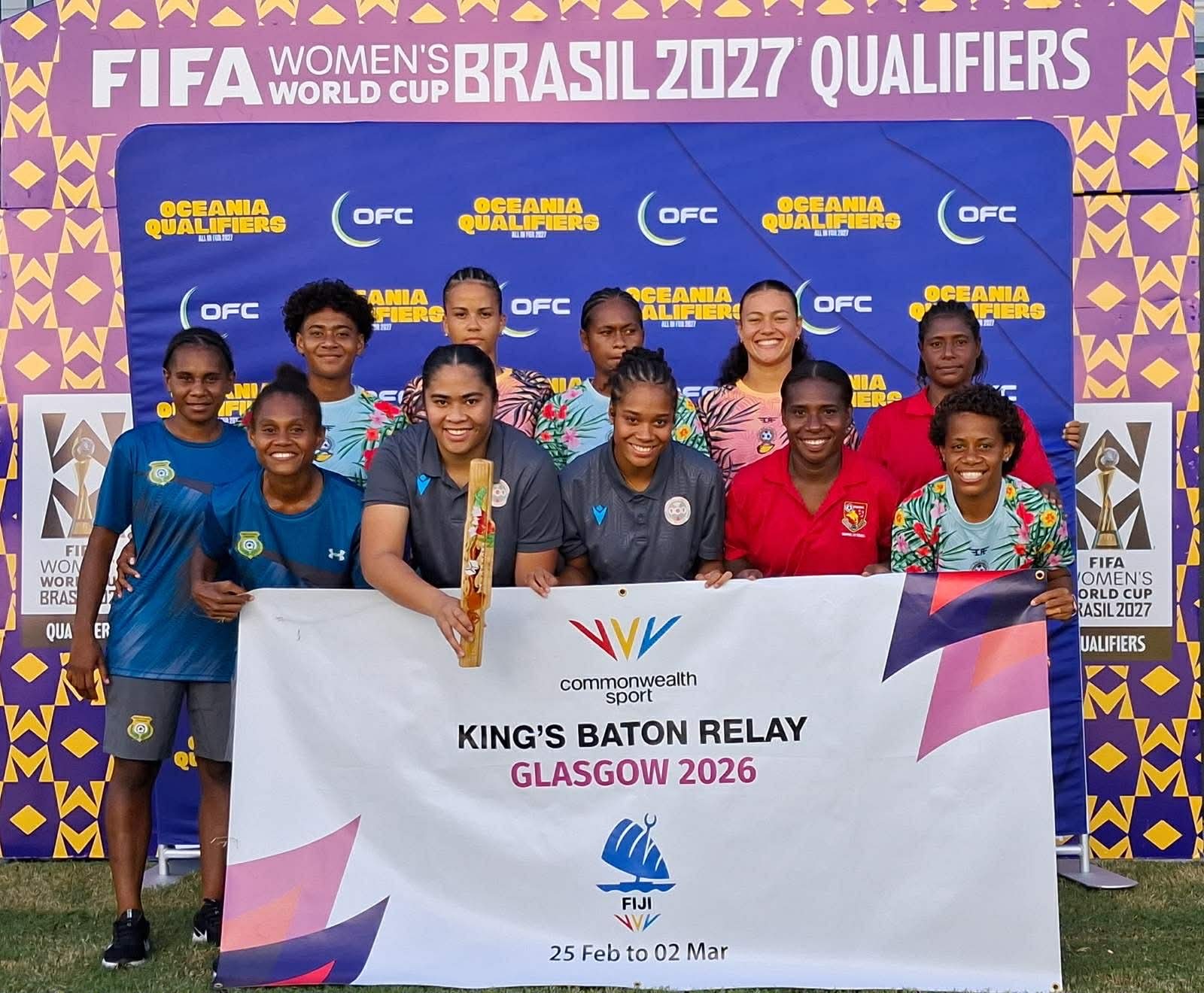
On Friday 27 February, the Baton travelled west, visiting the Ministry of Youth and Sports, the Fijian Broadcasting Corporation, Daomdar Arts Village, Ratu Filise Memorial School and Sigatoka Special School — where students of all abilities were included in the journey. That evening, at Govind Park, the Baton was present at the FIFA Women’s World Cup 2027 Qualifiers, as the Fijian women’s national team chased a historic first-ever qualification. It was a powerful statement about the rising prominence of women’s sport across the Pacific.
The loudest roar of the week, however, came not from the stands, but from the coastline. On February 28, over 500 volunteers gathered for a Clean Oceans Campaign across Suva and Nadi. Schools, embassies, sports federations and everyday citizens cleaning beaches together. This collective effort contributed significantly to the Commonwealth Games’ global target of collecting one million pieces of plastic. The spirit of unity then moved to Churchill Park in Lautoka, where the Baton was present for the Fijian Drua’s Super Rugby Pacific match. Adding to the celebratory mood, the Drua secured their first win of the season.
On March 1, youth volunteers from 33 SDA churches joined a foreshore clean-up along the Suva waterfront, reinforcing our Clean Oceans commitment. Amidst this environmental drive, an afternoon program scheduled to raise awareness on drug and substance abuse was unfortunately cancelled due to the impending Cyclone Urmil. Despite the weather, the unifying spirit of the Baton persisted; it was placed at the altar of Sacred Heart Cathedral during a regular Sunday service, joined by the Archbishop of Fiji, a powerful moment where faith, sport and community came together as one.
The final day took the Baton to Levuka, Fiji’s old capital and the site of the 1874 Deed of Cession, where Fiji’s high chiefs ceded the islands to Great Britain. Students at St John’s College, Cawaci and Levuka Public Secondary School became the first in their town to witness the Baton. At the historic Deed of Cession site, the Baton’s symbolic weight was profound: a nation that once became part of the Commonwealth through that document was now, 152 years later, proudly carrying its own Baton toward the Commonwealth Games in Glasgow, Scotland, part of that same United Kingdom.
From the Yasawa Islands to the Naitasiri Highlands, from ocean clean-ups to school visits and rugby stadiums, Fiji’s King’s Baton Relay activation proved one thing above all else: this journey was never just about sport. It was about a people – diverse, resilient and united, carrying their story, their art and their spirit toward Glasgow 2026.

