
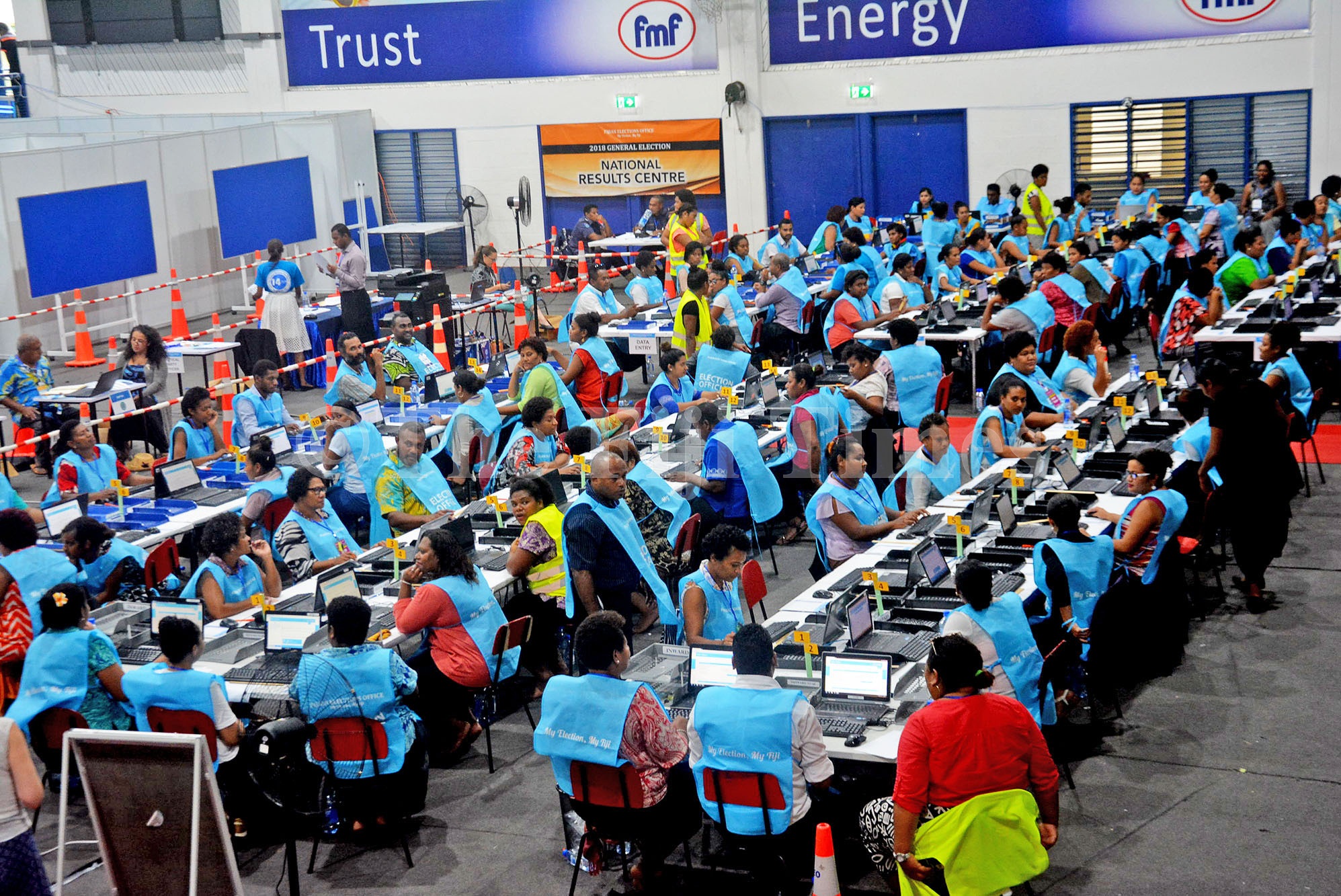
It’s crucial to approach the review of election laws with a focus on promoting democratic principles, inclusivity, and the protection of citizens’ rights to participate in the electoral process.
With the Coalition government announcing that it will soon commence a review of all electionrelated laws, it’s important that dialogue and collaboration among stakeholders take place to improve election laws to meet the evolving needs of society.
A joint report on the 2022 general election by the Electoral Commission (EC) and the Fijian Elections Office (FEO) sheds more light on what the two institutions may be lobbying for to change the laws on how elections are governed in Fiji.
The Multinational Observer Group (MOG) made several recommendations on how to improve the election process and the EC and FEO have given their thoughts, including the need to allocate a quota for women’s representation in the electoral process.
Electoral system and operation
MOG had recommended that the FEO conduct an external audit of the National Voter Register to ensure accuracy and public confidence.
The EC and the FEO have agreed, saying the accuracy of the National Voter Register is important to maintaining public confidence.
On the issue of clarifying the validity of voter cards and other allowable documents early ahead of the next election to maximise voter turn-out, the EC and FEO state there was some voter confusion in relation to the drive to update voter cards, and that they will work to minimise such confusion in the future elections.
MOG had recommended that a review on restrictions on election related activities for domestic and traditional civil society organisations (CSOs), particularly in relation to candidate development activities take place, which will result in wider participation in the electoral system by all sectors of society, including women.
EC and FEO agree that a review of the restrictions be included in the review of the electoral legislation announced by the Cabinet.
Legal framework
MOG recommended that Fiji consider the appropriateness of criminal penalties in electoral legislation, including the Electoral Act 2014, and whether the desire to deter criminal conduct, ultimately diminishes public confidence in the EC and FEO, with the two organisations stating that a review of the criminal penalties is included in the review of the electoral legislation announced by Cabinet. MOG had suggested Fiji consider whether the length and detail of the Electoral Act 2014 affect the public’s readability and understanding of the legal framework regarding elections, to the detriment of public confidence.
Consistent with recommendations in 2018, the MOG also recommended relevant Fijian institutions work towards consolidating and simplifying relevant electoral legislation, including the Electoral Act 2014.
The EC and FEO agreed that the length and complexity of the electoral legislation be considered as part of the review of the electoral legislation announced by the Cabinet.
On the issue of reviewing the appropriateness of the Supervisor of Election’s (SoE) powers, particularly in subsections 6(1A) – (1C) of the Electoral Act 2014, the EC and FEO recommend that a review of the SoE’s powers – including in relation to the variety of offices the SoE holds ex officio – be included in the review of the electoral legislation announced by Cabinet.
MOG recommended that best efforts are undertaken to use full parliamentary consultation processes when amending electoral legislation, including providing advice to relevant decision-makers regarding the appropriateness of using Standing Order 51 when passing amendments to electionrelated legislation.
EC and FEO said they look forward to being consulted whenever any amendments to electoral legislation are being contemplated.
“While we have no mandate in relation to the parliamentary process, we understand that democracies with equivalent provisions to Standing Order 51 use them sparingly, and rarely in relation to electoral amendments, in order to preserve the spirit of parliamentary democracy,” state the EC and FEO.
“We therefore support the use of the full parliamentary consultation and legislative amendment processes when amending electoral legislation.”
Electoral authorities
MOG had recommended that Fiji develop and better publicise procedures for the EC to ensure due process in considering complaints against the SoE, political parties, and the FEO.
The EC said it is reviewing the procedures it inherited from the previously constituted EC for processing complaints, objections, and appeals, and the means of publicising them.
Pre-election and campaign environment
On the issue of MOG recommending a review of the appropriateness of section 115 of the Electoral Act 2014, especially its effect on free political debate, the EC and FEO said any review of these sections be included in the review of the electoral legislation announced by Cabinet.
MOG said Fiji should develop guidelines for the conduct of ministers, members of Parliament, and the civil service when the government is in caretaker mode to reinforce public confidence in a level political playing field. EC and FEO said they have no mandate in relation to the conduct of members of Parliament or the civil service.
“However, we understand that democratic international good practice recognises the value of guidelines for their conduct during the caretaker period to ensure public confidence in elections.”
On the issue of requiring all political parties to report campaign expenditure and consider setting campaign expenditure limits, the EC and MOG state that a review of political party campaign expenditure and reporting be included in the review of the electoral legislation announced by the Cabinet.
MOG had said Fiji should consider providing technical support and potentially public funding for the costing of parties’ political manifestos to ensure voters have reliable policy information.
The EC and MOG state the requirement for political parties to cost their manifestos be included in the review of the electoral legislation announced by Cabinet and scheduled to commence, with a view to repealing it. “If any such legislative requirements remain, we recommend that Parliament considers how to
appropriately support political parties to comply with such requirements.”
“We suggest that, as election management bodies are required to remain politically neutral, it would be inappropriate for such support in relation to political party manifestos to be provided by the EC and/or FEO.”
Public awareness and civil society participation
On the issue of the EC and FEO strengthening efforts to build productive partnerships with civil society organisations during both the pre-election phase and following the issuance of the writ, and to actively work with CSOs in voter awareness, information, and education activities, the EC and FEO state they recognise the important role they play as stakeholders in the electoral process.
“We intend to continue to develop these relationships, in particular with domestic CSOs.”
Women and voters with disabilities
MOG had recommended that all stakeholders continue their efforts to promote women’s representation
and safeguard gender diversity in the electoral system, including as candidates, and that gender safeguards be integrated into any electoral system reforms. EC and FEO say they support the MOG’s recommendation to promote women’s representation and gender diversity in the electoral system.
“We recognise that this is consistent with international good practice. The Convention on the Elimination of all Forms of Discrimination Against Women, which Fiji ratified in 1995, obliges Fiji to take temporary special measures aimed at accelerating de facto equality between men and women shall not be considered discrimination.
“We recommend that the review consider the implementation of temporary special measures to enhance gender diversity and women’s representation in Parliament.
“We will continue to review our processes to identify and rectify any potential barriers to women’s participation and to promote their participation in the electoral process.”
Media and elections
On the issue of reviewing the operation of media blackout requirements in the law and providing greater clarity through published guidelines, EC and FEO recommend that a review of the provisions in the Electoral Act regarding the media blackout be included in the review of the electoral legislation announced by Cabinet.
On the MOG recommendation that a review on the appropriateness of the EC guidelines on the conduct of opinion polls and their effective constraint on the media’s ability to contribute to public discourse and political accountability, the EC states it intends to review these guidelines and the associated processes well in advance of the conduct of the next election.

