
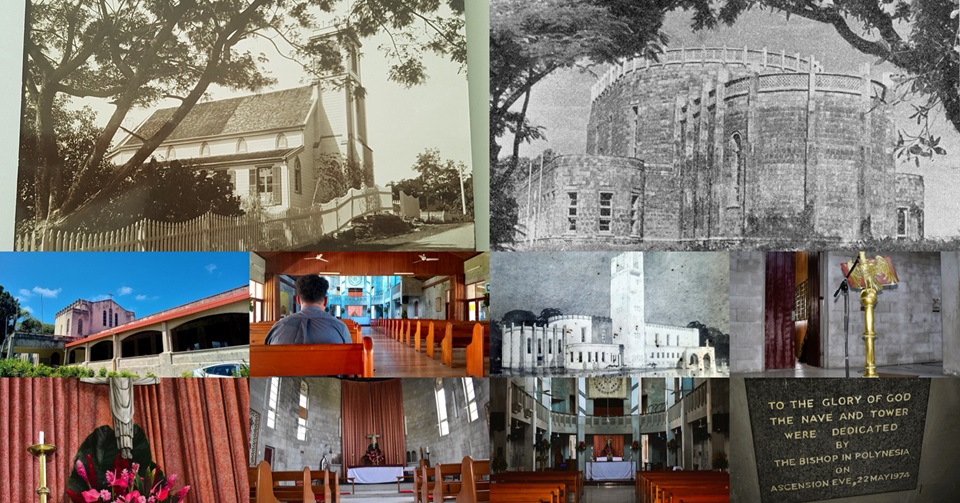
The Anglican Church was first established in Levuka in 1870, under the jurisdiction of the Diocese of Polynesia, which was founded in 1908 with the blessing of its first bishop. Levuka, Fiji’s first capital, was a pleasant place in many ways, but before Fiji’s cession in 1874, it was far from a model of law and order.
For Anglicans, particularly those with religious inclinations, facilities were scarce, as there was no Anglican minister to serve them. While the Methodist and Roman Catholic churches were active in Fiji, Anglicans were left without a dedicated minister.
In response to this, cotton planters and traders wrote to the Anglican Church of Australia, voicing their concerns. In turn, the bishops of Sydney, Melbourne, and Melanesia sent Reverend William Floyd, an Irishman, to Fiji.
He arrived in 1870 and became the first Anglican priest in Levuka. His arrival led to a growth in the Anglican community, and in 1908, the Diocese of Polynesia was established to better serve the needs of the region.
The first Anglican church building in Fiji was constructed in Suva in 1880, on what is now Ellery St. Later, the church was relocated to the site where Pacific House now stands.
Sepiuta Hala’api’api, the Reverend Diocesan Secretary Registrar of Moana Anglican and Teaching Centre, explained to The Fiji Times in 2022: “Our church was situated where Pacific House and Opium are now located. That was Anglican land, and when it was traded, we moved across.”
Today, the diocese includes countries such as Tonga, American Samoa, Samoa, and New Zealand.
Like many early churches, the Holy Trinity Anglican Cathedral holds significant historical value.
Beneath the cathedral rest the bones and ashes of several bishops, including the Right Reverend LS Kempthorne, who died in 1965, and The Most Reverend Jabez Leslie Bryce (2010) and The Most Reverend Fereimi Cama (2021), whose ashes are interred within the cathedral’s walls.
Reverend Hala’api’api adds: “It’s an ancient tradition to build churches next to graveyards.
Over time, churches were built over the graves, and this became part of Christian tradition. It’s all very significant.”
Although an ambitious plan for the cathedral was drawn up, it could not be completed due to funding shortages and challenges posed by Fiji’s changing climate.
According to an article in The Fiji Times dated October 23, 1968, a fundraising appeal was planned for early 1969, with hopes to complete the cathedral by 1970, marking the 100th anniversary of the first public Anglican worship in Fiji.
The Diocese also hoped to host the biennial Synod of the Province of New Zealand (now known as the Anglican Church in Aotearoa New Zealand) in Suva that same year.
Reverend Orisi Vuki, in an interview with The Fiji Times in 2022, explained the challenges faced in construction.
“The concrete bricks used were meant for cold climates, so the cathedral was only halfway finished before wood was used as a substitute due to the heat.”
Despite these challenges, the Holy Trinity Anglican Cathedral still stands proudly on McArthur St in Suva today.
Early history
In March 1882, James McEwen and Company donated freehold land to the Trustees of the Church of England.
This land, located on the northern side of Gordon St, was opposite the site where the present St. Andrew’s Presbyterian Church now stands.
By June 1886, an alternative site was secured at the corner of Butt St and McArthur St with the assistance of the colony’s acting Governor, John Bates Thurston.
The original location had proved problematic as it was too close to the Presbyterian Church, and the noise from competing choirs during services had become disruptive.
A wooden church building was erected on the new site, designed in a similar style to St. Andrew’s.
However, the church building suffered damage in a cyclone in 1910.
A proposal to replace it with a new timber chapel was rejected in favour of constructing a more permanent stone or brick structure.
The outbreak of World War I in 1914 delayed the church’s rebuilding efforts. It wasn’t until 1919 that a Cathedral Committee was formed, and Bishop Twistchel, the first Bishop of Polynesia, launched a fundraising campaign to raise £10,000 for a new church building.
In July 1926, a three-acre plot at the corner of Holland and Knolly streets was purchased for £735.
In 1929, a residence for the bishop was constructed on part of this site.
On January 25, 1940, the first two foundation stones of the new church were laid by Governor Sir Harry Luke.
On March 25, 1950, the second foundation stone was laid by Acting Governor Mr. A.F.R. Stoddart on the East wall, which would later become known as the Lady Chapel.
The architect for this phase of the project was Mr. C.H. Nettleton, the government architect, and the building work was contracted to Whans Construction, with an estimated cost of £17,280.
The first phase of the cathedral was completed in 1952 and was consecrated on the Feast of St. Mark.
On April 25, 1953, the consecration ceremony was conducted by Bishop Stanley Kempthorne, Bishop of Polynesia.
The ceremony was attended by the Archbishop of New Zealand, the Right Reverend Reginald Owen, and the Archbishop of Sydney, the Right Reverend Howard Mowill.
In May 1954, approval was granted for the foundation of the second phase of the cathedral, which would include the nave and the bell tower.
By 1955, the foundation for the second phase was completed, and the temporary west wall remained in place as a feature of the cathedral for the next 20 years.
On October 17, 1973, a tender from Cork Builders for £98,000 was accepted to build the western extension of the cathedral.
The original design was modified to enhance ventilation and light.
By May 22, 1974, the western section of the cathedral was completed and was dedicated by Bishop John Holland on the eve of the Feast of the Ascension.

