
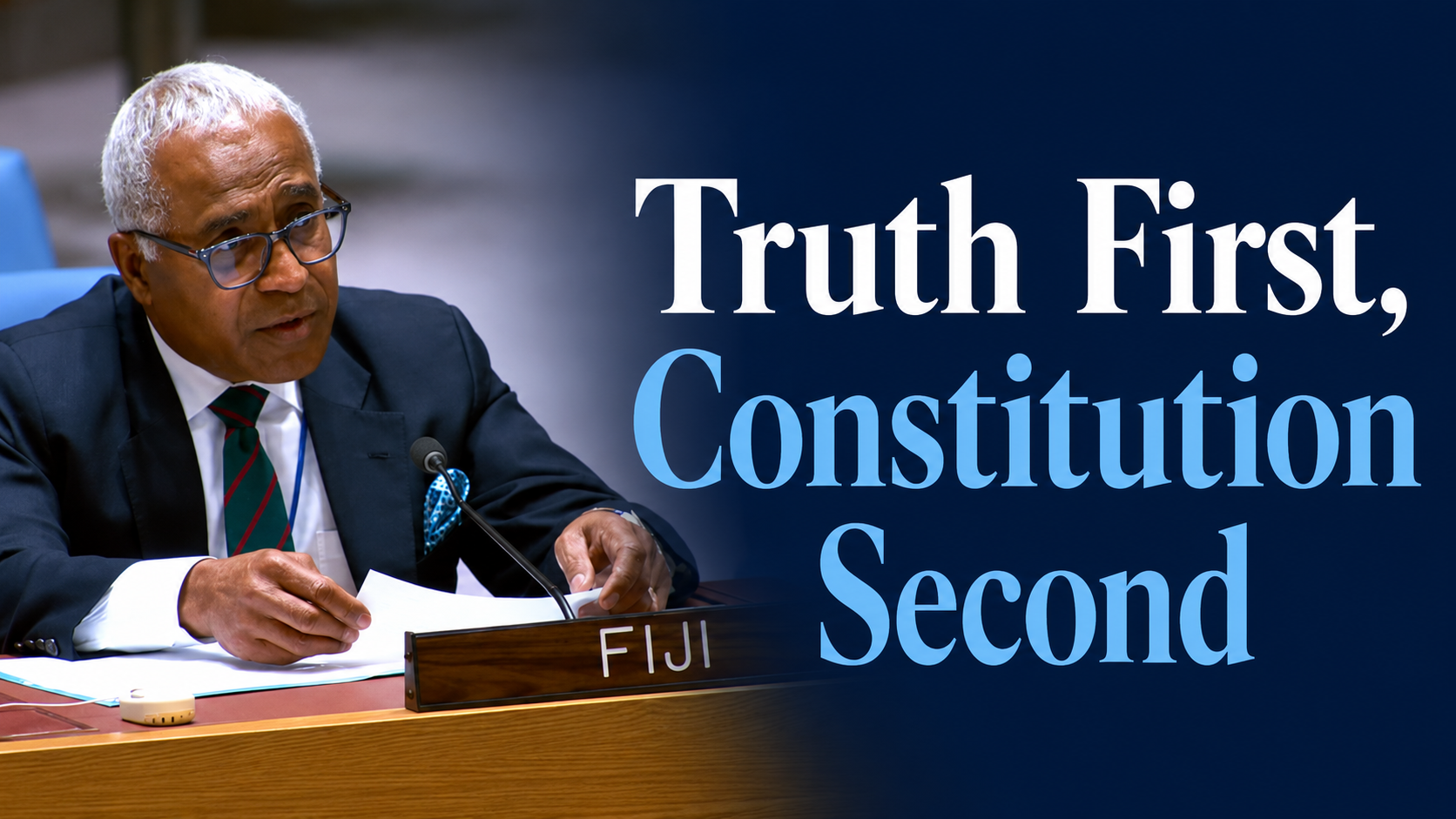
Fiji’s Ambassador to the United Nations, Filipo Tarakinikini, says the country’s Constitution Review process will fall short of delivering lasting political stability unless it is closely linked to truth-telling and national reconciliation.
In an opinion piece titled “The Missing Foundation of Fiji’s Constitution Review: Why Truth and Reconciliation Must Inform Constitutional Reform”, Tarakinikini argues that Fiji must confront the underlying causes of its history of coups and constitutional crises rather than rely on legal reforms alone.
“As Fiji embarks on its Constitution Review, there is understandable excitement and equally understandable impatience,” he said.
“However, if we are serious about ending Fiji’s coup culture once and for all, we must resist the temptation of quick fixes.”
Tarakinikini said Fiji’s recurring political instability was not simply caused by individuals seizing power but was also rooted in unresolved communal fears, sectarian divisions and political grievances.
“There is no single clause, amendment, or election that will, by itself, cure what ails us,” he said.
A key issue he believes must be addressed is the constitutional immunity clause, which protects individuals involved in actions against constitutional order.
While acknowledging calls for the clause’s removal, Tarakinikini warned that doing so without a broader reconciliation framework could create new problems.
“The immunity clause cannot be safely or legally removed in isolation,” he said.
“The only legitimate pathway is through a Truth and Reconciliation Commission.”
He argued that those protected by immunity provisions should be given the opportunity and responsibility to testify before a properly constituted Truth and Reconciliation Commission, explaining not only what happened but also the social and political circumstances that led to their actions.
“This is not about excusing what was done. It is about understanding it deeply enough to ensure it is never repeated,” he said.
Tarakinikini described truth-telling as a constitutional necessity rather than merely a healing exercise, saying any future constitution should reflect an honest account of Fiji’s past and the realities of its multi-ethnic society.
“A document that reflects the genuine values, fears, aspirations, and hard-won unity of a people is fundamentally different from one imposed, amended, or adopted under the shadow of unresolved grievance,” he said.
Drawing parallels with countries such as South Africa and Rwanda, he said lasting peace and stability could only be built on a foundation of truth.
He has also called for the mandates of both the Truth and Reconciliation Commission and the Constitution Review Commission to be expanded so the two processes can inform each other.
“The Constitution Review is an opportunity of rare significance,” Tarakinikini said.
“Let us not squander it by treating it as a legal exercise alone. Let us have the courage to make it a national act of truth so that what emerges from it can genuinely hold us together.”

