
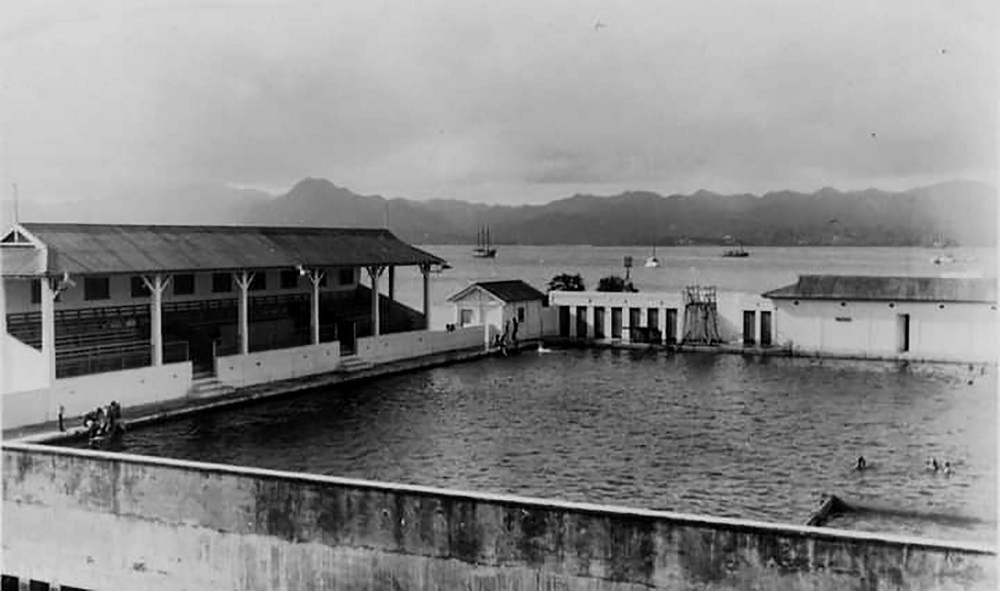
Located along Victoria Pde and sandwiched between the Old Town Hall and Suva City Carnegie Library lies the Suva Olympic Pool.
Built in 1925 by the British administration led by GJ Grahame, it is considered the oldest colonial natatorium in Fiji.
Initially, the pool was a whites-only zone, but after 30-odd years, it became the meeting place for people of all races and ages seeking time out from the rat race, fitness fanatics looking to keep their bodies in tiptop shape and club and school competitions for close to a century.
There is a lot of history and memories etched into the hearts and minds of those who have used the facility over the years and will continue for many more years to come.
It was originally called the Suva Sea Baths in the 1920s as seawater was pumped in from the ocean to fill the then newly constructed swimming pool.
Fiji’s first Hibiscus Queen and living historical legend Liebling Marlow shared her memories of swimming at the Suva Sea Baths.
“Our class at Saint Joseph’s of Cluny School, which used to be along Pratt St, would go to the Suva Sea Baths for swimming classes,” the 73-year-old said.
“There was a net covering the big hole where they’d pump the sea water in from and chemicals were also used to clean the water those days.”
In the days before shopping malls and cinemas, the pool was where Suvasiders would gather for a quick catch-up.
“It was like a social place those days. After school or work we used to stroll there because there wasn’t anything much to do.
“We didn’t have any theatres like how they have now, so the baths were a way of having a great time with friends and family.”
Ms Liebling laughed as she recalled meeting her first boyfriend at the baths.
“His name was Peter Maxwell and his sister and I were great friends.
“He used to come over to the baths with a lot of other Grammar School boys.”
She said those who frequented the baths back then were considered “strong” as they had to do laps through salt water, minus the goggles and fancy attire modern swimmers used today.
“I remember Mrs Weaver, who was the caretaker at the time. She taught us how to swim during classes. She was an old dragon, that one.
“She would tie a rope around our waists and throw us into the pool and just watch us as we’d swim in the salt water.
“It used to have a diving board, but I never used it. Every now and then I’d show off and jump off it, but would end up doing a big belly flop.” She said at one stage the Suva Sea Baths would not allow coloured people in.
“I remember once two siblings came to use the baths, the brother was white but his sister had coloured skin and looked a bit Indo-Fijian, so they forbade her from entering.
“My mother, Faga Bentley, a very short and quick tempered lady, went to the old Town Council, chewed somebody’s ear there and managed to get the girl in.”
Ms Marlow said she witnessed a few funny and crazy moments, which she would not have dared to do.
“I was doing some work for the Fiji Trade and Investment Board (FTIB) in one of the civic buildings where I could look out through the window straight to the baths.
“I saw a bunch of young Fijian boys climb the roof of the baths, take off their clothes and jump into the pool with just their sapos (underwear) on. They were just swimming and having a wonderful time, which was so funny.”
In 1956, the municipal council decided to open the Suva Sea Baths to all and racial segregation was abolished.
The 1963 South Pacific Games held from August 29 to September 9 in Suva was the first edition of the athletics competition, which also included swimming, and the Suva Sea Baths has since hosted countless swimming competitions.
According to the Fiji Museum, in 1970 after the Suva City Council was met with complaints from members of the public of the pool’s unhealthy water, the Town Board decided and agreed to abandon the use of seawater for freshwater.
By the time 1972 came around, a new 100 metre pool was established and Suva Sea Baths changed its name to Suva Olympic Pool.
Swim champ Sharon Pickering-Smith recalls training at Olympic Pool in 1977.
“I have some great memories swimming and training there and I am still in contact with swimmers I trained with from 1977,” she said. At the age of 12, she represented Fiji at the South Pacific Games, which was held at the Olympic Pool.
“I trained twice a day Monday to Friday and Saturday morning, so 11 sessions a week.
“I loved training and loved working hard and I also had an awesome coach who also taught me how to teach from an early age of 15 and I continued coaching at Olympic Pool until 1994.”
Samuela Tupou won a bronze medal during the South Pacific Games in the 100 metre freestyle race at the venue.
The Suva Olympic Pool is surrounded by some of Suva City’s most historical landmarks. These include the old Town Hall, Suva City Carnegie Library and the Civic Building.
“I think people need to be more aware – aware of where they swim and, most importantly, awareness of learning the basics of swimming.
“People have to be more alert when around water, whether it’s a swimming pool, the beach, creek or river and aware of currents in river and creek and sea as well as safety around water.”
Her advice to the public is “be aware, teach your children to be aware or get them to learn the basics of swimming. Parents also need to know how to swim and be aware.
“People need to at least know how to swim to at least save themselves.”

