
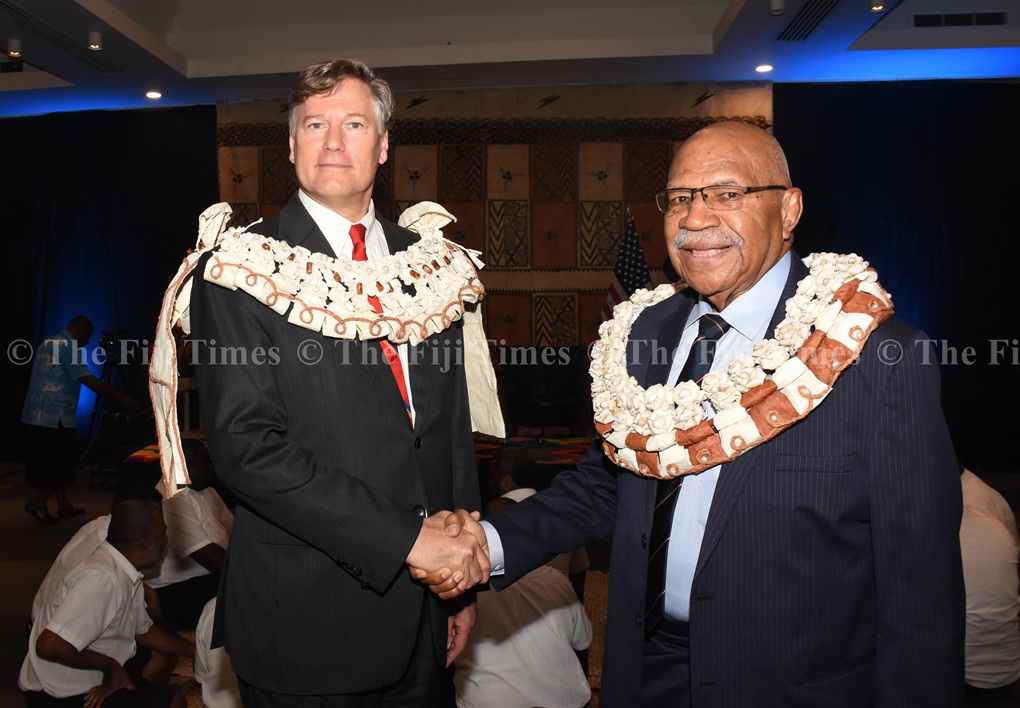
US Deputy Secretary of State Christopher Landau reaffirmed Washington’s commitment to deepening its engagement in the Pacific following a recent high-level visit to Tonga, Fiji and Samoa.
From February 26 to March 2, Mr Landau travelled to the three Pacific Island nations to advance the Trump Administration’s America First economic and security priorities in the region.
The visit followed the Pacific Agenda investment summit he hosted in Honolulu from February 22–24, which brought together senior officials from 16 Pacific Islands and territories along with members of the American private sector.
According to the US Department of State, the trip underscored the United States’ “longstanding commitment to partnering with Pacific Islands to increase economic and commercial opportunities, improve digital connectivity, combat criminal activities, and safeguard global health.”
During meetings with senior leaders in each country, Mr Landau announced a series of initiatives aimed at strengthening maritime security, boosting economic growth, improving digital infrastructure and enhancing health resilience.
Strengthening maritime security
A major focus of the visit was countering Illegal, Unreported and Unregulated (IUU) fishing and other maritime threats that continue to challenge Pacific Island nations.
To support regional fisheries management, the US Department of State announced it intends to provide $US2.5million, working with Congress, to partner with the Pacific Community (SPC).
The funding will help build the capacity of compliance officers to oversee coastal fisheries management and combat IUU fishing. In a further step to enhance maritime domain awareness, the United States plans to provide $US540,000 to support automatic identification systems (AIS) for Tonga and Samoa.
These systems are expected to improve navigational safety and help deter maritime crimes by enabling better monitoring of vessels operating in national waters.
In Tonga, Mr Landau and Crown Prince Tupouto’a ‘Ulukalala signed an arrangement expanding the US Coast Guard’s ability to assist in combating illegal fishing and other criminal activities in Tongan waters.
Enhancing security
Fiji is also set to benefit from enhanced security cooperation. The United States intends to provide $US500,000 in Foreign Military Financing funds to secure communications capabilities for the Republic of Fiji Navy.
The funding is aimed at strengthening the Navy’s ability to combat transnational crime and illegal fishing.
In Samoa, the US Department of State provided $US138,000 worth of custom-fitted ballistic vests and helmets to protect law enforcement officers defending against transnational criminal organisations.
Expanding economic opportunities
Beyond security cooperation, the visit placed strong emphasis on expanding trade, investment and commercial opportunities.
In Samoa, Mr Landau signed an Open Skies agreement designed to remove barriers to increased air transportation between Samoa and the United States. The agreement is expected to promote trade, tourism and people-to-people ties.
In Fiji, the Millennium Challenge Corporation (MCC) signed an agreement with the Government of Fiji for a $US12 million grant.
The funding will support design and feasibility studies that will inform a potential compact programme for consideration by the MCC Board. Such compact programs typically involve large-scale grants aimed at reducing poverty through economic growth.
In Tonga, after extensive consultations with the Government, MCC identified digital technology and energy as the focus areas for the country’s threshold program, first announced in August 2025.
The United States and Tonga also announced cooperation to advance marine scientific research for the responsible exploration of seabed mineral resources, reflecting growing international interest in deep-sea minerals and the importance of ensuring environmental safeguards.
Energy security was another priority. The US Trade and Development Agency announced funding for project scoping services to initiate infrastructure improvement planning for the strategically important Tonga Fuel Storage and Transport Infrastructure feasibility study.
Improving digital connectivity
Digital connectivity featured prominently in the announcements.
The US Department of State said it intends to provide $US6million, working with Congress, to support subsea cable branching units that will enable Tonga and Samoa to connect to the Pacific Connect undersea cable network.
The initiative builds on more than $US230million in funding committed by the United States, Australia, New Zealand, Japan and Taiwan toward trusted undersea cable systems for 13 Pacific Island countries and territories.
In Tonga, an additional US$1 million is planned to support the migration of critical government data assets to trusted cloud infrastructure, strengthening cybersecurity and digital resilience.
Safeguarding global health
Health security was also highlighted during the visit.
The US plans to provide $US5.14million over five years to strengthen Fiji’s ability to prevent, detect and contain life-threatening disease outbreaks.
The support aims to bolster surveillance systems, laboratory capacity and response mechanisms in the wake of lessons learned from recent global health emergencies.
Collectively, the initiatives announced during Mr Landau’s visit signalled an expanded US engagement strategy in the Pacific, combining security cooperation with economic development, digital transformation and health resilience.

