JET fuel was the first to feel the heat when the Israeli-US war on Iran erupted on February 28, 2026, as crude supply crunch due to the closure of the Strait of Hormuz by Iran and subsequent bombing of oil infrastructure in the Gulf region triggered price increases that saw global jet fuel prices almost double in the first week of the conflict.
IATA’s latest jet fuel price monitor shows a jet fuel price average of $US217.34 a barrel for the Asia & Oceania region for the week ended April 10, 2026 against the global average of $197.83 for the week.
Since the war, jet fuel prices have increased by 95 per cent according to Euro News.
In no time, airlines around the world were counting the cost and returning to the drawing board to re-strategise on how to weather the shocks as it became clear that the war would drag on.
Among them was Fiji’s flag carrier Fiji Airways – headed by former Virgin Airline chief executive officer Paul Scurrah.
Mr Scurrah, who is credited with successfully navigating Virgin Australia through COVID-19, considered global aviation’s biggest disruption in modern history, spoke to The Fiji Times last month, three weeks into the conflict when jet fuel prices were touching historical highs and climbing.
FT: You’ve experienced shocks like this before as head of Virgin Airline in Australia during COVID. What do you think of this event. Worse than COVID?
Scurrah: One thing you learn when you’re the CEO of an airline is to consistently expect the unexpected. “Plan for the worst, hope for the best” is a mantra often heard within airlines so that you are prepared when what history has proven is inevitable happens, and that is you’re going to have peaks and troughs, you’re going to have shocks. Generally though, the shocks historically in the airline industry have been isolated to a region, and so it hasn’t had the global impact COVID had.
So COVID was what they call a black swan event, an extreme black swan event where, I think, as we get further away from it, people do tend to forget just the dramatic impact COVID had. Pretty much every airline in the world was fully grounded with no revenue. So while this is a crisis, particularly a crisis for carriers in that region, it is less impactful but still a shock to the rest of the industry.
And the shock we’re feeling at the moment, like every airline in the world, is a shock associated with the spike in fuel prices.
And so obviously, we need to take measures to mitigate the impacts that has on our business. That is something that we’re monitoring on a daily basis, not just the price of fuel but the supply of fuel as well.
And so every single day, we’re checking on both of those factors.
What we are contemplating doing, which every airline who’s affected is doing, is making sure that on our revenue side, we can recover enough to cover the increasing costs that’s coming with fuel.
For us specifically though, the crisis also has an opportunity. And that is because we are, or we do have as Fiji, a reputation of being safe and family friendly. And our relative distance from the conflict has seen what we think is a big increase in interest in coming to Fiji.
So, it’s a very different crisis to COVID, it’s an interest to us to make sure we manage the costs and also capitalise on the opportunity to get greater visitor numbers to Fiji.
And the people of Fiji are relying on us to do that.
FT: What’s the worst-case scenario that is on the table moving forward?
Scurrah: The worst-case scenario for any airline is another COVID. In this circumstance, the worst-case specifically related to the Middle East crisis is that it is prolonged and that we start to see an impact on our ability to get fuel.
Of course, there’s going to be, if it goes for much longer, a sustained increase in the cost, and that will start putting pressure on airlines, particularly on marginal routes where they may have been not necessarily making money.
And so you might see temporary network changes. We may do that. Certainly the other carriers are doing it. But we want to resist the temptation to do that just on a cost basis and do what we can to recover on the revenue side. Now, we know that that’s not an open opportunity for us. If we push our fares up too much, it might actually kill demand. So it’s a balancing act.
But my ambition is to make sure that we continue flying with our full fleet, with a full amount of seats that are coming in and out of Fiji so the hotels and the tourism industry here who are so reliant on us have an opportunity to actually help their businesses and to help the tourism industry here.
FT: So when you look at the fuel jet fuel price, that’s the one that’s very important for you in your operations, when you look at the price now, how much does it have to increase to before you start to think like, okay, this is the worst case scenario and we have to cut some routes?
Scurrah: Well, right now, where the fuel price is, it’s pushing the limits of every airline in the world. And when I say the limits, it’s pushing the limits of maintaining exactly what you do on a normal schedule basis.
So we are seeing other carriers make network decisions because of the fuel price. We haven’t yet got there. And that’s only through the nature of this crisis, seeing an increase in demand to fly in our services.
Without that, we would probably have been in the position to temporarily cut some of the destinations or the frequencies with which we fly.
So while that demand stays high, we think we’re okay to keep operating. The worst-case scenario, though, is that fuel becomes completely unaffordable to the point that, in order to recover it, that means that people stop wanting to travel.
And that is definitely a possibility if this goes on for too much longer.
FT: So how much longer are we looking at before we reach that critical point, like probably say another few months, three months?
Scurrah: I don’t have a crystal ball, unfortunately. If you listen to the political leadership in the world, you know, the ambition is that the Middle East conflict is over quickly.
I think we all want that to happen for so many different reasons. But for us specifically in the airline industry, the quicker it’s over, the more we can get back to normality in terms of supply chain for fuel and the sort of costs that are common and expected for fuel in the airline industry.
FT: Between the time that this war started and now (three weeks later), how much has your fuel costs increased by?
Scurrah: I think what you’ve seen is more than doubling and potentially even tripling of the expected fuel costs. So it’s a significant impact on all carriers. Not only the carriers, though, it impacts on everyone in tourism. Those who are transport operators are feeling it as well.
And so you can’t sustain what could be a tripling of price for very long before it has an impact on demand. And so that’s why you’re seeing airlines and transport operators for that matter, actually increasing [fare].
It’s not because they want to make more profits during this time. It’s because they want to continue operating.
FT: Fuel hedging is something that’s come up in the overseas media for companies like yours where some of them have not hedged because there was hardly any risk of prices going up in the near future. What about Fiji Airways? Have you hedged?
Scurrah: We have historically hedged and spent a lot of money doing so, actually. Hedging can be effective to a degree. It still doesn’t completely insulate you from the challenges, particularly the ones that we’re seeing right now. So hedging is just one way that you can partially mitigate the impact, so it hasn’t fully mitigated. Our previous hedging hasn’t fully mitigated.
And what we’re seeing right now is that we are heavily impacted by the increase in fuel that we’re seeing some airlines choose not to do it because the cost of hedging is pretty significant as well. But you take the risk of these sorts of fluctuations when you do that. So hedging is a tool, but it’s not the only tool, but it certainly doesn’t fully mitigate the risk.
FT: You were talking about how the fuel prices increased, but that there has also been an increase in visitors to Fiji, which has allowed you to maintain things as they are at the moment…
Scurrah: We’ve seen an increase in interest in booking traffic or at least enquiry levels to come to Fiji. But we’ve also, and I believe, I hope I’m proven wrong, but I think it’s a short-term level of interest in flying with our long-haul services as people who were stranded in Europe in particular and had their original plans disrupted, are looking to piece together itineraries to get home to the Southern Hemisphere, Australia, New Zealand in particular. And as that occurs, we are seeing that we are getting more and more traffic through our North American ports. That could be temporary, but on the flip side, we are seeing, particularly in our core source markets Australia and New Zealand, we are seeing a diversion of interest away from further flung tourist opportunities for them. Because we are closer and easier in many cases for them and we are reputationally very safe and family friendly, we’re seeing an increase in that interest as well.
That is not something we’re entitled to and it’s not something that we take for granted because if we push our fares up too much, if the industry here makes it too expensive, we’re going to see interest divert back to other competitive markets. So particularly out of Australia and New Zealand, you’re looking at Indonesia, Thailand, Vietnam, so we don’t have it all our own way.
We can’t just push prices up without having some regard to the impact on demand. And that’s a team effort. Our operating costs are going up quite a lot because of fuel.
We know that that will push up the cost of the holiday to Fiji. But we need the industry to work together to make sure that we minimise the impact so we remain competitive. Otherwise, we all lose.
FT: There have been calls made for us to take this opportunity to market Fiji as a safe destination, like urging other stakeholders to get together and do that. What are your thoughts on that?
Scurrah: Yes, I agree. I think this is an opportunity given the unique circumstances of what the crisis has created.
You never want to be blindly chasing something without respect to what is happening. But this does present us an opportunity and one that we should gracefully accept.
But also make sure that when we get the opportunity for people to fly on Fiji Airways or to transit through or even get off at Fiji when they weren’t contemplating it just two or three weeks ago, that’s our opportunity to then promote why it’s good to come back to Fiji.
And I think that’s what we should all be doing together.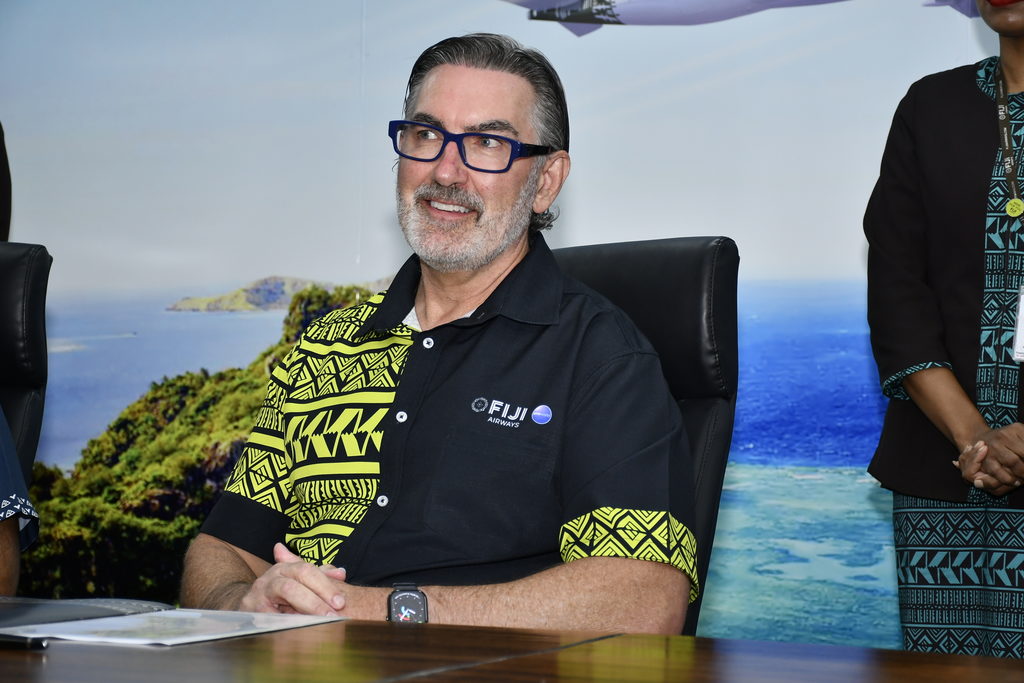
Fiji Airways CEO Paul Scurrah. Picture: BALJEET SINGH