THE Fijian Competition and Consumer Commission (FCCC) has pushed back multiple submissions from Fiji’s sole power utility for an increase in electricity tariff, finally settling on a tiered pricing structure designed to soften impact for Fijian households and businesses.
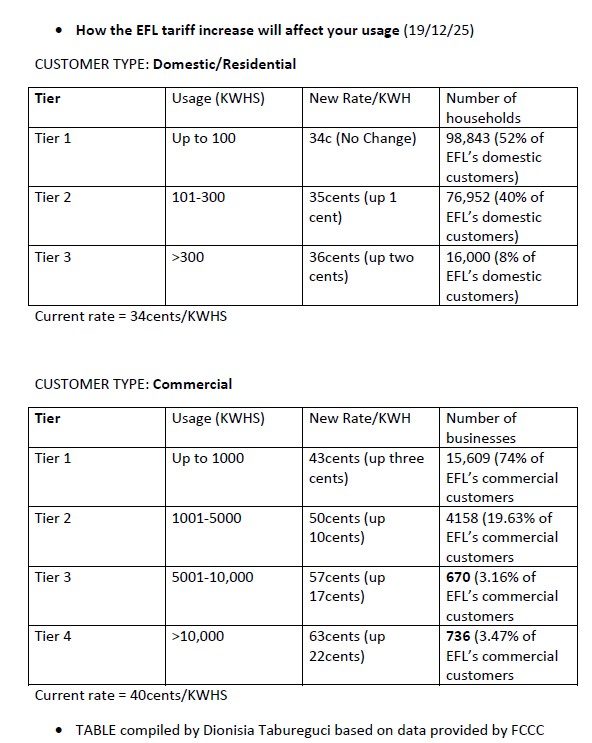
The new usage-based tiered rates will shield 98,843 households or over half of Energy Fiji Ltd’s (EFL) domestic customers from any increase while ensuring minimal impact for small businesses (see table).
“After rigorously assessing all these (EFL multiple submissions since 2023) FCCC did not approve the proposed 37per cent increase and instead allowed an increase of 24.2per cent in the revenue requirement,” FCCC chief executive officer Senikavika Jiuta said in a media conference yesterday.
“Approval was granted only because the revised plan is fair to the average consumer, necessary to maintain system reliability and essential to securing Fiji’s future energy needs in a sustainable manner.”
The 24.2 per cent increase in EFL’s revenue requirements approved by FCCC translated to a three to six per cent increase in domestic tariffs and increases of between seven to 55per cent for commercial customers.The Commission has also tied renewable energy-based power generation conditions to the rate increase, which it said it will monitor and evaluate every six months.
“The renewable energy project they’ve provided (in EFL’s submission) is investment into two hydros. That’s Vatutokotoko (Lower Ba) and Qaliwana,” FCCC manager Economic Regulations Avneet Singh said.
“The Vatutokotoko will finish within the next five years and Qaliwana will carry on, while the investments that we’re seeing in the IPP sector would be a core investment between EFL and the IPPs (Independent Power Producers) amounting to $200million and that will be in solar.
“That’s an area that Fiji has lacked and now finally, EFL is venturing into that.
“So, the target is 60per cent renewables with IPPs by 2029, because this tariff cycle is from 2026-2029, and by 2035, their target is 90per cent renewables.
“So based on these, that’s why this decision has been reached,” Mr Singh said.
The inclining block tariff structure replaces the current single rate structure and will be due for review in 2029, according to FCCC.
NOTE: The Table below has been modified to show the correct figures in Tier 3 and Tier 4 of the Commercial Customers category (in Number of Businesses). These were erroneously entered in the print version of this article.