
Smart farms or smart farming is now widely acknowledged to be the future of agriculture around the world. Smart farming techniques are becoming a preferred practice in agricultural production – integrating high-technology digital innovations to farming systems, promising high yields with reduced operational costs and crop damage, minimal water use, fuel, fertiliser and pesticide to make farming more environmentally-friendly. On June 14, the Ministry of Agriculture and Waterways, Taiwan Technical Mission (TTM), Taiwan International Cooperation Fund (TaiwanICDF) and stakeholders celebrated the opening of Fiji’s first agriculture technology centre – the Centre for Agriculture Technology Transfer (CATT) – at Bau Rd outside Nausori. Representative of the Taipei Trade Office in Fiji Paul Chen said CATT is a holistic ecosystem that integrates agriculture and technology to bring innovation and efficiency to the two countries’ agricultural cooperation project.
Centre for Agriculture Technology Transfer (CATT)
It has been more than three years since the groundbreaking ceremony for CATT on February 15, 2021. Taiwan ICDF secretary general Dr Charles Li said the centre – managed and overseen by TTM specialists and staff, will feature agricultural technological innovations, cultivation management demonstrations and crop tissue culture of seedlings like banana, guava and dragon fruits that’s in progress. He said CATT would mobilise resources to enhance function and efficiency in agricultural production. The smart farm, built at a cost of $3million funded by Taiwan ICDF, features a tissue culture laboratory, technologically controlled greenhouse, processing facility, training hall, staff quarters, and demonstration fields to also train extension officers and farmers on latest advancement and technology. CATT has two objectives:
i) education and training seminars for farmers and student internships in partnership with MOA in areas of tropical vegetable and fruit seed production; and
ii) demonstration and experimental planning will primarily focus on main crops of current program and future crops to be promoted by MOA.
Tissue culture lab
Thousands of plants can be prepared in a few weeks in the TC lab from a plant tissue that is prepared in a controlled environment; and the method requires very little space, produces disease resistant materials of good quality, and no weather effects. The TC lab is equipped with quality equipment like laminar flow bench, autoclave, glass bid sterilisation and others by which plant tissue culture is done without any contamination. The lab has produced tissue cultured planting materials for guava, dragon fruit, dalo, and banana, and talks with specialists are happening for kava.
Smart greenhouse
The functions of the smart or “intelligent” greenhouse include the cultivation and acclimatisation of tissue-cultured seedlings, propagation and cultivation of general vegetables and fruit tree seedlings, demonstration of modern cultivation techniques for fruits and vegetables, and a venue for hands-on practice. The construction area is 537.6 square metres, dimensions of 28m in length, 19.2m – width, and 6.5m – height. The main structure is steel-based, with reinforced concrete foundations, exterior insect-proof net covering, and a Prince’s roof cooling structure at the top of the greenhouse. The interior has fixed planting beds, internal circulating fans, external exhaust fans, fine mist spray cooling system, environmental monitoring system, and automatic external shading system. The design prioritises cyclone resistance and equipment durability.
Demo farms
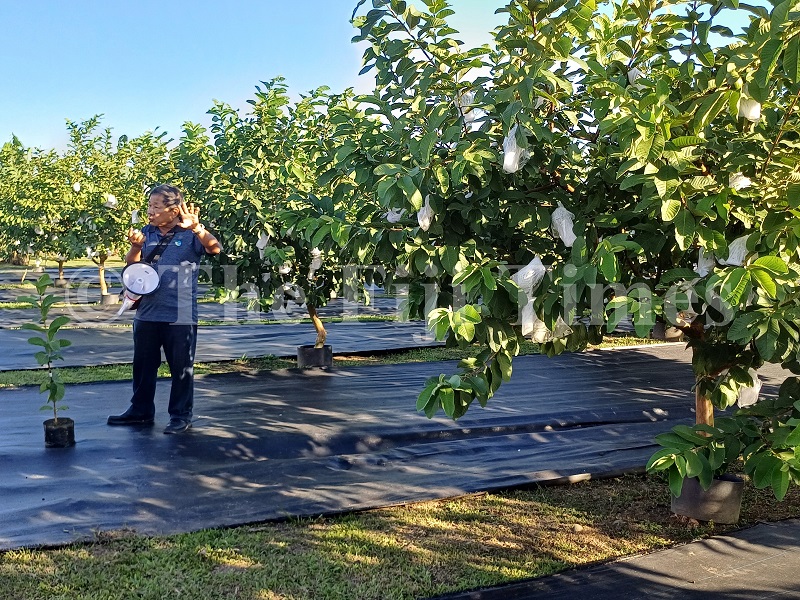
Of the 2.8 hectares of land CATT sits on, 0.2ha is for the dragon fruit and guava demo farm, and 1.2 ha for dalo and banana to produce seedlings. Guava is being piloted by 50 farmers around Fiji.
The Taiwan cooperation project has helped 35 family-owned farms to produce guava that has generated revenue valued at $F4m; and 16 family-owned farms to produce dragon fruit farmers.
Mr Chen said within CATT, the focus extends beyond productivity and efficiency.
“Through collaboration with the MOA in Fiji, we will develop and improve new crop varieties, actively mentor farmers, engage with Fijian communities, and promote local agricultural economic development.”

