
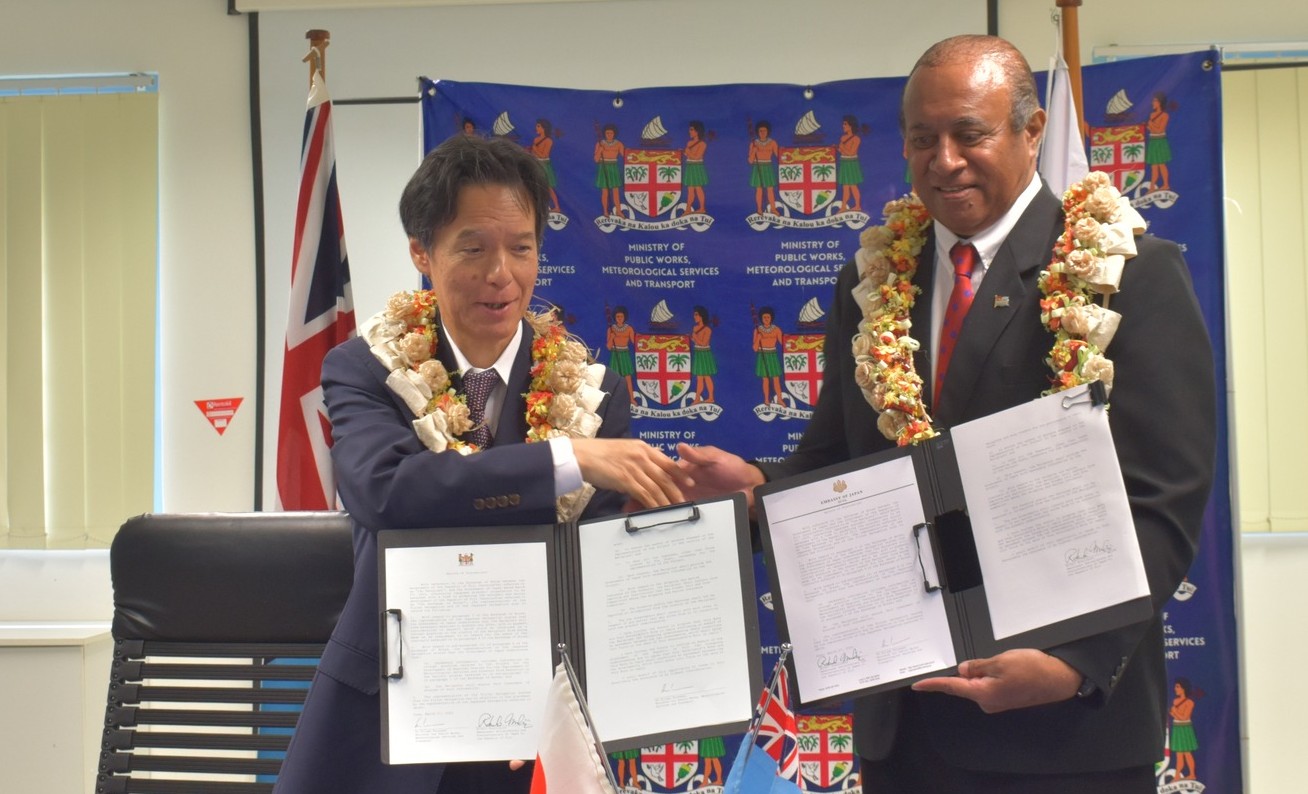
FIJI will soon have state-of-the-art meteorological training facilities, funded by the Japanese Government, to help advance staff capabilities from forecasting organisations in Fiji and the Pacific.
Yesterday, an Exchange of Notes signing ceremony was held between Japanese Ambassador Rokuichiro Michii and Minister for Public Works, Meteorological Services and Transport Ro Filipe Tuisawau at the Fiji Meteorological Service (FMS) office in Laucala Bay, Suva.
Mr Michii said the cooperation between Fiji and Japan began in the 90s when Japan helped build the existing meteorological centre in Nadi.
“People actually continue to talk and share information and find a way of how we can improve the collaboration,” he said.
Mr Michii said with the severity of climate change and natural disasters increasing, preparedness was no longer an issue for a single country but a common agenda.
“And so, what we have been doing is to collaborate with each other, share information and provide what we have at the moment. Which includes this kind of modern technology, also satellite technology, which we’re operating. So over the past years, we have tried to expand the areas of cooperation, even for climate change,” he said.
Ro Filipe said this was a significant milestone in Fiji’s journey towards progress and development in the Pacific.
“Fiji is vulnerable to climate change and at high risk of disasters and there is a need to strengthen disaster prevention and monitoring systems in Fiji and the Pacific region,” he said.
“This is to reduce disaster risk and to enhance our response capabilities. This year, we haven’t been hit by a major cyclone, there have been some weather systems passing through and so we have been fortunate in 2024/2025 cyclone season.
“We would like to express our gratitude towards the Government of Japan and support to this program, and in the setting up. It is a substantial investment in Fiji and the Pacific.”
Ro Filipe said the Pacific Meteorological Council had recommended Fiji to host these two regional centres.
“As a Government, it’s critical in any development cooperation to reiterate our responsibilities in terms of effective project management, which is basically to have a good concept plan, proposal and achievable based on relevant data.”
He said the project would be a positive step towards upskilling local and regional staff.
The project would include the construction of training facilities compliant with World Meteorological Organization (WMO) guidelines, as well as calibration facilities for meteorological instruments.
A library would also be set up to store and view books and records related to meteorology.

