
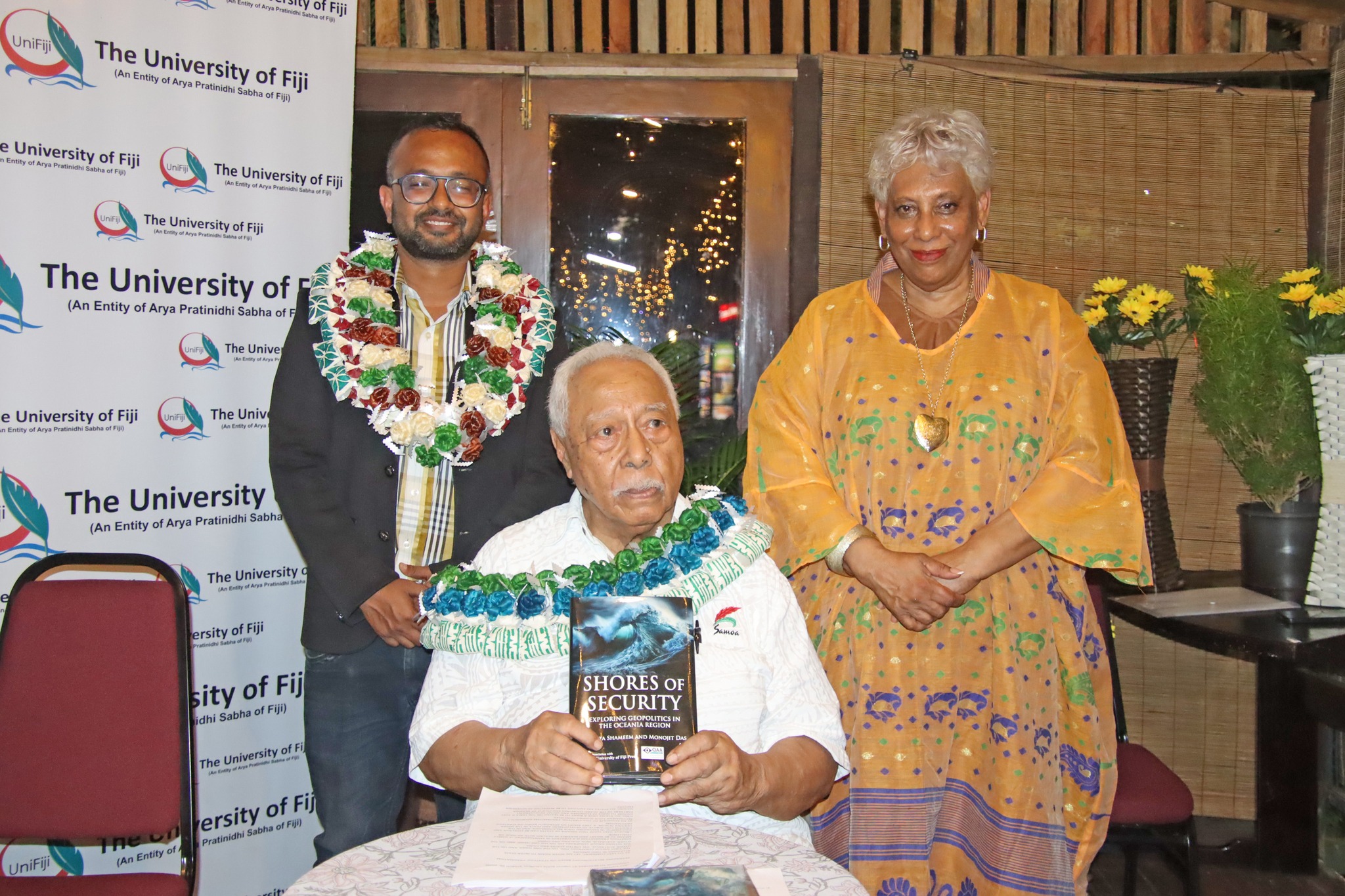
The growing strategic tug-of-war shaping the Pacific and the careful balancing act of island nations caught in between was brought into sharp focus at the launch of a major new regional publication in Suva.
Shores of Security: Exploring Geopolitics in the Oceania Region, co-edited by Shaista Shameem and Monojit Das, was officially launched on Thursday evening by Jioji Kotobalavu at the University of Fiji campus at 1 City Central.
The event formed part of the university’s 21st anniversary celebrations, with Mr Kotobalavu acknowledging the traditional landowners of Vuda for their role in supporting the institution’s establishment.
But beyond ceremony, his remarks turned to a central question driving the book’s analysis: why States behave the way they do in managing relationships with others.
A region of shifting alliances
Drawing on the publication’s framework, Mr Kotobalavu outlined how Oceania’s geopolitical landscape can be understood through three broad groupings Pacific Island countries themselves, traditional Western powers, and newer external partners.
At the centre are island states, alongside Australia and New Zealand, forming the core membership of the Pacific Islands Forum.
Alongside them are long-standing powers such as the United States, France and the United Kingdom.
Increasingly, however, newer actors particularly China, as well as India, Japan and others are reshaping the region’s strategic dynamics.
Balancing security and opportunity
This shifting landscape is reflected in the approach taken by Papua New Guinea.
While maintaining strong defence ties with Australia and the United States, Papua New Guinea has simultaneously expanded economic cooperation with China, particularly in infrastructure and development.
The result is a dual-track strategy that reflects a broader regional pattern maintaining traditional security partnerships while embracing new economic opportunities.
Fiji’s strategic positioning
For Fiji, longstanding relationships with Australia and New Zealand remain central to national development.
These partnerships underpin key sectors including trade, education, health and security, with growing cooperation in tackling transnational crime.
Fiji has also strengthened defence ties with the United States, while continuing to recognise China as a vital partner in economic development — a relationship dating back to the 1970s.
This balancing approach aligns with Prime Minister Sitiveni Rabuka’s vision of the Pacific as a “zone of peace,” grounded in dialogue and mutual respect.
Survival and strategy
For smaller island states such as Tuvalu, geopolitics is closely tied to survival.
Rising sea levels pose an existential threat, making international partnerships critical. Agreements such as the Falepili Union treaty with Australia offer support, while also highlighting the strategic interests shaping such arrangements.
Superpower rivalry intensifies
The broader contest between the United States and China continues to influence the region.
The United States is reinforcing its presence through defence agreements and funding support to key Pacific partners, while China has focused on economic engagement, particularly through infrastructure investment and bilateral cooperation.
Both approaches are reshaping alliances and testing the region’s ability to maintain unity.
A call for strategic pragmatism
In his concluding remarks, Mr Kotobalavu distilled these complex dynamics into two key relationship groupings.
The first centres on Papua New Guinea and its interactions with Australia, the United States and China. The second focuses on Fiji and its relationships with Australia, New Zealand and China.
To manage these relationships effectively, he advocated for what he described as “strategic pragmatism” — a practical and measured approach to navigating competing interests.
Strategic pragmatism simply means being smart and sensible in dealing with challenges,” he said, arguing that such an approach could enable countries to foster both development and peace across the region.
He outlined four guiding principles to support this framework.
First, all states should have a place at the table if they wish to contribute to the economic and social development of Pacific Island Nations.
Second, all countries must be respected as sovereign entities, regardless of size or influence.
Third, relationships should be conducted in good faith, underpinned by mutual trust and confidence principles that have long guided dispute resolution in legal and institutional settings.
Finally, the ultimate objective should be to achieve “win-win” outcomes, ensuring shared benefits for all parties involved.
Mr Kotobalavu said this approach is particularly relevant in engaging newer partners in the region, including China, India, Japan, South Korea, ASEAN member states and Canada.
A region shaping its own future
As geopolitical competition intensifies, the Pacific faces increasing pressure from external powers.
Yet, as highlighted throughout the discussion, island nations are not passive participants. Instead, they are actively shaping their own pathways, balancing relationships, protecting sovereignty and pursuing development on their own terms.
Declaring the book officially launched, Mr Kotobalavu described Shores of Security as a timely contribution to understanding these dynamics.
In a region navigating both opportunity and uncertainty, his message was clear: the Pacific’s future will depend not only on the interests of global powers, but on the wisdom and strategy of the nations at its centre.

