
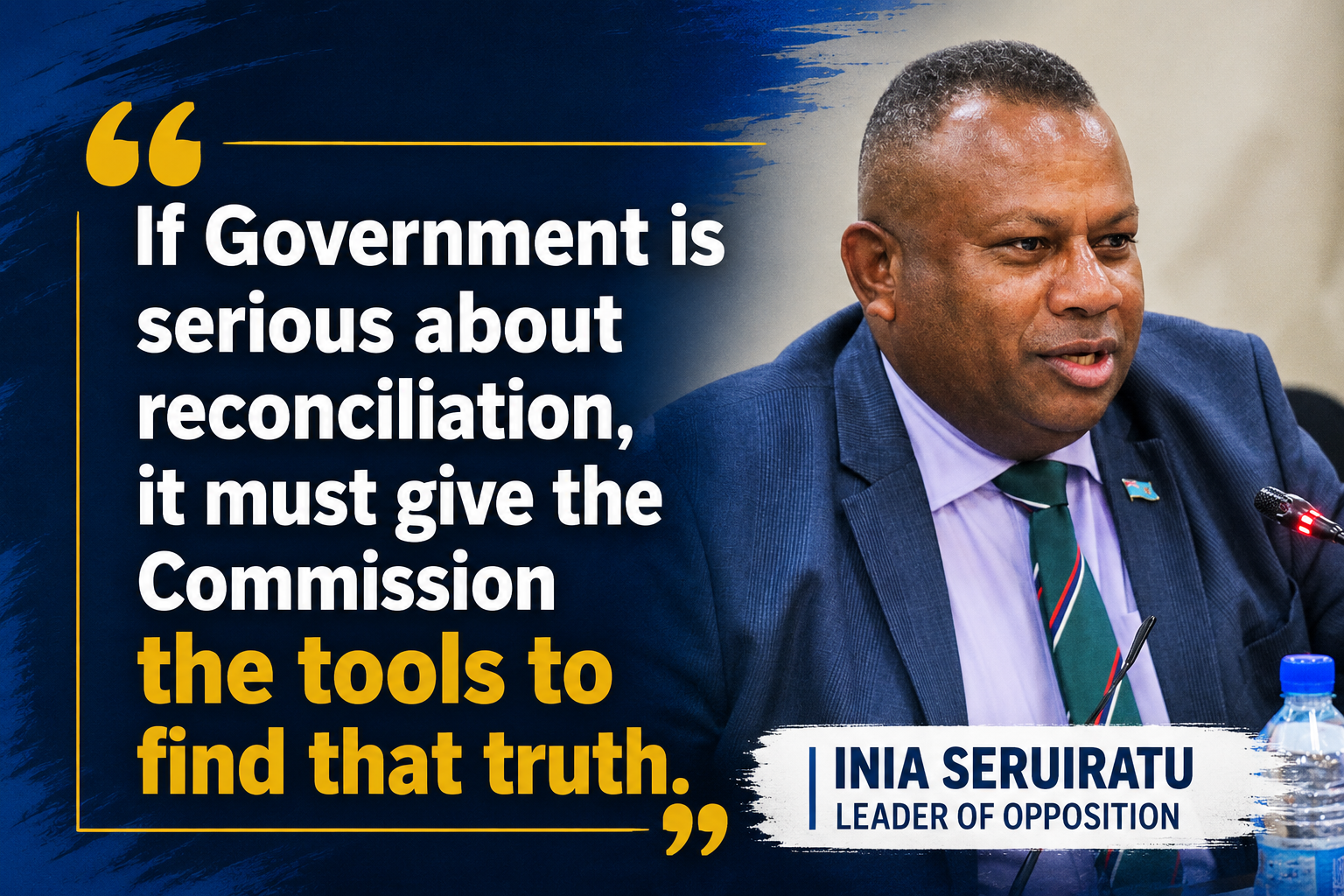
Opposition Leader Inia Seruiratu has questioned whether Fiji’s Truth and Reconciliation Commission has been given sufficient powers to uncover the full truth behind the political upheavals of 1987, 2000 and 2006.
Seruiratu says almost two years into the process, fundamental questions remain unanswered about the individuals who planned, supported, financed or influenced Fiji’s coups.
“I raised this concern in Parliament last December when I asked: Who were the people behind 1987? and who were the people behind 2000?” Seruiratu said.
“Those questions remain unanswered.”
He acknowledged the importance of the Commission hearing from victims and families but argued that documenting their experiences alone would not establish the full circumstances behind Fiji’s political crises.
“Recording people’s suffering is not, by itself, the same as establishing the truth about why these events happened, who planned them, who supported them and who benefited from them,” he said.
Seruiratu’s central concern is that the Commission does not have the power to summon witnesses.
He questioned how it could establish the truth if people with critical information refused to voluntarily appear.
“Government cannot establish a Commission to find the truth and then deny that Commission the power to require those who may hold that truth to appear before it,” he said.
Seruiratu also questioned the Government’s allocation of another $1.5 million to the Commission in the 2026–2027 National Budget, saying taxpayers were entitled to expect measurable results.
“The Opposition does not object to spending money on a credible process that can establish the truth and contribute towards lasting national reconciliation,” he said.
“What we question is spending another $1.5 million on a Commission that Government itself has prevented from using one of the most important tools available to uncover that truth.”
Seruiratu said the Commission should ultimately provide answers about who was involved in Fiji’s political upheavals, what occurred behind the scenes and what lessons could prevent similar events in the future.
He also pointed to Prime Minister Sitiveni Rabuka’s appearance before the Commission, saying Rabuka had stated that he succumbed to pressure from influential figures in carrying out the 1987 coup.
“The obvious question is: who were those influential figures?” Seruiratu said.
“The Commission should have the ability to pursue that evidence. It should be able to identify those individuals, summon relevant witnesses, examine their evidence and establish what role, if any, they played.”
Seruiratu said George Speight, people with direct knowledge of the 2000 events, and former and serving RFMF officers with relevant information should be heard by the Commission.
He stressed that strengthening the Commission’s powers should not be about conducting a “witch-hunt” or using the process to prosecute individuals.
“The purpose should be to establish, as accurately as possible, what happened, who was involved, why it happened and how Fiji can prevent it from happening again,” he said.
Seruiratu called on the Government to explain what had been achieved with previous funding and what specific outcomes taxpayers could expect from the additional $1.5 million.
“If Government is serious about reconciliation, it must give the Commission the tools to find that truth,” he said.
“If taxpayers are expected to fund it, then Government must ensure that the country receives tangible results.”

