
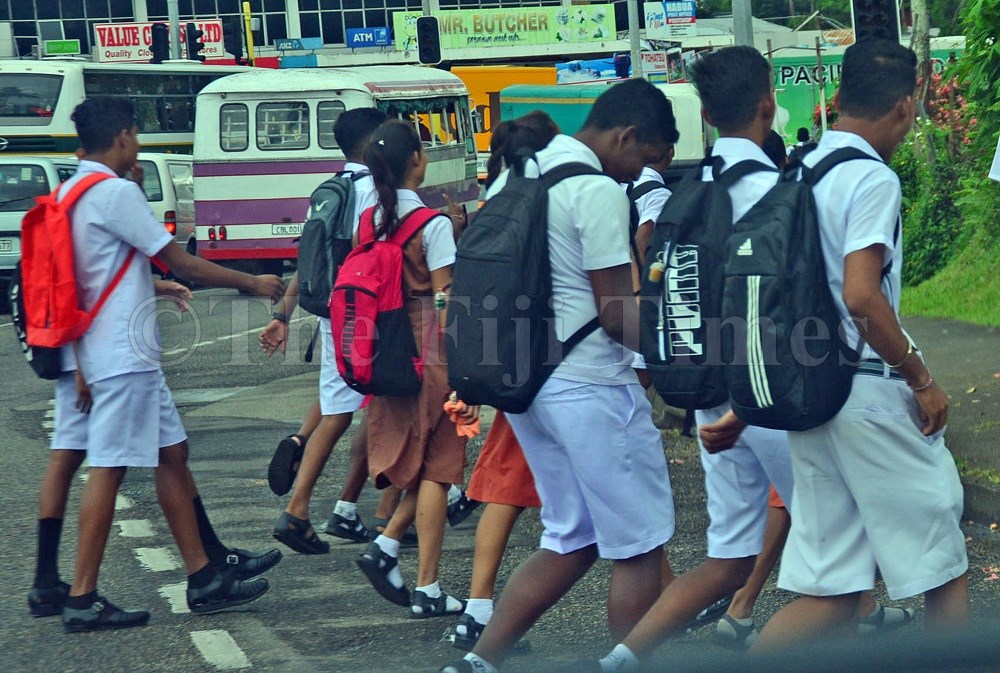
ABOUT 70 per cent of 86 schools in the Suva-Nausori corridor, surveyed for an infrastructure project are overcrowded.
This is outlined in the Infrastructure Assessment Report for Suva-Nausori Schools released recently, which also states there is inconsistency in classroom sizing between the Fiji National Building Code (FNBC) and the Ministry of Education.
The report said based on the current student population, application of the FNBC results in almost 100 per cent schools being deemed severely overcrowded.
“By contrast, application of the Ministry of Education specifications results in only six schools being deemed overcrowded,” the report said.
“A ratio of 1.5 square metres per student is recommended as a more appropriate benchmark for the Fiji context. This specification aligns with the recommended classroom sizing in several middle-high income countries globally.
“Based on the recommended spacing of 1.5m2/student, to meet the current student population, 249 additional classrooms are needed: 168 additional classrooms are required for primary schools and 81 for secondary schools.
“If utilising the FNBC guidelines of 2m2/student, to meet the current student population, 745 additional classrooms are needed.”
The report also said addressing all current and future overcrowding meant construction of the additional classrooms needed to be considered in conjunction with the available land, staffing and teaching requirements, and enrolment growth rates.
In addition to overcrowding, there were concerns raised about the poor condition of water, sanitation and hygiene (WASH) facilities.
“Most schools surveyed have insufficient toilets and taps, preventing proper hygiene practices during school attendance, particularly for female students.
Teachers interviewed throughout the audit spoke of the correlation between absenteeism and poor WASH facilities for students and staff.”
About 47 per cent of schools do not meet FNBC’s toilet-to-student ratio. The report said primary schools required 17 new male and 97 new female toilet cubicles, while secondary schools required two new male toilet cubicles and 67 new female ones.
“Many schools have buildings that were not constructed in line with current FNBC or MoE guidelines, 55 per cent of schools surveyed exhibited defects (cracks in walls, floors, and beams, broken fixtures, water damage), deteriorating infrastructure (corrosion, likely presence of asbestos, deteriorating structural elements) and damaged infrastructure.
“Primary schools were observed to be in poorer condition than secondary schools. The structures’ condition indicated that maintenance had not occurred at frequent or regular intervals.
“All schools lack accessible infrastructure, including ramps and WASH facilities. Of the student population — 56,908 students enrolled in the 86 schools surveyed — only 31 students identified as having a disability.
“This demonstrates the prohibitive impact of inaccessible infrastructure.”

