
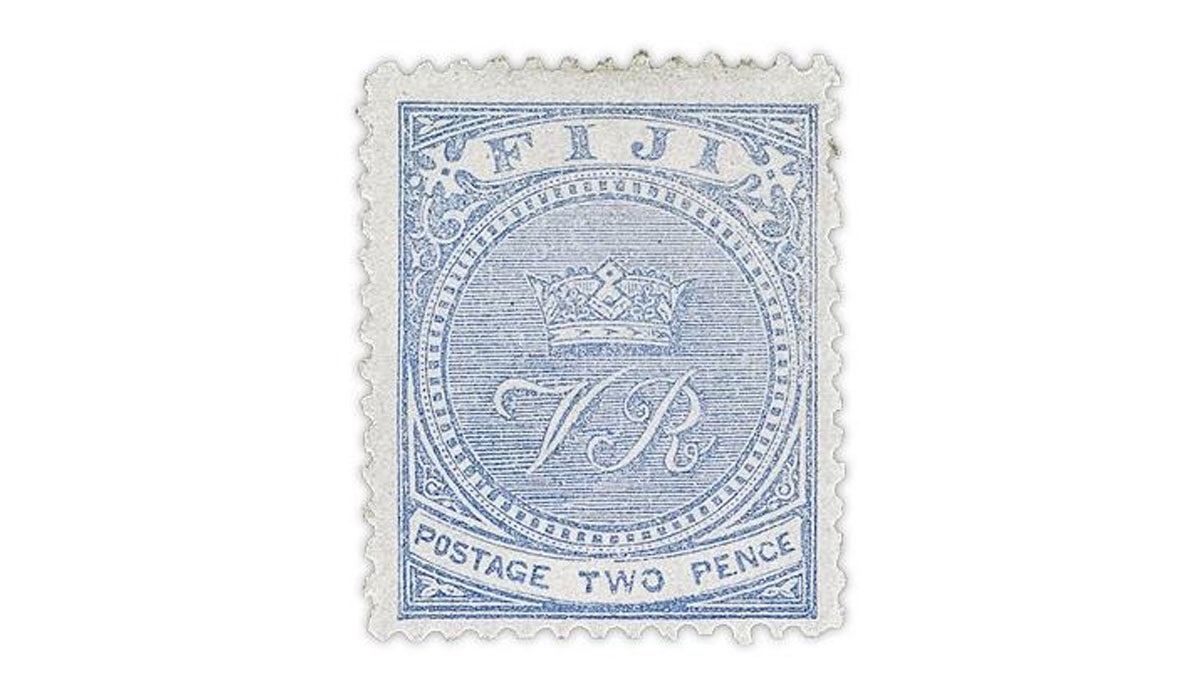
A rare two-pence Fiji stamp, which was once locked up due to a colouring mistake, has been sold for $US94,400 ($F214,354) at an auction in New York this week.
The stamp captured the curiosity of stamp enthusiasts and collectors when it was listed for auction by Siegel Auction Galleries in New York City and was part of a collection of Fiji and Samoa stamps being sold by Barry K. Schwartz.
A statement from the auctioneers stated the two-pence Fiji stamp was printed for the Fiji Post Office, 145 years ago and its blue colour made it rare and valuable.
“The stamp was initially supposed to be green, however, when it arrived from the printers to Fiji in 1878, a government official recognised the error and asked for a new shipment,” the statement said.
“Hence, 50,000 stamps in the wrong colour were locked up and never meant to be sold. Out of this, four survived.
“Two are part of the Royal Philatelic Collection and The British Library respectively, one was acquired by famous Parisian collector Count Philipp la Renotiere von Ferrary, and it was sold after his death.”
In 1983, the stamp was in the hands of collector John Gartner until bushfires in Australia claimed his home and stamp collection.
Thus, only one remained in the hands of a private collector. According to Siegel Auction president Scott Trepel, the purchase price of $US94,400 for the Fiji two-pence blue colour error might “seem like a lot for a stamp from a small island post office in the South Pacific”, but he felt it was really a bargain.
“There are only three in the world, and two of them will never be sold because they are held by the Royal family and a British museum,” he said.
“The collector who bought the stamp in our auction on November 15 possesses something that is, for all practical purposes, one-of-a-kind.
“Fiji stamps have been in great demand since the 19th century, close to the time they were issued.
“The two-pence blue error appeals not only to collectors of Fiji, but to collectors of British Commonwealth and worldwide stamps. And there is only one copy available, which puts it in a special class of stamps.”

