
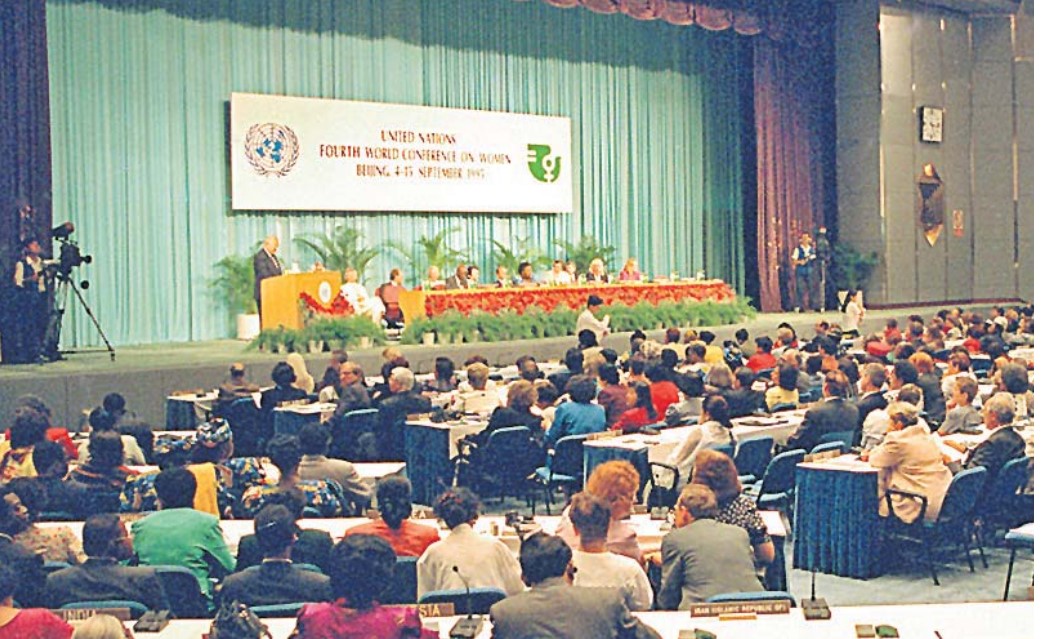
In 1995, more than 189 countries at the Fourth United Nations World Conference on Women in Beijing, China, spearheaded a momentous declaration to advance gender equality across the globe.
The Beijing Declaration and Platform for Action (BPfA) has become the blueprint for advancing women’s rights and achieving gender equality.
Next year marks 30 years of the declaration’s existence, but progress to implement change has been slow.
While there have been advancements made to reaffirm women’s rights, the reality on the ground is a different story as some countries have made significant progress while others have lagged.
To identify the gaps and discuss the way forward, representatives from the Asia-Pacific region are in Bangkok, Thailand, this week for the Asia-Pacific Ministerial Conference ahead of the BPfA’s 30th anniversary next year, and the 69th session of the Commission on the Status of Women in New York.
What is the BPfA?
Countries present at the Fourth World Conference on Women 29 years ago recognised the dire need to advance the rights of women and girls, eliminate all forms of violence and, fundamentally, empower all women.
The document outlined that all states, regardless of their political, economic and cultural systems, must promote and protect all human rights and fundamental freedoms.
“The full and equal participation of women in political, civil, economic, social and cultural life at the national, regional and international levels, and the eradication of all forms of discrimination on the grounds of sex are priority objectives of the international community,” the document stated.
The BPfA also pointed out that the end of the Cold War had diminished the threat of a global armed conflict, however, wars of aggression, armed conflicts, colonial or other forms of domination and foreign occupation, civil wars and terrorism continued to plague many parts of the world.
“Grave violations of the human rights of women occur, particularly in times of armed conflict, and include murder, torture, systematic rape, forced pregnancy and forced abortion, in particular under policies of ethnic cleansing,” the document said.
The document emphasised economic growth which improved the quality of life of the entire population and spurred growth, equality between women and men, social justice, conservation and protection of the environment, sustainability, solidarity, participation, peace and respect for human rights.
The BPfA also expressed concern about women in leadership positions.
“There has been important progress in achieving equality between women and men.
“Many governments have enacted legislation to promote equality between women and men and have established national machineries to ensure the mainstreaming of gender perspectives in all spheres of society.
“The growing strength of the non-governmental sector, particularly women’s organisations and feminist groups, has become a driving force for change.”
The BPfA called for equal and equitable opportunities for women and girls, particularly in the areas of education, access to healthcare, environmental protection and political participation.
Fiji’s status
The Fiji Country Gender Assessment (FCGA), launched in 2023, took three years to collate. It involved a whole-of-society approach and was deemed the first of its kind in the region.
The assessment contains findings on Fiji’s progress towards achieving the Sustainable Development Goals (SDGs), and whether the country’s progress falls in line with the objectives of the BPfA and 1979 Convention on the Elimination of All Forms of Discrimination Against Women (CEDAW).
According to the FCGA, Fiji’s score on the World Economic Forum’s Gender Gap Index improved from 0.638 in 2017 to 0.674 in 2021.
About 46 per cent of women are in the labour force, compared to 83 per cent of men. The FCGA also said women made up 79 per cent of vendors across the 13 municipal markets.
While girls make up a higher number of students in primary and secondary schools, less than 50 per cent of all graduates at tertiary level are women. Women are also severely underrepresented in leadership positions.
Fiji also faces one of the highest rates of violence against women and girls; 64 per cent compared with the global average of 35 per cent.
Access to healthcare is also a challenge for some women, and the FCGA states that half of the women diagnosed with cancer do not seek further medical assistance or treatment.
In addition, the FCGA states that iTaukei women represent the majority of breast and cervical cancer cases in Fiji.
Women are also disproportionately affected during disasters as domestic violence cases increase post-disasters.
The document has also identified that gender norms in Fiji sustain the patriarchal hierarchy of men’s power and privilege over women.
Where to from here?
Fiji Women’s Rights Movement (FWRM) executive director Nalini Singh, one of Fiji’s representatives at the Asia-Pacific Regional Review of the 30th Anniversary of the BPfA in Bangkok, says, “enough is enough”.
She said the review was a pivotal moment for women’s rights activists, feminists, women’s and human rights defenders, as well as governments and member states of the UN, to come together and realise that they were 10 years behind a global agenda that was supposed to be completed about a decade ago.
“When we look at what’s happening to people, in our societies, and when we are talking about gender equality, that means we are leaving at least half the populations of each of our countries behind in so many different ways,” she told this newspaper.
Ms Singh said there were critical areas such as gender-based violence, violence against women and girls, employment, education, health and the climate crisis where women were disadvantaged.
She also questioned the lack of proper access to reproductive healthcare to all women and girls.
“Access to contraception. You know, why can’t they have access to that? Why do we have adolescent pregnancies in the numbers that we do in our countries?
“And then, of course, in the workplace, why aren’t they progressing at the level as men are and also getting into leadership positions?
“Why aren’t they there in equal numbers on our boards or as leaders, elected leaders in our parliaments, local government and all of that?
“So, there has to be a further examination as to what we have done on paper for education has really not translated into all the other areas. So, what more needs to be done?”
Ms Singh said women were still doing the same amount, or even more, of unpaid care work.
She said women on average do 74 per cent more unpaid communal and domestic care work.
“That burden still remains. And when women don’t have free time to socialise, network, build their social capitals and all of that, how are they expected to get into any other areas of engagement.”
Ms Singh said women were the ones who worked their nine to five jobs and often go back and do up to six hours of unpaid care work.
“They have to look after themselves. Some countries have good laws, regulations in regards to the kinds of leave women can take. Some countries don’t.”
Ms Singh said these were the same issues that happened 30 years ago and were still happening today.
“Our governments are obligated to act, but they’re too slow. We have, in Fiji, very good laws and policies, but how are they implemented?
“What’s the level of budget that goes to gender mainstreaming? How is that happening?
“You see women being employed in most ministries and across many institutions at the lower level still. What needs to change so that they move to higher levels?”
Ms Singh commended the flourishing civil society, feminist, civil rights, faith-based, community, youth-led, LGBTIQ+ and disability organisations in Fiji.
She said the forum was also crucial to ensure the Pacific’s voices were heard at the international level and help those coming into such spaces to also understand the work that has happened, and what more needs to be done.
“We hope that the chair summary is a strong one, one that carries forward our calls for action as well. Because we’re saying enough is enough. We need to have real action.”
Need for a united Pacific front
UN Women Fiji multi-country office representative Delphine Serumaga is encouraging members of the Pacific CSO Forum in Bangkok to ensure Pacific voices are not “drowned out”.
“It’s important to hear the voice from the Pacific as we know it does get drowned every so often when Asia-Pacific is put together,” she said.
Ms Serumaga said that being in the women’s rights movement for 30 years now, the Beijing process was not new to her.
“What is new to me is the Asia Pacific coming together because I used to do this on the African continent, bringing up the African civil society together, as well as African governments, especially the ministries of women’s affairs, whichever name they use.
“So, I see an absolute value of ensuring that new voices are brought to the table along with the veteran voices because it’s also about passing on the baton.
“You also, at some point, will be the veteran, telling others and bringing them forward to us that is essential because of the context of the world itself.
“A lot of governments are voting conservative. So, it’s almost like needing to go back to 1994, 95 or even 1975, to make sure that we’re not losing ground.”
She encouraged Pacific CSOs to continue “holding ground”.
“Let’s not repeat certain mistakes. Let’s do better than we have done before.
“What we would like to see is that you move into the space of the Asia Pacific fearlessly and unapologetically, needing to say what the Pacific needs, particularly because if you don’t speak the truth, nobody’s going to speak for you.
“That is because they are also speaking for themselves. By the time you get out of these sessions here with the other 350, you’re going to meet others at a global level, and they come in the thousands with their own priorities.”
Ms Serumaga also said CSOs were the ones that held governments accountable.
“It’s also about holding your governments accountable, of not creating gender as a trading point or one of interest that can be compromised.
“We’re very happy to see brand new faces. We’re very happy to see the support of veterans coming to support the new faces. We really look forward to the opportunities of opening doors where you feel you need to get into.
“But the first step you can only do is really bring you together, so you can create your own voice, and we can hear that voice.”

