
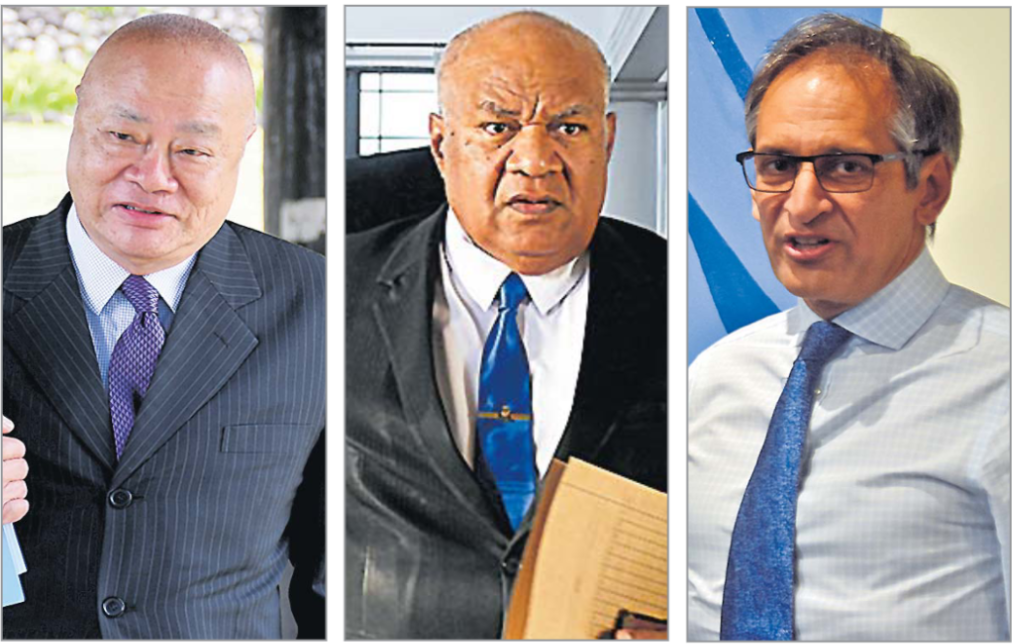
Senior lawyers Graham Leung and Richard Naidu said yesterday that the President of Fiji must follow the advice of the Judicial Services Commission (JSC) on the Acting Commissioner of the Fiji Independent Commission Against Corruption (FICAC), Lavi Rokoika, without delay, conditions, or bargaining.
“Under section 82 of the Constitution, they said in a public statement, he does not make choices. He does not exercise discretion. And he certainly does not bargain with constitutional bodies who require him to act as the law requires. If he is being advised otherwise, he is being wrongly advised.”
Fiji is at a critical constitutional moment, they said.
“Our leaders must be clear about what is required. The President of Fiji must act on the recommendations of the Judicial Services Commission on the Acting Commissioner of the Fiji Independent Commission Against Corruption, Ms Rokoika. He must do so without conditions, without bargaining and without delay.”
The lawyers said it was “an open secret” that the JSC recommended the termination of Ms Rokoika’s appointment following the High Court judgment of February 2, 2026, and that this was conveyed to the President on Monday, February 23.
“It seems equally clear from media reports that the President has declined to act on that recommendation. He has reportedly required that Ms Rokoika receive compensation before he revokes her appointment.
“Her appointment is temporary. She is not entitled to compensation when her appointment ends.”
Mr Leung and Mr Naidu warned that the situation could have wider implications for Fiji’s governance.
“The President is Fiji’s head of State. Under s. 81 of the Constitution, he ‘exercises the executive power of the State’.”
“But in a democratic republic… the President exercises that power only in the name of the people and only when and how the people’s constitutional bodies require him to exercise it.
“Those constitutional bodies include the JSC.”
Lawyers: President ‘wrongly advised
SENIOR lawyers Graham Leung and Richard Naidu have warned President Ratu Naiqama Lalabalavu that he is being wrongly advised if he believes he can ignore the recommendations of the Judicial Services Commission (JSC) on the acting Fiji Independent Commission Against Corruption (FICAC) Commissioner, Lavi Rokoika.
As head of State, the President is the guardian of the Constitution, the lawyers said in a joint statement issued yesterday.
“He must set the standard of constitutional conduct and be seen to do so,” the lawyers said, warning of potential constitutional risks if the President delays or conditions action on the JSC recommendation.
The lawyers stressed that under section 82 of the Constitution, “the President acts only on advice”.
“He does not make choices. He does not exercise discretion. And he certainly does not bargain with
constitutional bodies who require him to act as the law requires. If he is being advised otherwise, he is being wrongly advised.”
They warned that the President, by ignoring the JSC, could set a dangerous precedent.
“If he decides instead to do what he wants, what other similar decisions will he make? Will he decide who should be the Prime Minister after the election? Or who should be the RFMF Commander or the Chief Justice?”
Legal voices question FICAC leadership
IT is “undignified for a high public office holder to cling to her position and hope for the best”.
Senior lawyers Graham Leung and Richard Naidu, in a statement issued yesterday, said this was what acting Fiji Independent Commission Against Corruption (FICAC) Commissioner Lavi Rokoika appears to be doing.
Mr Leung and Mr Naidu said Ms Rokoika should have stepped down after a High Court ruling earlier this month “which made clear that she could not have been lawfully appointed”.
“The honourable course would be to avoid a potential constitutional crisis and simply resign. Why has she not done so?”
The news media has reported that the JSC has recommended Ms Rokoika should leave FI- CAC because she was not appointed under the FI- CAC Act, but President Ratu Naiqama Lalabalavu has yet to act on that recommendation.
Prime Minister Sitiveni Rabuka has distanced himself from FICAC matters, saying the Government will not
interfere with the anti– corruption body’s work, while confirming plans to move ahead with amendments to the FICAC Act later this year.
The lawyers’ statement adds to mounting calls from legal and civil society voices urging clarity and adherence to constitutional processes in the handling of FICAC’s leadership.

