
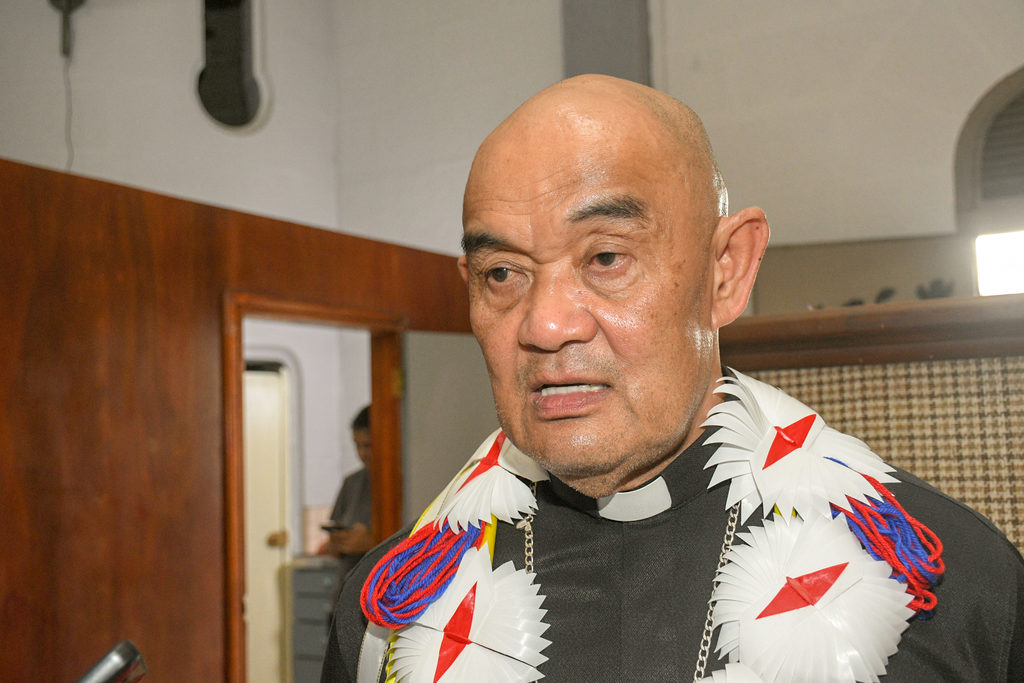
CATHOLIC priest Fr Frank Hoare’s spiritual journey in Fiji was punctuated by moments where children, often unknowingly, became the quiet carriers of grace.
Last week we saw the experiences he went through, from life in the villages, to interactions in parishes, and bus aisles, where children became the unlikely guides.
This week, we follow Fr Hoare into early 2018 and 2019 where personal loss, unexpected connections, and quiet summonses begin shaping his ministry in new ways.
A calling that wasn’t planned
The catechumenate training seminar in Suva on May 3, 2018 was meant to be routine, a simple rollout of new RCIA (Rite of Christian Initiation of Adults materials) for parish instructors.
But on the final day, a young man approached Fr Hoare with a story that felt more like providence than planning.
He had been scheduled to play rugby in Taveuni but the village catechist cancelled attending the seminar at the last minute. The parish priest, scrambling, told the catechist to “grab any unmarried man around.”
And so, by sheer accident or something more, he ended up at the seminar.
Embarrassed to find the room full of elderly participants, he had actually walked out.
But as he reached the door, he ran straight into Archbishop Peter Loy Chong, who gently took him by the arm and guided him back inside.
By the end, he wasn’t talking about rugby at all.
“I realise now that God wanted me here,” he told Fr Hoare.
“He made sure I stayed. I have work to do when I get home.”
A small kindness
After Fr Hoares usual swim in Suva, he stopped for a coffee while waiting for the library to open.
He ordered his drink, reached into his pocket, and felt his stomach drop, the $5 note he was certain he’d brought was gone.
Mortified, he fumbled for an explanation, but the Fijian woman serving him just smiled and said, “It’s okay, I feel blessed today. I will pay for you.”
It was such an unforced generosity, the kind that asks for nothing. It disarmed him.
He sat there drinking the coffee, grateful, but inwardly squirming at having received something he couldn’t yet return.
When he found the missing money on the floor of his car minutes later, he hurried back to repay her, but by then the moment had already settled inside him.
What stayed with him wasn’t the coffee, it was the reminder that grace often arrives through strangers, in small, almost invisible gestures that shift the tone of an ordinary day.
Fatherhood and priestly formation
During a conversation on 29 May 2019, Fr Hoare reflected on how his understanding of fatherhood had changed over time.
He recalled being invited to celebrate his first Mass after ordination in 1973, when an Anglican vicar shared a personal insight with him.
“I discovered a deeper meaning in the Our Father when I became a father myself,” the vicar said.
According to Fr Hoare, the comment stayed with him because, as a Catholic priest, he believed he would never be a father.
Since his ordination, Fr Hoare has served as a missionary in Fiji. He has worked in parishes, taught in the seminary, evangelised among ethnic Indian communities, and organised lay leadership and intercultural programs.
He said he remains grateful for the experiences and the life he has been given.
Fr Hoare recalled one moment that challenged his understanding of fatherhood. A Hindu man who occasionally joined a small Christian prayer group spoke to him unexpectedly.
“It is right that we call you ‘Father,’” the man said. “You left your country, you gave up a good job and a family, and you came here to show us the way to God. You are indeed a father to us.”
For the past two years, Fr Hoare has been responsible for the formation program for seminarians from across the Pacific.
“I encourage the seminarians to do their best in their study of philosophy and theology.”
He explained that his role includes helping them understand themselves and their motivations, guiding their prayer and worship, and organising pastoral placements where they can reflect on their experiences and develop spiritual skills.
“I actually feel like a father to these young men, supporting, correcting and caring for them.”
Fr Hoare said the community lives by shared guidelines, but seminarians are also given freedom to make their own choices.
“I have to trust them with that freedom, and then help them reflect on their decisions and learn from the outcomes.”
He added that the relationship is not without mistakes.
“I have made mistakes and apologised for them.
“I enjoyed the banter at the table and around the yaqona bowl. I admire their qualities and have great hopes that they will become good missionary priests in the future.”
Reflecting on his journey, Fr Hoare said his understanding of prayer has also deepened.
“I think I can say the Our Father, understanding something of its meaning too.”
When the years fell away
After Mass on 14 July 2019, Fr Frank Hoare was approached by a couple in the parish hall.
“Are you Fr Frank Hoare?” the woman asked.
According to Fr Hoare, the sound of her voice stirred a distant memory.
“You used to visit our house 40 years ago,” she said.
“We have been searching for you in recent months because we heard you were here in Suva. You named our eldest son, Stephen.”
Fr Hoare asked if they had lived in Vunikavikaloa, near Navunibitu Catholic Mission.
“Yes,” they replied, smiling.
He said the years seemed to fall away as he recognised them, and he embraced the couple.
In 1980, Fr Hoare served for six months in the rural parish of Navunibitu while a priest was on holidays. During that time, he met Shiri, a young Indo-Fijian mother, at the nearby Catholic maternity hospital.
Her first child had died, and she asked him to pray for her newborn son. Fr Hoare said he later visited the family regularly at their home.
Shiri and her husband, Shalesh, lived with his widowed mother and six younger siblings. Shalesh worked cutting sugarcane and taking on odd jobs to support the household.
Although the family was Hindu, Fr Hoare said they were open to all religions.
“We would chat, pray, and sing hymns during my visits,” he said.
Fr Hoare was later appointed to Lautoka, about three hours away. In subsequent years, he could no longer see the family home when passing through the area and assumed they had moved.
He said it was with astonished delight that they met again, four decades later.
A few weeks after the reunion, Fr Hoare visited the family’s home. Shiri showed him old photographs from Vunikavikaloa, including one of him holding her newborn son, Stephen.
He said many memories returned as they looked through the photos together. Shiri called Stephen, who now lives in California, and Fr Hoare was able to speak with him.
Shalesh, now a taxidriver, exchanged Hindi verse poetry with Fr Hoare. He was also introduced to the couple’s second son, James, a mechanic, along with his wife and child.
Their married daughter later joined them with her husband and two young daughters.
“We took photos, talked and joked and had a fine meal together,” Fr Hoare said.
Reflecting on the encounter, he described it as an extraordinary moment.
“For me, it was an incredible reunion.
“I was surprised by joy.”
Where the real lessons hide
If you’ve been here from the beginning, I hope by now you’ve realised that our lives are not measured only by what we set out to do, but by the traces we leave in other people’s lives, often without realising it.
Fr Hoare did not plan to change the direction of a young man’s life at a seminar, nor did he expect a brief visit to a struggling family in rural Fiji to echo 40 years later.
And what surprised him most was not recognition or gratitude, but the continuity of relationship, the way human connection endures beyond time, distance, and difference.
We are a nation facing increasing migration, fractured families, and communities where people often move on quickly to the city, overseas, or into new phases of life.
In this constant movement, it is easy to believe that what we do now has little lasting impact.
But you need to remind you that stability, care, and consistency matter deeply, especially in a society where many feel left behind.
Whether we are teachers, parents, leaders, or simply neighbours, we are shaping memories and futures in ways we may never fully see. So can we choose to be people who stay attentive, rooted, and present?
Because long after our plans fade, it is our presence that will be remembered.

