
THE places we arrive in often become the places that change us.
Last week, as we traced the story of one of Fiji’s earliest photographers, Leslie Norman Anderson, also known as LNA, we saw how his early years in Australia, shaped by loss, discipline and ambition, led him to pursue a new beginning in Fiji.
The story itself is told through the work of his grandson, James Norman Stevenson, in the book “The View from Delanasau: The Life and Times of Leslie Norman Anderson (LNA).”
Now, if you’re still with us, this is where Stevenson brings us into Levuka, sometime around April to May, 1901 and arguably, this is where the story stops being about where LNA came from, and starts becoming about who he was becoming.
Arrival into a Different World
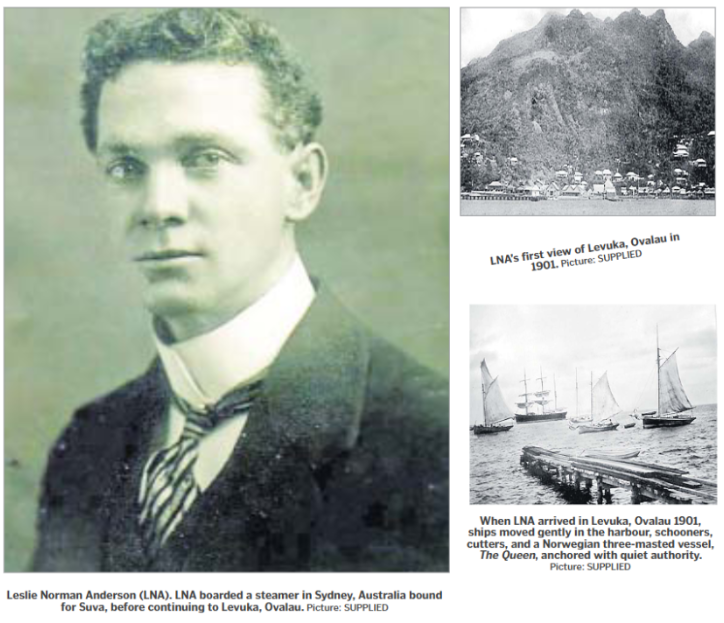
Stevenson writes that LNA boarded a steamer in Sydney, Australia bound for Suva, before continuing to Levuka on Ovalau, a journey that, in those days, wasn’t just travel. It was a quiet kind of gamble.
Suva, already the new capital, offered him his first glimpse of Fiji. A few days of sightseeing, perhaps curiosity mixed with uncertainty.
But Levuka was always the real destination. From there, he boarded an inter-island trader to Ovalau, part of the Lomaiviti Group “Middle Fiji.”
And in a way, it’s hard not to see the symbolism here.
Levuka, meaning “in the middle of things,” would quite literally place LNA at the centre of a life he hadn’t yet lived.
Stevenson lingers on the arrival and you can see why.
Standing on the deck as the vessel approached Levuka, LNA would have been met with a scene that, even today, feels almost cinematic.
Clear skies, calm waters, and a wall of green hills stretching across the horizon.
Ships moved gently in the harbour, schooners, cutters, and a Norwegian three-masted vessel, The Queen, anchored with quiet authority.
It was a working port, yes but also something more. A place in motion but not yet hurried.
And perhaps that’s what stands out most. Levuka, at that moment in time, feels less like a destination and more like a threshold.
Finding his place
Once ashore, reality sets in. Beach Street, the spine of Levuka, was where business, trade, and daily life converged.
Established companies, shipping houses, timber merchants, banks all operating within a compact strip along the waterfront.
It’s easy to imagine the noise, the movement, the sense that this small town still carried the weight of its former status as capital.
Because even though Suva had taken over two decades earlier, Levuka hadn’t quite let go of its importance. Not yet. Behind the commercial front, homes crept into the hills, churches stood as quiet anchors, and the Deed of Cession monument reminded everyone, subtly but firmly, of the colonial reality shaping it all.
What’s perhaps most striking in Stevenson’s account is how quickly LNA seemed to adapt.
His role with “Hedemann & Evers” demanded initiative and a willingness to step into responsibility.
And he did. But beyond the job, there’s a quieter transformation happening.
LNA, described by Stevenson as courteous and personable, found his way into Levuka’s social life.
He reconnected with the Anglican Church, even playing the organ, a small detail but one that says a lot about how he positioned himself within the community.
And then, almost quietly within that same space, something significant happened.
Because it was here, in Levuka, that he met Hilda Ethel Wilson.
Not as a dramatic turning point, but as part of the natural unfolding of a life beginning to take root.
LNA would spend the next decade in Levuka, from 1901 to 1911. And somewhere in that time, the decision he made at 21 stopped being a risk.
_In next week’s edition of The Fiji Times, Stevenson takes us through the story of Hilda Ethel Wilson, from her family’s early days in Fiji to the moment she meets LNA in Levuka, setting the course for a shared life in the islands.

